English
 ကညီကျိာ်
 မြန်မာ
This Incident Report describes events occurring in Moo special area, Moo (Mone) Township, Kler Lwee Htoo (Nyaunglebin) District, in March 2026. On 4 March 2026, four displaced villagers, including Maung H---, returned to Ba--- village, Lay Tone village tract, to collect possessions that they left in the village at the time of displacement. When they arrived at the village’s entrance, Maung H--- stepped on a landmine, which had been planted by the Burma Army, and he and another villager were injured by the landmine explosion. After that, a village tract administrator contacted the Karen National Liberation Army (KNLA) and People’s Defence Force (PDF) to rescue them. After the rescue, Maung H--- was transported to Bb--- clinic for treatment, located in Bb--- village, Kyaung Pyan village tract, Moo special area, while another injured villager received treatment in the village. Maung H---’s left leg was amputated at the KDHW-administered Bb--- clinic. He did not have to pay anything for the treatment or transportation costs.[1]
Part 1 – Incident Details
|
Type of Incident |
Landmine incident. |
|
Date of Incident(s) |
4 March 2026 |
|
Incident Location (Village, Township and District) |
Ba--- village, Lay Tone village tract,[2] Moo special area, Moo Township, Kler Lwee Htoo District. |
|
Victim Information |
|
|
Name |
Maung[3] H--- |
|
Age |
33 years old |
|
Gender |
Man |
|
Ethnicity |
Bamar[4] |
|
Marital Status |
Married (one child) |
|
Occupation |
Daily worker |
|
Religion |
Buddhist |
|
Position |
Villager |
|
Village |
Ba--- village, Lay Tone village tract, Moo special area, Moo Township, Kler Lwee Htoo District |
|
Perpetrator Information (Armed Actors) |
||||
|
Name(s) |
Rank |
Unit |
Base |
Commander’s Name |
|
Burma military regime[5] |
Unknown |
Unknown |
Unknown |
[Senior General] Min Aung Hlaing[6] [the Commander-in-Chief of Burma’s Armed Forces and the Chairperson of State Security and Peace Commission (SSPC)[7]] |
Part 2 - Information Quality
|
1. Explain in detail how this information was collected. |
|
Regarding this incident, a KNU [Karen National Union][8] coordinator of Moo special area told me [a KHRG researcher] that in his area, a villager was hit by a landmine which had been planted by the Burma military regime, and he was transported to Bb--- clinic, which is run by the KDHW [Karen Department of Health and Welfare],[9] so I [a KHRG researcher] went [to the clinic] and conducted an interview with the victim. |
|
2. Explain how the source verified this information. |
|
The people who provided the information to me [the KHRG researcher] are KNU authorities in that area, and some of them witnessed the incident when it happened. [The researcher also conducted an interview with the victim, Maung H---.] |
Part 3 – Complete Description of the Incident
|
Describe the Incident(s) in complete detail. |
|
The villagers who live in Moo special area, Moo (Mone) Township, Kler Lwee Htoo (Nyaunglebin) District had to experience displacement and relocation because the Burma military regime conducted indiscriminate shelling and air strikes during January 2026. Maung H--- was also one of the displaced villagers from Ba--- village, Lay Tone village tract, Moo special area, who displaced in Bc--- village, Mya P’Go village tract, Moo special area.
On 4 March 2026, some of the displaced villagers from Ba--- village went back to check on their houses and take their properties that they left in the village. Maung H--- was asked for help to carry the properties, so he accompanied those villagers to help his friends. Four villagers, including Maung H---, went back, and when they arrived at Ba--- village’s entrance at 6:40 am, Maung H--- stepped on a landmine, and it exploded. Due to the explosion, both of Maung H---’s legs were hit and injured by mine fragments, and another villager [unknown name] was also hit by the fragments and sustained minor injuries on his bladder and one of his eyes.
Prior to the incident [in early January 2026], an unknown battalion of the Burma military regime had entered the village for a short time, before leaving again. After they went back, the local army, PDF [People’s Defence Force][10] and KNLA [Karen National Liberation Army][11] soldiers, checked the area, and they found the Burma military regime had planted a lot of landmines. They removed [some of] the landmines, but [some of] these were not gone yet. However, [the PDF and KNLA] allowed the villagers to go back because the villagers wanted to take the things that they left [their properties]. Therefore, [Maung H---] stepped on this Burma military regime landmine. The victim, Maung H---, said: “They [the PDF and KNLA] said: ‘It is not clear yet.’ They were not allowing the villagers to enter [into the village]. However, because the villagers were very hurried, they allowed [them] to enter and unfortunately, I got hit [by a landmine]. I stepped on [the landmine] after two people passed ahead [of me]. There were four people in total who went back [to the village]. […] [When the landmine exploded,] I went up into the air and the bag that I took with me flew away. After that, [the other people] phoned a village tract administrator. Then, he contacted the organisations [the KNLA and PDF] to rescue [me]. They also called a mine clearance team and they cleared [the landmines]. It took 30 minutes [to clear the landmines].”
After Maung H--- stepped on the landmine, his friends transported him to Bb--- clinic, which is located in Bb--- village, Kyaung Pyan village tract, Moo special area. Because he sustained a severe injury on his left leg, it was amputated at Bb--- clinic. He didn’t have to pay anything for the treatment or transportation costs. Regarding the other injured villager, he received treatment from a CDM [Civil Disobedience Movement][12] doctor in Ba--- village, because he sustained only minor injuries. After this incident, Ba--- villagers dared not to go back and take their possessions from the village anymore. Regarding Maung H---, he lost his left leg, and he could not work as before to earn a livelihood for his family members. At the time of the interview, Maung H--- had not been discharged from the clinic yet, but his leg injury was getting better. He hoped to get a prosthetic leg once his injury healed so that he could work to earn a livelihood for his family members.
The villagers in Moo special area must face livelihood, healthcare, and education challenges because the Burma military regime violated the [human rights of the] villagers by conducting shelling, drone strikes, and air strikes and entering the villages. |
Part 4 - Permission for Using the Details
|
Did the victim(s) provide permission to use this information? Explain how that permission was provided. |
|
The victim [Maung H---], who provided the information, gave us [KHRG] full permission to use this information as needed. |
Further background reading on the situation of landmines in Southeast Burma/Myanmar can be found in the following KHRG reports:
- Danger Beneath Our Feet - Landmine contamination in Southeast Burma and its impacts on villagers since the 2021 coup, December 2023.
- “Doo Tha Htoo District Incident Report: A DKBA tripwire mine explosion injured two villagers in Hpa-an Township (June 2025)”, January 2026.
- “Kler Lwee Htoo District Incident Report: Landmine explosion severely injured a teenager in Moo Township (January 2025)”, December 2025.

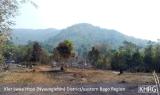
This photo was taken by a KHRG researcher in March 2026. On 4 March 2026, four displaced villagers returned to their village, Ba--- village, Lay Tone village tract, Moo special area, Moo (Mone) Township, Kler Lwee Htoo (Nyaunglebin) District, to take possessions that they left in the village when they displaced. When they arrived at the village’s entrance, Maung H--- stepped on a landmine planted by the Burma Army, and in the explosion, both of his legs were injured and one of his friends was minorly injured. Maung H---’s left leg was amputated at Bb--- clinic due to the severity of his injury. This photo shows Maung H--- recovering at Bb---clinic after his left leg was amputated. [Photo: KHRG]
Footnotes:
[1] The present document is based on information received in March 2026. It was provided by a community member in Kler Lwee Htoo District who has been trained by KHRG as a researcher to monitor human rights conditions on the ground. The names of the victims, their photos and the exact locations are censored for security reasons. The parts in square brackets are explanations added by KHRG. This document combines several received reports with the following KHRG internal log numbers: #26-89-I1, 26-89-A1-I1, and 26-89-M1/P1.
[2] A village tract is an administrative unit of between five and 20 villages in a local area, often centred on a large village.
[3] ‘Maung’ is a Burmese male honorific title used before a person’s name.
[4] The majority ethnic group in Myanmar, also known as ethnic Burmese or Burman.
[5] The terms Burma military, Burma Army, SAC, Tatmadaw, and junta are used interchangeably throughout this report to describe the Burma military regime’s armed forces. Villagers themselves commonly use Burma Army, Burmese soldiers, or alternatively the name adopted by the Burma military regime at the time —from the 2021 coup to July 2025, the State Administration Council (SAC). On 31 July 2025, the military junta changed its name to the State Security and Peace Commission (SSPC).
[6] Min Aung Hlaing, then Senior General and Commander-in-Chief of Burma’s Armed Forces, seized power in February 2021 in a coup d’état, overthrowing the quasi-civilian government that won the 2020 elections in a landslide. He has responded to the nationwide resistance with extraordinary brutality while continually rebranding himself and his regime to appeal for legitimacy abroad. Although the regime claims Min Aung Hlaing now holds a civilian position, reports of parliamentary coercion and installation of loyalists in the military strongly suggest that Min Aung Hlaing is not acting as a civilian ruler.
[7] The State Security and Peace Commission (SSPC) is one of the names of the executive governing body created in the aftermath of the 1 February 2021 military coup. Formerly called the State Administration Council (SAC), it was renamed by Senior General Min Aung Hlaing, who served as chairperson, on 31 July 2025 and was technically dissolved on 10 April 2026 following the installation of a purportedly 'civilian' government via elections that were widely regarded as non-democratic. The name State Security and Peace Commission (SSPC) is used interchangeably with military junta and Burma military regime.
[8] The Karen National Union (KNU) is the main Karen political organisation. It was established in 1947 and has been in conflict with the government since 1949. The KNU wields power across large areas of Southeast Myanmar and has been calling for the creation of a democratic federal system since 1976. Although it signed the Nationwide Ceasefire Agreement (NCA) in 2015, following the 2021 coup staged by Burma Army leaders, the KNU officially stated that the NCA has become void.
[9] The Karen Department of Health and Welfare (KDHW) is the health department of the Karen National Union. It was established in 1956 to address the lack of public healthcare resources in rural Southeast Myanmar. It currently operates a network of community-based clinics in the region, but its capabilities remain limited due to funding constraints.
[10] The People’s Defence Force (PDF) is an armed resistance established independently as local civilian militias operating across the country. Following the 1 February 2021 military coup and the ongoing brutal violence enacted by the junta, the majority of these groups began working with the National Unity Government (NUG), a body claiming to be the legitimate government of Burma/Myanmar, which then formalized the PDF on 5 May 2021 as a precursor to a federal army.
[11] The Karen National Liberation Army is the armed wing of the Karen National Union.
[12] On 2 February 2021, healthcare workers at state-run hospitals and medical facilities across Myanmar spearheaded what is referred to as a Civil Disobedience Movement (CDM), consisting of labour strikes in protest against the 1 February 2021 military coup. The movement quickly spread to include civil servants from all sectors of the government who are walking off their jobs as a way of non-recognition and non-participation in the military regime. Because of the popularity of the movement, and its seminal role in wider protests across the country, some people have begun using it as a catch-all phrase to include other protest forms like boycotts and pot-banging.
 Print: