
 English
 ကညီကျိာ်
 မြန်မာ
This incident report describes events occurring in Ta Kreh (Painkyone) Township, Hpa-an District, in September 2025. On September 3rd 2025, the Burma military regime conducted a strike with a kamikaze drone on a middle school in Aa--- village, Pee T’Hka village tract, Ta Kreh Township, injuring two teachers and one 15-year-old student, and damaging the school’s office. All the victims received treatment in a clinic in Pee T’Hka village tract. After the incident, the school had to close as villagers feared for their safety.[1]
Part 1 – Incident Details
|
Type of Incident |
Kamikaze drone strike [on a school] |
|
Date of Incident(s) |
September 3rd 2025 |
|
Incident Location (Village, Township and District) |
Aa--- village, Pee T’Hka village tract[2], Ta Kreh Township, Hpa-an District. |
|
Victim(s) Information |
|||
|
Name |
Saw[3] A--- |
Naw[4] B--- |
Saw C--- |
|
Age |
33 years old |
27 years old |
15 years old |
|
Gender |
Man |
Woman |
Boy |
|
Ethnicity |
Karen |
Karen |
Karen |
|
Marital Status |
Married |
Married |
- |
|
Occupation |
Teacher |
Teacher |
Student |
|
Religion |
Buddhist |
Christian |
Buddhist |
|
Position |
Villager |
Villager |
Villager |
|
Village |
Ab--- village, Pee T’Hka village tract, Ta Kreh Township. |
Ab--- village, Pee T’Hka village tract, Ta Kreh Township. |
Aa--- village, Pee T’Hka village tract, Ta Kreh Township. |
|
Perpetrator Information (Armed Actors) |
|||
|
Type of Aircraft |
Unit |
Base |
Commander’s Name |
|
Kamikaze drone |
Burma Army[5] |
Tha Ma Nya Town, T’Nay Hsah (Nabu) Township, Hpa-an District. |
N/A |
Part 2 - Information Quality
|
1. Explain in detail how you collected this information. |
|
[The KHRG field researcher] contacted the KNU [Karen National Union[6]] authorities in Ta Kreh Township, and a school teacher, and conducted documentation. [The KHRG researcher interviewed all three victims.] |
|
2. Explain how the source verified this information. |
|
I [the KHRG researcher] went to Aa--- school (run by the KECD [Karen Education and Culture Department][7]) and documented the damage by taking photos and videos of the school and the injured people [and interviewing them]. |
Part 3 – Complete Description of the Incident
|
Describe the Incident(s) in complete detail. |
|
On September 3rd 2025, at around 10 am, the State Administration Council (SAC)[8] [Burma military regime] conducted a kamikaze drone strike on a KECD middle school in Aa--- village, Pee T’Hka village tract, Ta Kreh Township, Hpa-an District. At the time of the strike, there was no fighting near the area. Villagers were present in the village when the incident happened. [Villagers believe that the drone came from Tha Ma Nya Town, as they saw it approaching from that direction.]
The school had three buildings. One building was for Grades 1 to 5, another for Grades 6 to 9, and the third served as an office and storage for books. The incident occurred while teachers and students were practising songs in the first two school buildings. The drone hit the teachers’ office, setting fire to materials inside and damaging the building. As a result of the explosion, two teachers and one student were injured by the shrapnel.
Saw A--- (33 years old), a teacher from Ab--- village, Pee T’Hka village tract, sustained injuries to his head and waist. He explained to KHRG: “I was teaching in the classroom. I was not aware. I was teaching as usual. When I was teaching, the weapon came, ‘shwee…’ [sound of drone] and landed, ‘grann….’ [sound of explosion]. I did not know what had happened. I was hit on the head. At first, I did not feel pain. I was hit on my back too. I thought it was just a small stone that hit me. When I touched my head, it was bleeding. My back was also bleeding. […] The drone landed on a building located in the centre of the compound. Luckily, no one was staying in the building. Many people would have been killed if they had stayed in that building. The children were running, crying, and shouting. They were unable to carry their slippers and bags.”
Naw B--- (27 years old), a teacher from Ab--- village, Pee THka village tract, sustained injuries to her chest and lower abdomen. She explained to KHRG: “Recently, I have not been able to move easily. It is uncomfortable for me to breastfeed my child because I was injured on my breast, and I need to take medicine. My child is only four months old. When I go to the clinic again, I will need to rent a car since I don’t have one of my own. The school had to close, but I am not sure how long it will remain closed.”
Saw C--- (15 years old), a student from Aa--- village, Pee T’Hka village tract, sustained an injury to his left arm. All three victims received treatment [free of charge] at Aa--- clinic [run by the Karen Department of Health and Welfare (KDHW)[9]].
The reason for the attack on Aa--- school remains unknown. After the incident, teachers, students, and parents were afraid to open the school, so it was closed. |
Part 4 - Permission for Using the Details
|
Did the victim(s) provide permission to use this information? Explain how that permission was provided. |
|
All the victims allowed KHRG to use the information and photos. |
Further background reading on the situation on attacks on education in Southeast Myanmar can be found in the following KHRG reports:
- Community spaces under fire: Attacks and destruction of community buildings and cultural events in Southeast Burma by the State Administration Council (SAC) (January - June 2025), August 2025.
- “Hpa-an District Short Update: SAC drone strikes and shelling injured four villagers and damaged a school and houses, in T’Nay Hsah Township (February and March 2025)”, July 2025.
- “Dooplaya District Situation Update: fighting, SAC air strikes and shelling causing destruction, displacement, and livelihood, healthcare and education challenges in Kaw T’Ree Township (April to July 2024)”, March 2025.
- Schools Under Attack: Challenges to the right to education in Southeast Burma (June 2023-February 2024), July 2024.
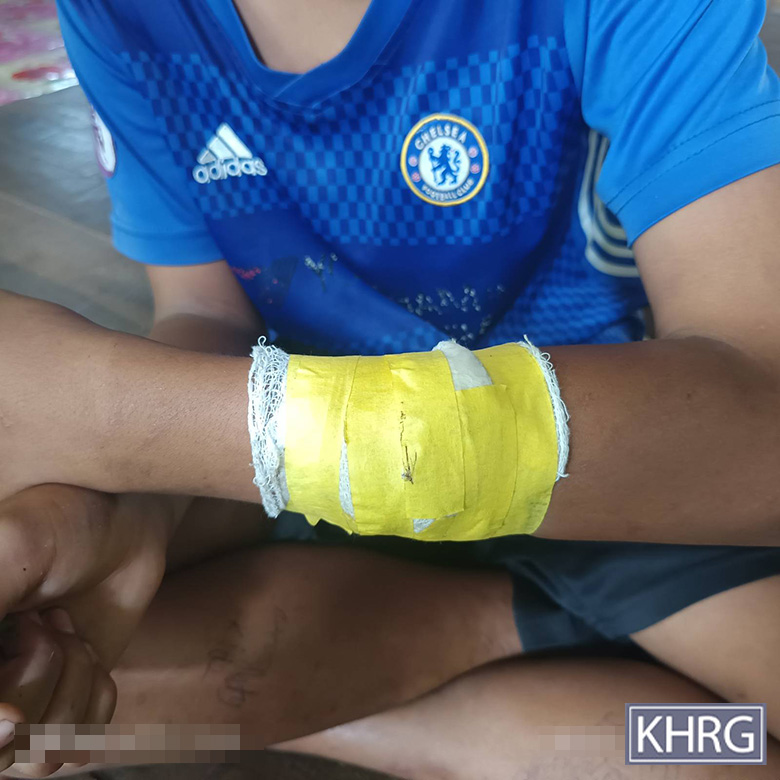
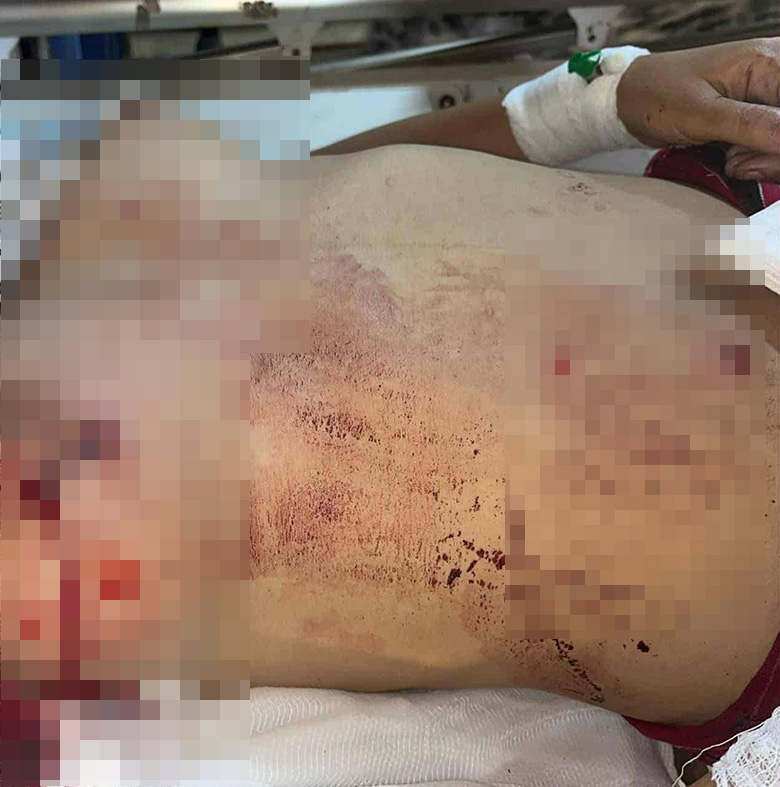

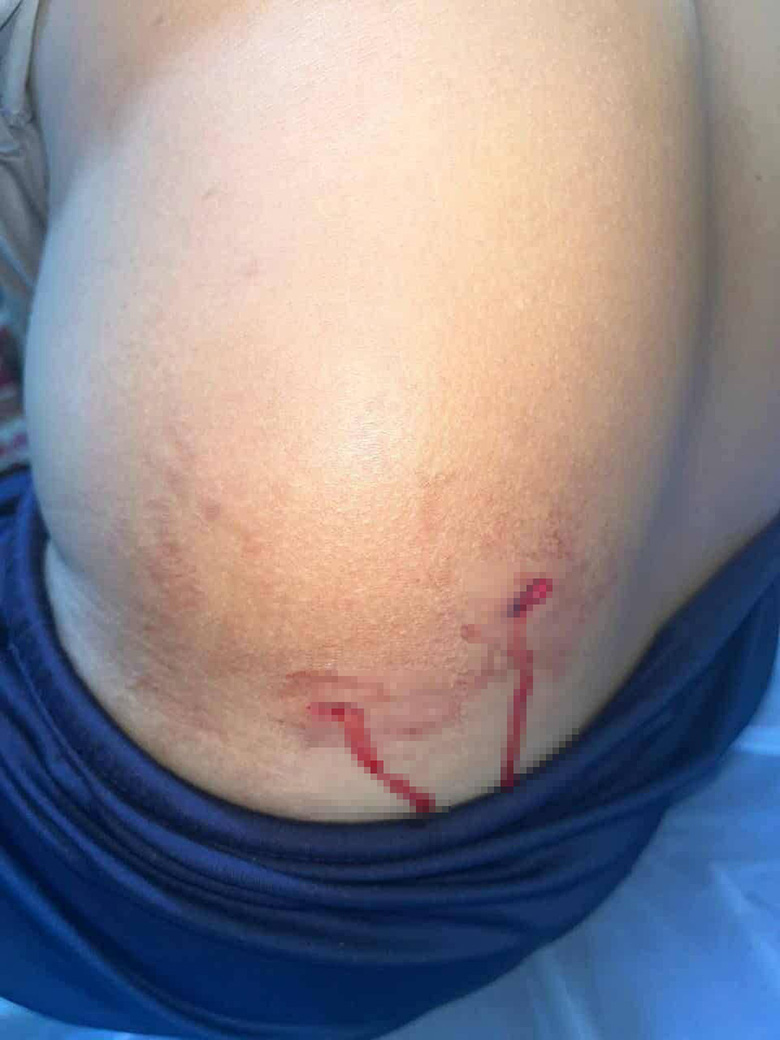


These photos were taken in September 2025 in Aa--- village, Pee T’Hka village tract, Ta Kreh Township, Hpa-an District. On September 3rd 2025, at around 10 am, the Burma military regime conducted a kamikaze drone strike on a KECD middle school in Aa--- village, injuring two teachers and one student. The photo on the top left was taken by a KHRG researcher, and it shows Saw C--- (15 years old), a student who sustained an injury to his left arm due to the attack. The photo on the top right and the two photos at the bottom were taken by a school teacher, at a clinic in Aa--- village. The photo on the top right shows Naw B--- (27 years old), a teacher who sustained injuries to her right breast and lower abdomen. Two photos in the bottom row show Saw A--- (33 years old), a school teacher who sustained injuries to his head and lower back. [Photos: KHRG / school teacher].
Footnotes:
[1] The present document is based on information received in October 2025. It was provided by a community member in Hpa-an District who has been trained by KHRG to monitor human rights conditions on the ground. The names of the victims, their photos and the exact locations are censored for security reasons. The parts in square brackets are explanations added by KHRG. This document combines several received reports with the following KHRG internal log numbers: #25-344-I1, #25-323-A1-I1, and #25-323-A2-I1.
[2] A village tract is an administrative unit of between five and 20 villages in a local area, often centred on a large village.
[3] ‘Saw’ is a S’gaw Karen male honorific title used before a person’s name.
[4] ‘Naw’ is a S’gaw Karen female honorific title used before a person’s name.
[5] The terms Burma military, Burma Army, SAC, Tatmadaw, and junta are used interchangeably throughout this report to describe Burma’s armed forces. Villagers themselves commonly use Burma Army, Burmese soldiers, or alternatively the name adopted by the Burma military regime at the time -since the 2021 coup, the State Administration Council (SAC). The military junta changed its name on July 31st 2025 to State Security and Peace Commission (SSPC).
[6] The Karen National Union (KNU) is the main Karen political organisation. It was established in 1947 and has been in conflict with the government since 1949. The KNU wields power across large areas of Southeast Myanmar and has been calling for the creation of a democratic federal system since 1976. Although it signed the Nationwide Ceasefire Agreement (NCA) in 2015, following the 2021 coup staged by Burma Army leaders, the KNU officially stated that the NCA has become void.
[7] The Karen Education and Culture Department is the education department of the Karen National Union. Its main goals are to provide mother tongue education services to rural Karen populations in Southeast Myanmar, as well as to preserve the Karen language, culture and history. Despite being an important education provider in the region, it is not officially recognised by the Myanmar government.
[8] The State Administration Council (SAC) is the executive governing body created in the aftermath of the February 1st 2021 military coup. It was established by Senior General Min Aung Hlaing on February 2nd 2021, and is composed of eight military officers and eight civilians. The chairperson serves as the de facto head of government of Burma/Myanmar and leads the Military Cabinet of Myanmar, the executive branch of the government. Min Aung Hlaing assumed the role of SAC chairperson following the coup. The military junta changed its name on July 31st 2025 to State Security and Peace Commission (SSPC).
[9] The Karen Department of Health and Welfare (KDHW) is the health department of the Karen National Union. It was established in 1956 to address the lack of public healthcare resources in rural Southeast Myanmar. It currently operates a network of community-based clinics in the region, but its capabilities remain limited due to funding constraints.
 Print: