English
 ကညီကျိာ်
 မြန်မာ
This Incident Report describes events occurring in Bilin Township, Doo Tha Htoo (Thaton) District, during October 2025. On October 9th 2025, at around 8 pm, the Burma Army conducted an air strike on Rn--- village in Yo Klah (Kya Thaung Hsein) village tract, dropping three bombs. One of the bombs landed and remained unexploded in the village. Another two bombs landed in front of a house, killing three children on the spot and severely injuring two more, who died after they arrived at the hospital. Nine other villagers were injured, including two children. Three houses of villagers were destroyed, and nine other houses were damaged by the air strike. Livestock were also injured and killed. Consequently, none of the villagers dared to stay in their village, so they fled to places they believed would be safe for them.[1]
Part 1 – Incident Details
|
Type of Incident |
[Air strike.] The Burma military regime[2] conducted an air strike, killing five children and injuring nine villagers. |
|
Date of Incident(s) |
October 9th 2025 |
|
Incident Location (Village, Township and District) |
Rn--- village, Yo Klah (Kya Thaung Hsein) village tract[3], Bilin Township, Doo Tha Htoo District |
|
Deceased Victims Information |
|||||
|
Name |
Saw[4] C--- |
Saw J--- |
Naw[5] O--- |
Naw N--- |
Naw B--- |
|
Age |
6 years old |
7 years old |
9 years old |
10 years old |
12 years old |
|
Gender |
Boy |
Boy |
Girl |
Girl |
Girl |
|
Ethnicity |
Karen |
Karen |
Karen |
Karen |
Karen |
|
Marital Status |
Child |
Child |
Child |
Child |
Child |
|
Occupation |
Student |
Student |
Student |
Student |
Student |
|
Religion |
Buddhist |
Buddhist |
Buddhist |
Buddhist |
Buddhist |
|
Position |
Student |
Student |
Student |
Student |
Student |
|
Village |
Rn--- village |
Rn--- village |
Rn--- village |
Rn--- village |
Rn--- village |
|
Injured Victims Information: Children |
||
|
Name |
Saw H--- |
Saw M--- |
|
Age |
2 months old |
10 years old |
|
Gender |
Boy |
Boy |
|
Ethnicity |
Karen |
Karen |
|
Marital Status |
Infant |
Child |
|
Occupation |
- |
- |
|
Religion |
Buddhist |
Buddhist |
|
Position |
- |
- |
|
Village |
Rn--- village |
Rn--- village |
|
Injured Victims Information: Adults |
|||||||
|
Name |
Naw K--- |
Saw Q--- |
Yah[6] D--- |
Yah A--- |
Tee[7] G--- |
Saw R--- |
Naw L--- |
|
Age |
31 years old |
34 years old |
61 years old |
51 years old |
62 years old |
54 years old |
18 years old |
|
Gender |
Woman |
Man |
Woman |
Woman |
Man |
Man |
Woman |
|
Ethnicity |
Karen |
Karen |
Karen |
Karen |
Karen |
Karen |
Karen |
|
Marital Status |
Married |
Married |
Married |
Married |
Married |
Married |
Single |
|
Occupation |
Farmer |
Farmer |
Farmer |
Farmer |
Farmer |
Farmer |
[Unknown] |
|
Religion |
Buddhist |
Buddhist |
Buddhist |
Buddhist |
Buddhist |
Buddhist |
Buddhist |
|
Position |
Villager |
Villager |
Villager |
Villager |
Villager |
Villager |
[Villager] |
|
Village |
Rn--- village |
Rn--- village |
Rn--- village |
Rn--- village |
Rn--- village |
Rn--- village |
Rn--- village |
|
Perpetrator Information (Armed Actors) |
|||
|
Type of aircraft |
Rank |
Base |
Commander’s Name |
|
[Unknown] |
Burma Air Force |
Unknown |
[General Htun Aung is the Commander-in-Chief of the Burma Air Force] |
Part 2 - Information Quality
|
1. Explain in detail how this information was collected. |
|
I [a KHRG researcher] received this information from nearby villagers [those living near the incident place], the village tract leader, the village head, and the relatives. [In total three interviews were conducted by researchers: two with family members and one with one of the victims, Tee G---.]. Some of them were present [at the incident place] when the incident happened, and some of them were present to help [the victims] after the incident. |
|
2. Explain how the source verified this information. |
|
The people who provided the information were present there [at the incident place] when the incident occurred. Some of them are the people who came and helped [the victims] after the incident. Their relatives live close to them, and they [the relatives] were the witnesses [of the incident]. |
Part 3 – Complete Description of the Incident
|
Describe the Incident(s) in complete detail. |
|
Details of the air strike attack:
On October 9th 2025, at [around] 8:10 pm, the Burma military regime attacked and dropped three 500-pound bombs into Rn--- village, also known as Qz--- village, Yoh Klah (Kya Thaung Hsein) village tract, Bilin Township, Doo Tha Htoo District. All three bombs landed in the area nearby the house of a villager named Tee G---. One of the bombs landed and exploded between the houses of Tee G--- and his niece, named Naw K---. Another bomb landed and exploded right in front of Tee G---’s house, and another one landed beside Tee G---’s house, remaining unexploded. The two exploded bombs killed five villagers in total, all children and students. In addition, nine villagers were injured, including three children [youth] in total. All of the victims were in their houses preparing to go to bed when the air strike happened.
Regarding the explosion of the bombs, Tee G--- stated: “When the air strike was conducted, we were not doing anything. We stayed in our house and were having a conversation with each other. Because it was already 8:30 pm, so it was time to go to bed. […] I had almost fallen asleep already when I heard the sound of an aircraft coming, ‘Woo Woo Woo’. Then I called my two little [youngest] children and my wife to go down from the [stilted] house. But when we got to the top of the ladder [at the entrance of their house], the bombs landed. Then, our house was completely destroyed. […] We can no longer live in our house. […] Two of the bombs exploded. One exploded right in front of my house, and the other one exploded between my house and the house of my niece. So, the house of my niece collapsed and was completely destroyed. […] The last bomb remained unexploded right beneath my house and was dug down very deep into the ground. No one dared to dig it out. But they [elder villagers] put a warning symbol showing that no one was allowed to go there.” The villager continued: “I have no idea why they [the Burma Army] conducted an air strike on our village. Because the aircraft always flew over our village, but they [usually just] passed by it [their village]. So, we did not know that it would conduct an air strike on us someday. […] During the dry season, we always lived carefully. We even did not usually sleep in our house [at night]. We had been [living] like that for a few months [but nothing happened]. So, we thought nothing would happen to us. […] So, we [started to] live our daily lives as we usually do. As soon as the air strike stopped, I could not do anything. I ran down to the ground, hugging my child [Naw B---] and cried for help. Then villagers ran to me [to help]. Then we carried my child and transported her to Tk--- hospital.”
As a result [of the air strike], three children were killed on the spot [and 11 villagers were injured]. [Nine of] the injured villagers were immediately transported to Tk--- hospital by their families and some of the other villagers for medical treatment. Two more children [Naw B--- and Saw C---] died after arriving at the hospital. Seven of the remaining injured villagers were in life-threatening condition and receiving treatment in Tk--- hospital [as of October 2025]. [Tk--- hospital is located in Tk--- village, Pgwa Ghaw village tract, Hpa-an Township, Doo Tha Htoo District, administered by Karen Department of Health and Welfare (KDHW)[8]]. Three other villagers received treatment at a KDHW clinic in the village.
The body of Naw N---, who was a Grade 3 student, was split in two parts, and she was killed. A Grade 2 student named Naw O--- was hit [by shrapnel] on her head and killed. Also, the head of a kindergarten student named Saw J--- was hit, and he was killed on the spot. The whole body of Naw B--- was hit by the shrapnel of the explosion. She was severely injured on her belly, so she died after she arrived at the hospital. The whole body of Saw C--- was also hit, and he was severely injured on his head, therefore he also died after he arrived at the hospital.
In addition, Saw R--- was injured on his whole body, Tee G--- was injured on his left hand and jaw, Yah A--- was injured on her whole body, Yah D--- was injured on her right hand and belly, Saw Q--- was injured on his buttock and right leg, and Naw K--- was injured on his left leg and back. All of them were severely injured and were in life-threatening condition, so they were receiving treatment in Tk--- hospital. The distance from the village to the hospital is around three hours by car.
Saw H--- was injured on his buttock, Saw M--- was injured on his jaw and right hand, and Naw L--- was injured on her left hand. All three of them received treatment in the KDHW-administered clinic located in the village from a KDHW local health worker, because they were not severely injured.
Due to the air strike, the houses of Tee G--- and his niece, named Naw K---, were completely destroyed. The house of Yah A--- was also destroyed. Furthermore, nine other houses owned by the villagers Saw R---, Yah X---, Yah W---, Yah T---, Saw S---, Naw P---, Saw I---, Yah E---, and Yah D--- were damaged by the bombs from the Burma Army air strike.
Due to the air strike, shrapnel hit three of Saw S---’s cows and killed two of them. The air strike killed three pigs and two ducks of Yah A---. Also, the air strike killed two cats and a dog owned by Saw V---.
There was no fighting happening and no armed groups nearby or in the village when the Burma Army conducted the air strike. Villagers from Rn--- village also said that none of the armed groups had previously patrolled through the village.
When the Burma Army conducted the air strike, the villagers were panicked. So, [after the air strike,] some of the villagers went and slept in their huts at their farms outside of the village, and some of the villagers moved to the river source. Some of the villagers transported the people who were injured [to the hospital for treatment], and some of the villagers went to bury the corpses of villagers who were deceased.
A villager from Rn--- village named Naw Z--- (35 years old), who is a relative of the victims, stated: “My relatives were injured by the air strike conducted by the Burma Army. Three villagers [children] were killed on the spot, and two died after they arrived at Tk--- hospital. […] The Karen Women’s Organisation (KWO)[9] provided assistance to the injured villagers. But I am not sure if they [KWO] provided support to every victim or not. Also, victims received donations from other villagers’ who were willing to donate to them. Some villagers provide 100,000 Kyats [47.61 USD][10]. After the air strike, villagers feel insecure living in the village. Students are also afraid to go to school. […] Two family members [Naw O--- and Saw C---] of my younger sister [Naw K---] were killed, two family members [Naw N--- and Naw B---] of my aunt [Ya D---] were killed, and one of the family members of Saw J---, [along with Saw J---] himself were killed by the air strike. He [Saw J---] lived with his uncle Saw R---.” The villager, Naw Z---, added: “I would like to tell the KNU [Karen National Union][11] leaders to make efforts to bring peace to our area. We cannot live like this. […] We live our lives with panic and anxiety right now. If they make it [the situation] peaceful for us, we will be happy. Presently, none of the villagers stay in the village, and the village looks scary. […] Some fled to the forest, some fled to the edge of the village, and some [fled] to safer places. I would like to say to the leaders of the Burma Army that please, stop bombarding our area. Please give us peace. […] We are no longer able to bear this kind of situation. We are hurt to see our relatives injured. […] I wonder how they could dare to bombard us”.
The wife of Saw R---, named Daw Za--- (52 years old), from K’Baw Yoo Plaw village, stated: “The air strikes were conducted on my village and injured many people. I no longer dare to return to my village, if I think about that [the air strike], I am really afraid of it. […] My nephew [Saw J---] was hit by the shrapnel and was killed on the spot. My husband was injured and needed surgery several times. I’m traumatised by this air strike. Even when I heard the sound of a car’s engine, I thought it was an aircraft. I feel nervous. My husband was hospitalised in Tk--- hospital for six days, then we transferred him to Pr--- hospital because his situation was getting worse. […] I want peace and no air strikes. My husband was severely injured, and his injury might cost a lot. So, if people pity us and support us with his medical fees, we will be very happy.” [Pr--- hospital is located in Thailand’s Tak province.]
Currently [as of October 17th 2025], none of the villagers dare to live in the village, so all of them fled. Also, the students no longer dare to attend school, and the students’ parents dare not allow their children to attend school as well. Consequently, the school [from Rn--- village] had to close. The school is administered by the KECD [Karen Education and Culture Department][12]. |
Part 4 - Permission for Using the Details
|
Did the victim(s) provide permission to use this information? Explain how that permission was provided. |
|
KHRG was allowed to publish this information by the three villagers who provided the information, including Daw Za---, the wife of one of the victims [Saw R---]; Tee G---, one of the injured villagers; and Naw Z---, a relative of the victims [Naw K---, Naw O---, Saw C---, Ya D---, Naw N---, and Naw B---]. |
Further background reading on the situation on air strikes in Southeast Burma/Myanmar can be found in the following KHRG reports:
- ကဘီယူၤဟဲလံ Aircraft coming! : Impacts of air strikes on local communities and villagers’ protection strategies in Southeast Burma since the 2021 coup, November 2024.
- “Mu Traw District Situation Update: SAC air strikes and shelling caused death, injuries, and damage in Dwe Lo, Bu Tho, and Lu Thaw townships (January-April 2025)”, December 2025.
- “Dooplaya District Situation Update: SAC air strikes causing casualties and damage; education, healthcare, and livelihood challenges; and travel restrictions in Kaw T’Ree Township (January to April 2025)”, December 2025.
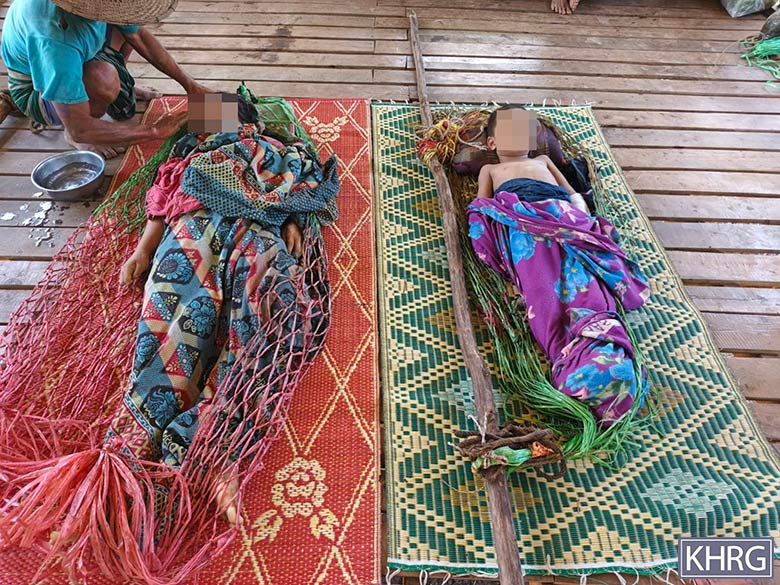
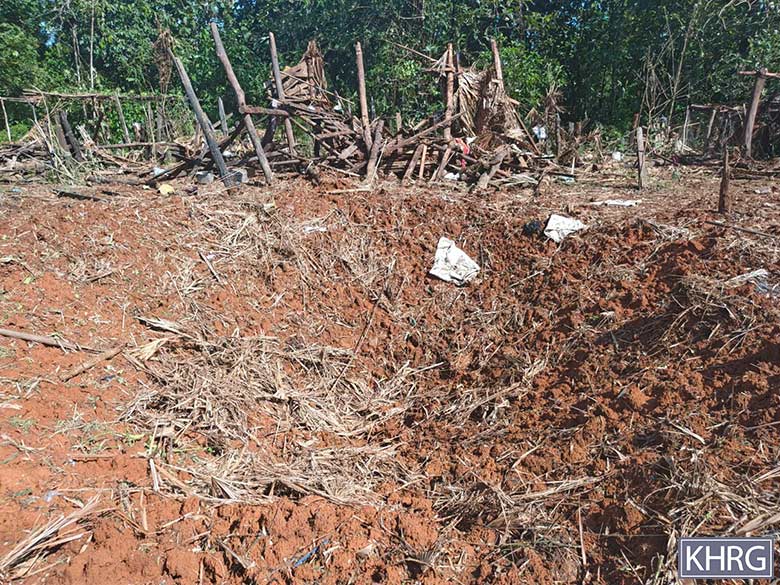
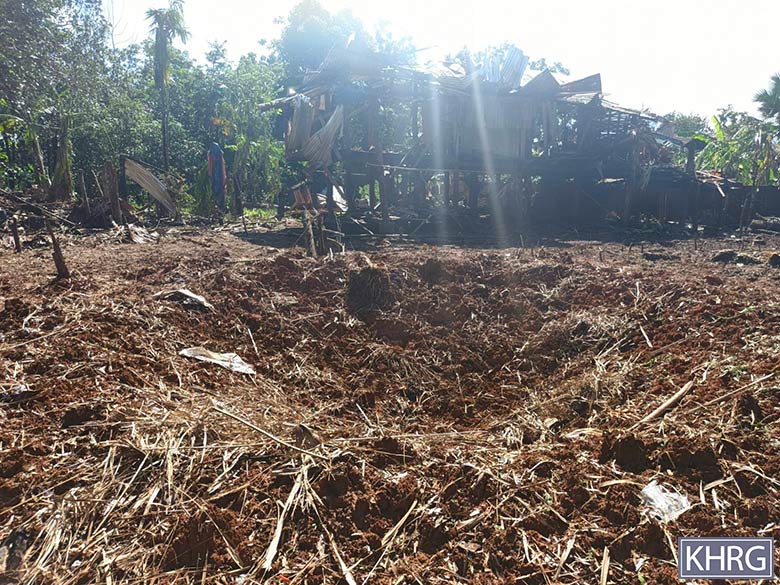
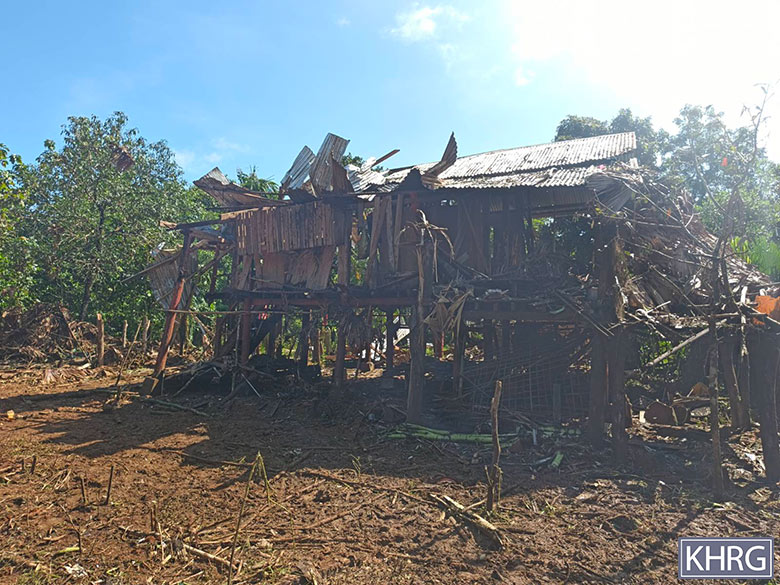


These photos were taken by a KHRG researcher in October 2025, in Rn--- village, Yo Klah (Kya Thaung Hsein) village tract, Bilin Township, Doo Tha Htoo District. The right photo on the bottom row shows the bodies of 9-year-old girl Naw O--- and her younger brother Saw C--- (6 years old), who were killed by the Burma Army air strike conducted into Rn--- village, on October 9th 2025. The photo on the right on the top row shows the place where the bombs landed between the houses of two villagers, completely destroying them. The photos in the left column show the destroyed house of one of the villagers. [Photos: KHRG
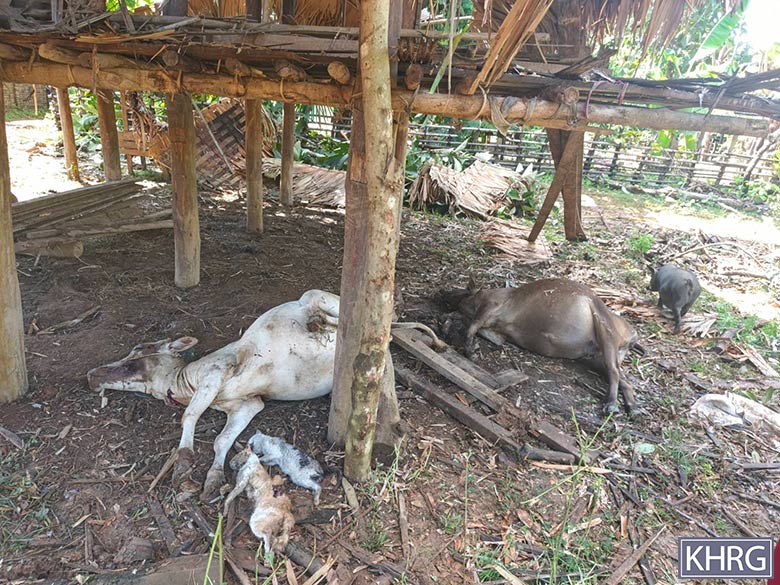
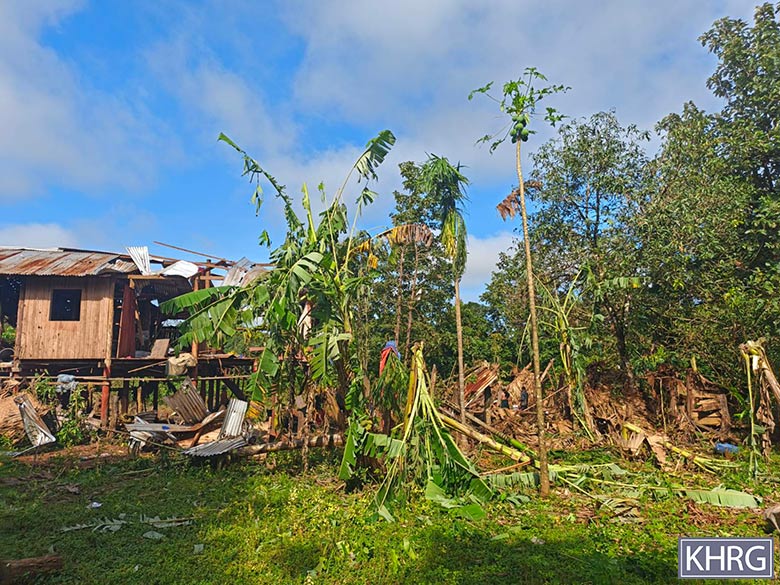
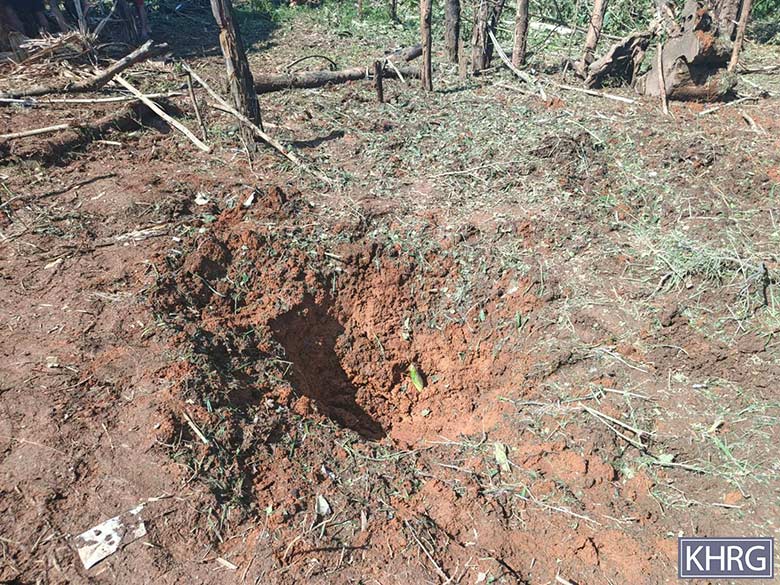


These photos were taken by a KHRG researcher in October 2025, in Rn--- village, Yo Klah (Kya Thaung Hsein) village tract, Bilin Township, Doo Tha Htoo District. The photo on the left at the top shows livestock of villagers that were killed by the Burma Army air strike conducted in Rn--- village, on October 9th 2025. The photo on the right shows a house that was destroyed by the air strike, owned by a villager named Yah A---. The photo at the bottom shows the place where the unexploded bomb landed and remained buried, near Tee G---’s house. [Photos: KHRG]
Footnotes:
[1] The present document is based on information received in October 2025. It was provided by a community member in Doo Tha Htoo District who have been trained by KHRG to monitor human rights conditions on the ground. The names of the victims, their photos and the exact locations are censored for security reasons. The parts in square brackets are explanations added by KHRG. This document combines several received reports with the following KHRG internal log numbers: #25-360-D1, #25-360-A1-I1, #25-360-A2-I1, #25-360-A3-I1, and #25-360-I1.
[2] The terms Burma military, Burma Army, SAC, Tatmadaw, and junta are used interchangeably throughout KHRG’s reports to describe Burma’s armed forces. Villagers themselves commonly use Burma Army, Burmese soldiers, or alternatively the name adopted by the Burma military regime at the time. In the aftermath of the February 1st 2021 military coup, Senior General Min Aung Hlaing established the State Administration Council (SAC) as the executive governing body. The military junta changed its name on July 31st 2025 to State Security and Peace Commission (SSPC).
[3] A village tract is an administrative unit of between five and 20 villages in a local area, often centred on a large village.
[4] Saw is a S’gaw Karen male honorific title used before a person’s name.
[5] ‘Naw’ is a S’gaw Karen female honorific title used before a person’s name.
[6] Mu ghar or Yah is a familiar term of respect in S’gaw Karen attributed to an older woman that translates to “aunt” but it does not necessarily signify any actual familial relationship.
[7] ‘Tee’, Pa Dtee, or Dtee is a familiar term of respect in S’gaw Karen attributed to an older man that translates to “uncle” but it does not necessarily signify any actual familial relationship.
[8] The Karen Department of Health and Welfare (KDHW) is the health department of the Karen National Union. It was established in 1956 to address the lack of public healthcare resources in rural Southeast Myanmar. It currently operates a network of community-based clinics in the region, but its capabilities remain limited due to funding constraints.
[9] The Karen Women’s Organisation (KWO) is a Karen community-based organisation formed in 1949 to support women in its operational areas across Karen State and in refugee camps along the Thai-Burma border. KWO works to empower women, fights against all forms of oppression of women and children, and provides support for communities in their operational areas. The organisation promotes women’s leadership, gender sensitivity, and runs health and education programs.
[10] All conversion estimates for the kyat are based on December 18th 2025 mid-market exchange rate of 1,000 kyat to USD 0.48 (taken from wise.com/gb/currency-converter/mmk-to-usd-rate ).
[11] The Karen National Union (KNU) is the main Karen political organisation. It was established in 1947 and has been in conflict with the government since 1949. The KNU wields power across large areas of Southeast Myanmar and has been calling for the creation of a democratic federal system since 1976. Although it signed the Nationwide Ceasefire Agreement (NCA) in 2015, following the 2021 coup staged by Burma Army leaders, the KNU officially stated that the NCA has become void.
[12] The Karen National Union's Education and Culture Department is the education department of the Karen National Union. Its main goals are to provide mother tongue education services to rural Karen populations in Southeast Myanmar, as well as to preserve the Karen language, culture and history. Despite being an important education provider in the region, it is not officially recognised by the Myanmar government.
 Print: