
 English
 ကညီကျိာ်
 မြန်မာ
 Print:
This Situation Update describes events occurring in Luh Pleh (Hlaingbwe) and Ta Kreh (Paingkyon) townships, Hpa-an District, from October 2025 to January 2026, covering issues related to displacement, gambling, checkpoints, the election, education, and rising commodity prices. From October to December 2025, approximately 5,300 displaced villagers from T’Nay Hsah (Nabu) Township fled to Ta Kreh Township due to fighting and the deployment of the Burma Army, also known as the State Security and Peace Commission (SSPC) in the area. As a result of the large number of displaced people, they faced challenges related to livelihoods, healthcare, and access to drinking water. From October to December 2025, gambling and entertainment events were widespread in Ta Kreh Township, leading to conflicts and arguments among villagers. In 2025, numerous checkpoints run by KNU/KNLA-Peace Council (KNU/KNLA-PC) and Border Guard Forces (BGF) collected fees along the main road in Ta Kreh Township, causing an increase in the price of commodities. Schools administered by the Burma military regime continued as usual in this township. However, Karen Education and Culture Department (KECD) schools opened depending on the situation, due to concerns about air strikes. In Luh Pleh Township, the Burma Army deployed additional troops in December 2025 in view of the junta’s election. In January 2026, the Burma Army further deployed troops to both Luh Pleh and Ta Kreh townships. In response, Karen National Liberation Army (KNLA) soldiers also increased their presence in the areas. As both the Burma Army and the KNLA reinforced their troops, local villagers became increasingly worried that fighting could break out. As a result, some villagers fled to Doo Tha Htoo (Thaton) District, while others fled across the Thai–Burma border. Some displaced villagers were forced by the Burma Army to return to their villages to vote. Many villagers participated in the election out of fear, while some villagers fled to safer locations in order to avoid participating.[1]
Increasing number of displaced people in Ta Kreh (Paingkyon) Township (October-November 2025)
In October 2025, fighting broke out between the State Security and Peace Commission (SSPC)[2] and Karen National Liberation Army (KNLA)[3] soldiers in T'Nay Hsah (Nabu) Township, Hpa-an District. The villagers from around ten villages, including Aa--- village, Myat Pa Taing village tract[4]; Ab--- village, Htee Hpoh Kyaw village tract; Ac--- village, Ag--- village, and Ad--- village, Noh Kay village tract, all in T’Nay Hsah Township, fled to Ta Kreh Township, Hpa’an District, as the Burma Army deployed more troops in the area.
In November 2025, approximately 1,400 households and 5,300 displaced people sought shelter in the village tracts in Ta Kreh Township. The Committee for Internally Displaced Karen People (CIDKP), the UN World Food Programme (WFP), and the Food and Agriculture Organisation (FAO) provided some support and food for the displaced people. However, due to the large number of displaced people, they [displaced villagers] faced challenges related to livelihoods, healthcare, and access to drinking water. During displacement, conflicts occasionally arose between the displaced people and local villagers, and sometimes even among the displaced villagers themselves. Improper waste disposal also remained a persistent issue in the displacement site.
Increased gambling issues in Ta Kreh Township (October 2025)
From the first week of October 2025 [and continuing throughout the reporting period of this Situation Update], entertainment events such as Our Day celebrations[5], DJ shows, and gambling took place routinely in Yay Pu Gyi village tract, Htee Hpoh Kay village tract, K’Kyo (Ka So) village tract, Paw village tract, and Kyeik Paw village tract, all in Ta Kreh Township. The contractors were backed [allowed to operate] by the Border Guard Forces (BGF)[6] and KNU/KNLA-Peace Council (KNU/KNLA-PC)[7].
There were multiple contractors [to organise the events], which led to competition among them. They moved from one village tract to another to organise entertainment events. They focused only on their own business and held ceremonies [and events] continuously. As a consequence, conflicts arose among the young people who attended the events. Sometimes, disputes also occurred among the soldiers themselves. The game players argued with the owner of the Anglo-dice (အန်ဂလုံ), and the Fish game [two common gambling games in Burma].
According to a villager from Ah--- village, Htee Hpoh Tray village tract, the villagers could not sleep well due to the loudspeakers. Although the villagers felt uncomfortable, they did not dare to speak up because the contractors were backed by the BGF and KNU/KNLA-PC.
Increasing checkpoints and extortion (November 2025)
In November 2025, the KNU/KNLA-PC reinstated old checkpoints and established additional new ones along the main road from Ta Kreh Township to T’Nay Hsah Township. There was one KNU/KNLA-PC checkpoint in Ai--- village, Taung Soe village tract, and another checkpoint in Af--- village, Htee Hpoh Tray village tract. There was also one KNLA Battalion #19 checkpoint on the main road, near Aj--- village, Noh Hkwee village tract. Moreover, there were three BGF checkpoints and one KNU/KNLA-PC checkpoint that had existed previously and continued to collect fees [from villagers] along the main road.
Due to the numerous checkpoints collecting fees [extorting villagers] along the main road, commodity prices increased. From October to December 2025, the price of one gallon (3.79 litres) of gasoline rose to 22,000 kyats (10.48 USD[8]). However, by the end of the year, the price had decreased to 18,000 kyats (8.57 USD) per gallon, making it slightly easier for villagers to travel.
Education challenges in schools (October to December 2025)
From October to December 2025, schools administered by the SSPC [Burma military regime] operated as usual in Ta Kreh Township. However, due to security concerns about air strikes, KECD [Karen Education and Culture Department][9] schools opened only when conditions were deemed safe.
In November 2025, each KECD teacher received an annual support [from the KECD] of 7,500 THB (232.16 USD[10]). Members of the KECD school committees have been trying to provide as much support as possible. Some teachers who are from another village tract faced difficulties with living expenses. According to one teacher from Ah--- village, the [annual stipend] was not enough to cover the motorcycle transportation cost for commuting from home to school for the entire year.
There are concerns about future challenges for children's education. A local villager from Ak--- village, Pee T’Hka village tract, reported that some teachers planned to stop teaching and go to Thailand to find work. Therefore, both material provision and capacity building are needed for the teachers.
First and second phases of the Burma military regime elections
The SSPC [Burma military regime] planned to hold three phases of its election.[11] In the first phase [first polling stations set on December 28th 2025], the Burma military regime did not hold the election in Ta Kreh Township [it took place in other areas instead]. Although the Burma military regime did not hold the election in Ta Kreh Township during the first phase, on December 26th 2025, they deployed more troops to Lu Pleh (Hlaingbwe) Town in Lu Pleh Township, near Ta Kreh Township, for the election.
After the first phase of the election [December 28th 2025], the BGF announced its transformation into the Karen National Army (KNA)[12] on January 1st 2026. The KNA also increased its operations [militarisation] in Ta Kreh Township as well as in the area of T’Nay Hsah Township. At the same time, more SSPC troops entered Ta Kreh Township, particularly in K’Kyo village tract. The KNLA also reinforced its troops within its controlled areas [Pee T’Hka village tract and Ta Kreh village tract, Ta Kreh Township].
As a result [fearing that fighting would break out], villagers from K’Kyo village tract have been fleeing their villages to different locations. Some fled to [different areas in neighbouring] Doo Tha Htoo District, while others fled to the Thai–Burma border, including Mae La refugee camp.
Displaced villagers from K’Kyo village tract have not been able to return to their villages yet due to ongoing SSPC operations near their villages [as of January 21st 2026]. At the same time, the KNLA has also established military positions in the area to defend its territory and to prevent further SSPC intrusion. If SSPC troops continue to intrude further into the area, fighting could break out between the two sides.
Although no fighting has occurred so far, tensions between the SSPC and resistance groups remain high. As the SSPC continues to deploy additional troops for the election, local villagers are closely monitoring the situation and hoping that conditions will improve after the third phase of the election.
- Second phase of the election in Luh Pleh and Ta Kreh townships (January 11th 2026)
On January 3rd 2026, more than 100 SSPC soldiers from Lu Pleh Township were deployed to K’Kyo village tract in Ta Kreh Township. The KNU [Karen National Union][13] leaders were aware in advance that the election would take place and did not trust the presence of SSPC soldiers. Therefore, in order to protect civilians and territory, KNLA soldiers were also deployed in these areas. SSPC troops were stationed in Paingkyon Town and at Ta Paung Bridge, located between Htee Loh (Hti Lon) and Ta Kreh townships. According to local villagers, SSPC soldiers were expected to withdraw [from the area] one or two days after the election [held on January 11th]. [A villager who was displaced in Ae--- village, P’Ta village tract, Ta Kreh Township, explained to KHRG that] fighting could have occurred if SSPC troops failed to withdraw from the designated areas within a limited time after the election.
The electricity supply was cut off [by the Burma Army] from noon on January 6th 2026 until the morning of January 7th 2026. On the night of January 6th, SSPC soldiers arrived at the Ta Kreh Township office [Burma military regime office]. As a result, local villagers were afraid to go outside, and “Our Day” events and drama entertainment events were closed.
On January 11th 2026, the Burma military regime conducted a second phase of the sham election in village tracts under KNU administration in Lu Pleh and Ta Kreh townships, Hpa-an District. The Burma military regime primarily used schools and monasteries as polling stations. In Ta Kreh Township, they used the monasteries in K’Kyo village, K’Kyo village tract; T’Kreh village, T’Kreh village tract; and Taung Soe village, Taung Soe village tract, as polling stations. They also used schools in Moe Naing village, Moe Naing village tract; Yay Pu Gyi village, Yay Pu Gyi village tract; Htee Hpoh Tray village, Htee Hpoh Tray village tract; and P’Ta village, P’Ta village tract; as polling stations. In total, there were around seven polling stations in Ta Kreh Township during the second phase of the election.
The [junta’s] election was organised by [the Burma military regime’s] election officials together with Burma government teachers [administered by the military regime since the 2021 coup]. The KNA, which split from the BGF, was deployed for the election. Before the election, the Ta Kreh Township General Administrator [under the administration of the Burma military regime] held five meetings with village tract administrators. In addition, SSPC troops ranging from 20, 30, 50, to up to 100 soldiers were stationed in villages along the route from Lu Pleh Township to Ta Kreh Township. In total, more than 500 soldiers were deployed in the area. Due to the increased military presence, local villagers were forced to flee to safer places because they feared that fighting would occur.
The election could not be conducted in Pee T’Hka village tract, Naw Hkwee village tract, and Paw village tract, Ta Kreh Township [because the KNU controlled the area]. The civilians [there] were not interested in the election. However, according to local villagers, many people [from Taung Soe village tract, Ta Kreh Township, which is a mixed-control area] voted because they were afraid of SSPC and KNA soldiers. Some displaced villagers from Ae--- village also stated that, whether they voted or not, the party supported by the SSPC would win the election and that nothing would change as a result.
An [Burma military regime] authority in Kaw T’Ree Town [Kaw T’Ree Township, Dooplaya District] contacted villagers who displaced in Al--- village, Taung Soe village tract; Am--- village, P’Ta village tract; An--- village, Yay Pu Gyi village tract; and Ah--- village, Htee Hpoh Tray village tract, all in Ta Kreh Township, Hpa-an District, to return to cast their votes in Kaw T’Ree Town. The SSPC organised a car for displaced villagers to return to cast their votes. Some displaced people temporarily returned to their villages to cast their votes.
In November 2025, displaced people from Ah--- village, An--- village, and Am--- village, received 60,000 kyats (28.57 USD) per person, and household registration documents were collected [by the Burma military regime]. Some people reported hearing that financial assistance and food support would be cut off if they did not vote, which pressured them to participate in the election.
During the election, people were not allowed to document the process or bring mobile phones or bags. Most villagers from Ah--- village, An--- village, and Am--- village participated in the vote because they were afraid. Some villagers chose not to vote and fled to other locations to ensure their security.
Further background reading on the situation in Hpa’an District in Southeast Burma/Myanmar can be found in the following KHRG reports:
- Stolen Childhoods: Violations of children’s rights, urgent needs, and local agency in rural Southeast Burma during the conflict, October 2025.
- “Photo Set: Shelling of villages in Southeast Burma by the Burma Army, the BGF, and other affiliated armed groups, and its impacts (January to November 2025)”, March 2026.
- “Hpa-an District Incident Report: a Burma Army drone strike injured two teachers and one child, and damaged a school building in Ta Kreh Township (September 2025)”, November 2025.
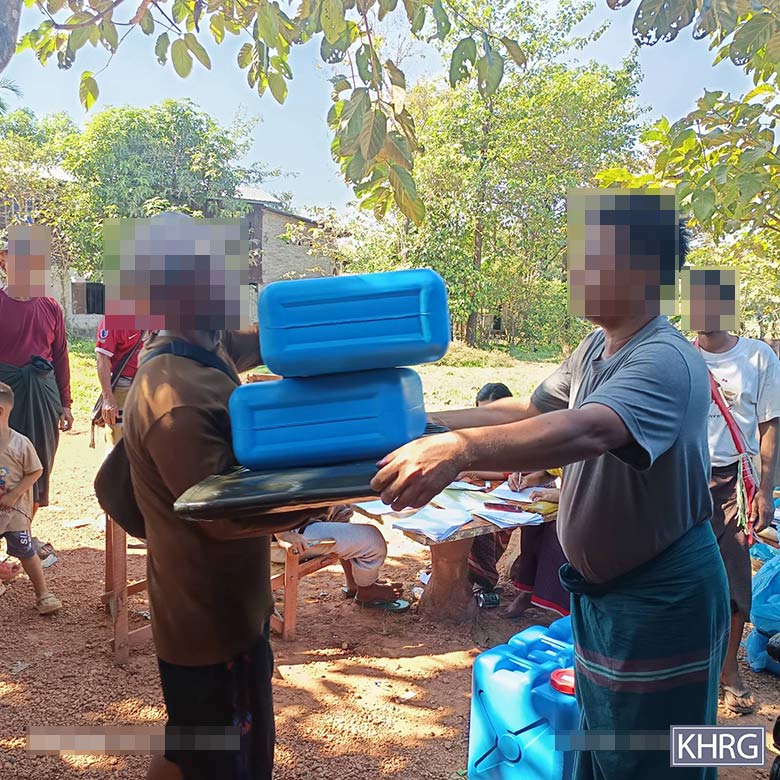
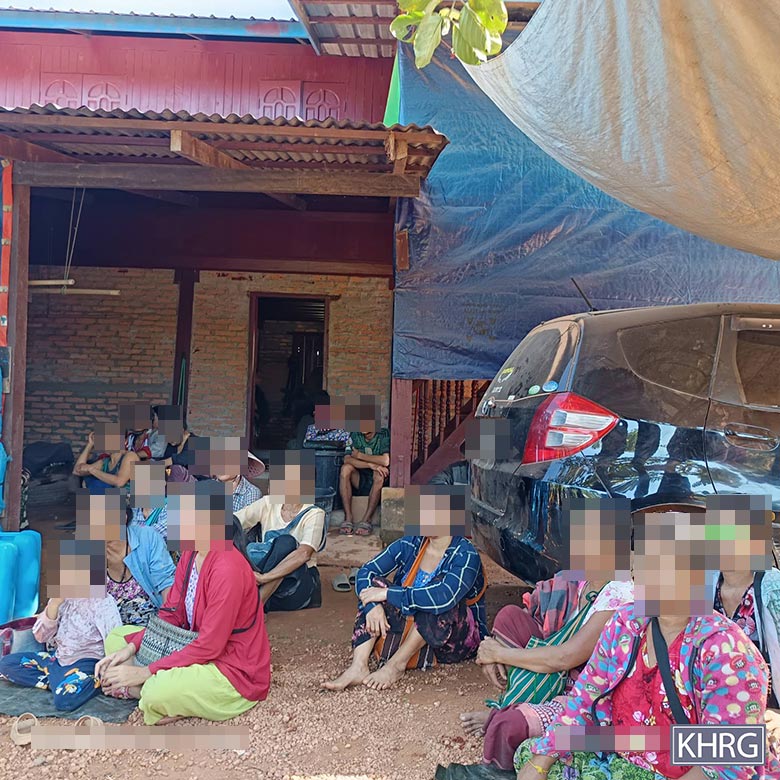


These photos were taken in December 2025, in Ae--- village, P’Ta village tract, Ta Kreh Township, Hpa-an District. These photos show the Committee for Internally Displaced Karen People (CIDKP) providing water containers and tarpaulins to villagers who were displaced in Ae--- village. [Photos: KHRG]
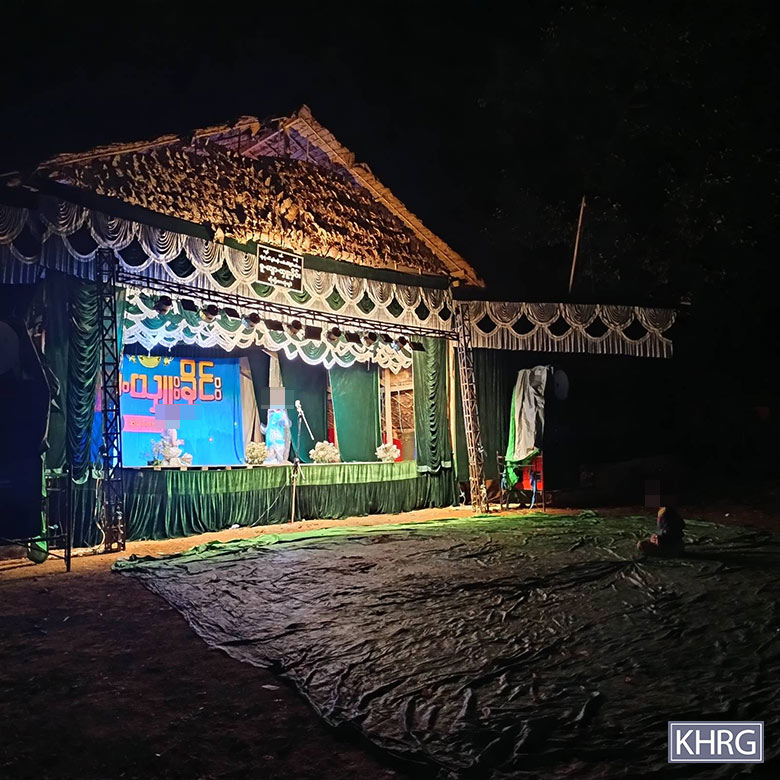
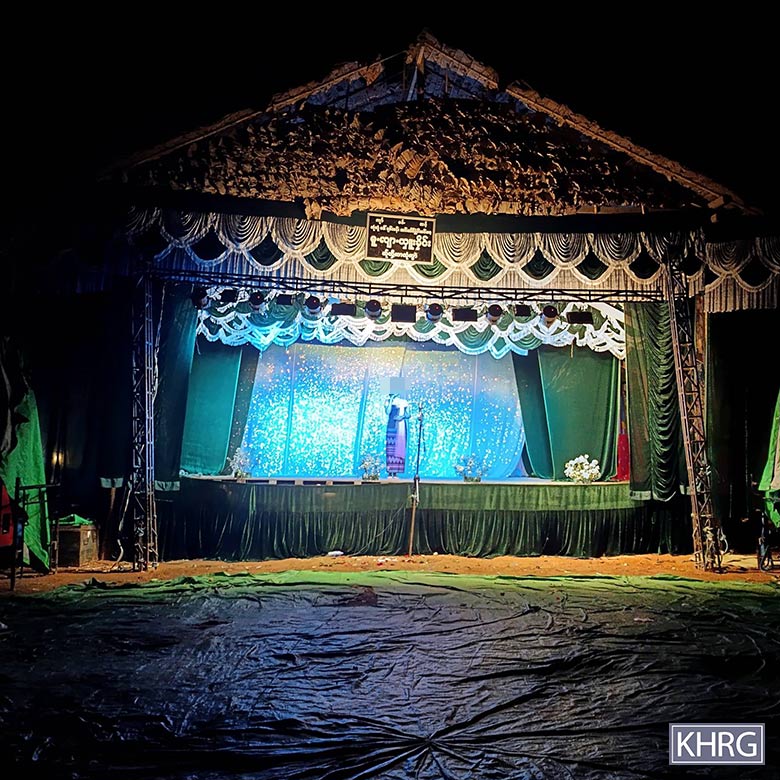


These photos were taken in December 2025, in Af--- village, Htee Hpoh Tray village tract, Ta Kreh Township, Hpa-an District. These photos show the stage that was set up for traditional entertainment performances during the Our Day events that were held in Af--- village. [Photos: KHRG]
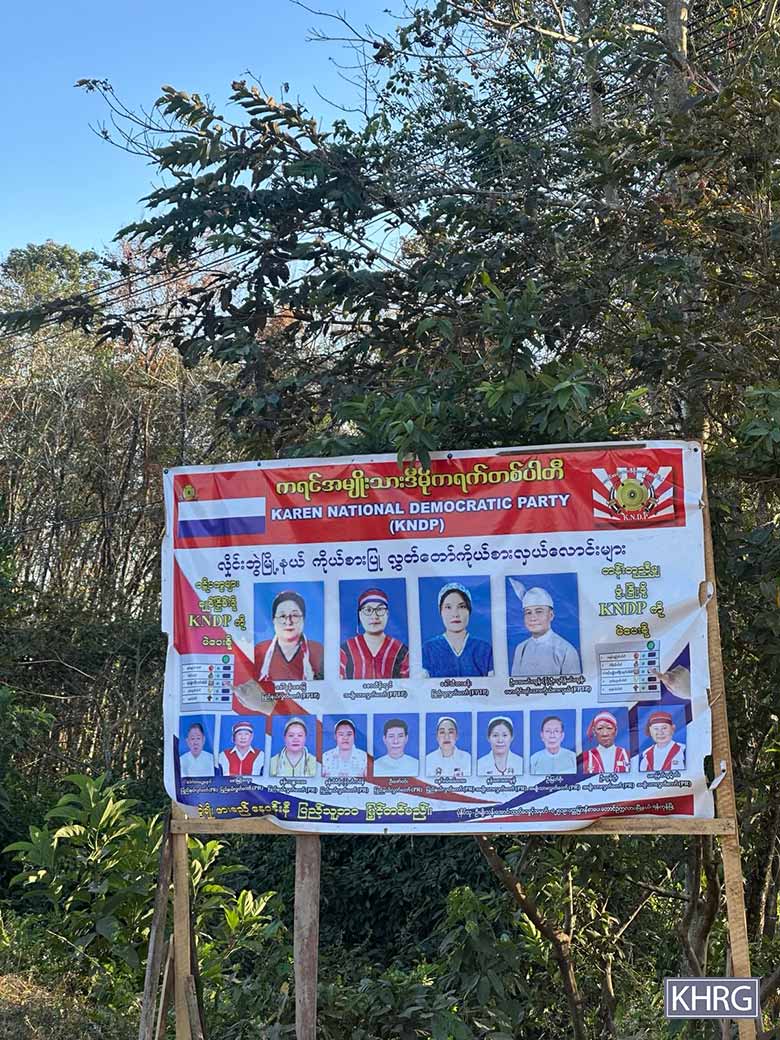
This photo was taken in December 2025, in the area near Ta Kreh Town, Ta Kreh Township, Hpa-an District. This photo shows a signpost campaign of three parties beside a vehicle road: Karen National Democratic Party (KNDP), Plone-Sgaw Democratic Party (PSDP), and Union Solidarity and Development Party (USDP). [Photo: KHRG]
Footnotes:
[1] The present document is based on information received in January 2026. It was provided by a community member in Hpa-an District who has been trained by KHRG to monitor human rights conditions on the ground. The names of the victims, their photos and the exact locations are censored for security reasons. The parts in square brackets are explanations added by KHRG. This document combines several received reports with the following KHRG internal log numbers: #26-9-S1 and #26-13-D1.
[2] The State Security and Peace Commission (SSPC) is the new name of the executive governing body created in the aftermath of the February 1st 2021 military coup. Formerly called the State Administration Council (SAC), it was renamed by Senior General Min Aung Hlaing on July 31st 2025.The chairperson serves as the de facto head of government of Burma/Myanmar and leads the Military Cabinet of Myanmar, the executive branch of the government. Min Aung Hlaing assumed the role of SAC chairperson following the coup and remains the head of the SSPC. The name State Security and Peace Commission (SSPC) is used interchangeably with military junta, Burma military regime, Burma Army, and SAC throughout this report to describe Burma’s armed forces.
[3] The Karen National Liberation Army is the armed wing of the Karen National Union.
[4] A village tract is an administrative unit of between five and 20 villages in a local area, often centred on a large village.
[5] ‘Ar Wer Day’ also known as 'Our Day’ is a term co-opted by DKBA, BGF and KNU/KNLA-PC and used to describe special days that they organise. Our Day events typically involve celebrations to mark a special occasion such as the building of a new pagoda or monastery or to honour these armed groups. Activities can include zat pwe, a Burmese traditional dance-drama, as well as singing, dancing, and magic. Sometimes Often, people also engage in illicit activities such as gambling and drug use during Our Day. The Our Day is primarily celebrated by armed groups to serve as a main fundraising activity for them.
[6] Border Guard Force (BGF) battalions of the Tatmadaw were established in 2010, and they are composed mostly of soldiers from former non-state armed groups, such as older constellations of the Democratic Karen Buddhist Army (DKBA), which have formalised ceasefire agreements with the Burma/Myanmar government and agreed to transform into battalions within the Tatmadaw. Some of the BGF battalions transformed into the Karen National Army (KNA) in January 2026.
[7]The KNU/KNLA-PC is an armed group based in the Htoh Kaw Koh village tract area, Hpa-an District. It split from the Karen National Union (KNU) and signed a ceasefire agreement with the Myanmar government in 2007, but refused to transform into a Border Guard Force (BGF) in 2010. It signed the Nationwide Ceasefire Agreement in October 2015 (and are still part of it after the 2021 coup). They currently operate in Hpa-an and Dooplaya districts.
[8] All conversion estimates for the kyat in this report are based on the 18 March 2026 mid-market exchange rate of $1 USD = 2,100 MMK, https://wise.com/gb/currency-converter/usd-to-mmk-rate
[9] The Karen National Union's Education and Culture Department is the education department of the Karen National Union. Its main goals are to provide mother tongue education services to rural Karen populations in Southeast Burma, as well as to preserve the Karen language, culture, and history. Despite being an important education provider in the region, it is not officially recognised by the Burma government.
[10] All conversion estimates for Thai Baht in this report are based on the 18 March 2026 mid-market exchange rate of $1 USD = 32.30 THB, https://wise.com/gb/currency-converter/usd-to-thb-rate
[11] The non-democratic elections held by the Burma military regime in 2025-2026 have been largely condemned by various international stakeholders, including ASEAN and high-ranking UN officials, as not legitimate. The junta’s election was split into three phases, making polling stations subsequently available in different regions: phase 1 took place on December 28th 2025; phase 2 took place on January 11th 2026; and phase 3 took place on January 25th 2026. The military junta backs the Union Solidarity and Development Party (USDP), a party which is known for its close ties with the military and from which most officials are former military personnel. The junta was formerly self-designated as the State Administrative Council (SAC), after the February 1st 2021 military coup headed by Senior General Min Aung Hlaing, which deposed the democratically elected government led by the National League for Democracy (NLD), following Burma’s 2020 general elections.
[12] Karen National Army (KNA) was established in January 2026, and it is composed mostly of battalions which split from the Border Guard Force (BGF) battalions that serve under the Burma Army. It is active in Mu Traw and Hpa-an districts. The majority of the BGF battalions in two out of four Cantonment Areas, Cantonment Area #2 and Cantonment Area #3, transformed into KNA. However, two battalions under Cantonment Area #3, BGF’s Battalion #1013 and #1014, remain under BGF control. They are active in Mu Traw Distirct and remain in ongoing conflict with Brigade #5’s KNU/KNLA.
[13] The Karen National Union (KNU) is the main Karen political organisation. It was established in 1947 and has been in conflict with the government since 1949. The KNU wields power across large areas of Southeast Myanmar and has been calling for the creation of a democratic federal system since 1976. Although it signed the Nationwide Ceasefire Agreement (NCA) in 2015, following the 2021 coup staged by Burma Army leaders, the KNU officially stated that the NCA has become void.

