English
 ကညီကျိာ်
 မြန်မာ
 Print:
This Incident Report describes events occurring in Dwe Lo Township, Mu Traw (Hpapun) District in October 2025. On October 10th 2025, Burma Army soldiers from Light infantry Battalion (LIB) #407 and LIB #408 under the control of Military Operations Command (MOC) #8, based in K’Ter Tee army camp, fired two mortar shells into Aa--- village, K’Ter Tee village tract. Before the mortar shelling, the Burma Army also conducted an air strike by dropping two 500 pound bombs into the village. The bombs landed on a farm near the edge of the village and caused no casualties and destruction; only the farm where it landed was damaged. The other bomb landed near a house of a villager and remained unexploded. The first mortar shell landed on a farm at the edge of the village with no casualties reported, but the shrapnel of the explosion scattered in the surrounding area and it minorly damaged the house of Naw B--- and Saw A---. The second mortar shell landed and exploded near their house. Saw A--- was hit by shrapnel on his back, head, and his right temple. The force of the shrapnel forced his intestines out and he was killed instantly. His wife is now widowed with three young children and his grandmother, so she is struggling with the family’s livelihood since Saw A--- was the only breadwinner of the family when he was alive. Also, their children and his grandmother are not in good health. After the incidents, villagers were afraid and dared not stay in the village. So, they fled to a cave in a forest. The villagers faced challenges with their livelihood and need staple foods to survive. They stayed in the cave alertly and cautiously, and they went out to work on their plantations to secure their livelihood when the sound of mortar shells reduced to a minimum or stopped entirely.[1]
Part 1 – Incident Details
|
Type of Incident |
[Indiscriminate firing of mortars / small arms and air strike] [The Burma Army[2]] fired mortar shells, killing one villager. |
|
Date of Incident(s) |
October 10th 2025 |
|
Incident Location (Village, Township and District) |
Aa--- village, K’Ter Tee village tract[3], Dwe Lo Township, Mu Traw District. |
|
Victim Information |
|
|
Name |
Saw[4] A--- |
|
Age |
31 years old |
|
Gender |
Man |
|
Ethnicity |
Karen |
|
Marital Status |
Married |
|
Occupation |
Farmer |
|
Religion |
Buddhist |
|
Position |
[Villager] |
|
Village |
Aa--- village, K’Ter Tee village tract, Dwe Lo Township, Mu Traw District. |
|
Perpetrator Information (Armed Actors) |
||||
|
Name(s) |
Rank |
Unit |
Base |
Commander’s Name |
|
Unknown |
Unknown |
[Burma Army] MOC [Military Operations Command][5] #8, LIB [Light Infantry Battalion][6] #407 and LIB #408 |
K’Ter Tee army camp, K’Ter Tee village tract, Dwe Lo Township, Mu Traw District |
Unknown |
Part 2 - Information Quality
|
1. Explain in detail how this information was collected. |
|
A KHRG researcher was in the area when the incident happened. On October 9th 2025, at 8:22 pm, the researcher heard a sound of a fighter jet flying overhead and dropping bombs onto Aa--- village [K’Ter Tee village tract, Dwe Lo Township, Mu Traw District]. Then, at 8:24 pm and 8:26 pm, [the KHRG researcher heard] the Burma Army[7] [Light infantry Battalion] (LIB) #407 and LIB #408 under the control of Military Operations Command (MOC) #8 fired mortar shells from K’Ter Tee army camp. At that time, the KHRG researcher [was not asleep] yet so he looked at the clock as soon as he heard the sound. |
|
2. Explain how the source verified this information. |
|
The next morning [October 10th 2025], the K’Ter Tee village tract head informed Saw E--- of the situation. Then, Saw E--- informed the KHRG researcher that the air strike was conducted into Aa--- village the night before. There had been raining and thundering while the incident happened [so villagers did not recognise the sound of mortar shelling and air strike]. |
Part 3 – Complete Description of the Incident
|
Describe the Incident(s) in complete detail. |
|
On October 9th 2025, at around 8:22 pm, a fighter jet [of the Burma Army] dropped two 500 pounds bombs [near] Aa--- village, K’Ter Tee village tract, Dwe Lo Township, Mu Traw District. One of the bombs landed and exploded on a farm close to the village, while another bomb landed close to a house of a villager and remained unexploded. So, the air strike did not cause any casualties to villagers and their domestic animals. It only damaged the farmland where it landed and exploded. As it was raining and thundering that night, villagers could not recognise the sound of the aircraft engine when it came.
During the air strike, 31-year-old Naw[8] B---, her 31-year-old husband named Saw A---, the grandmother of her husband, and their [three] children were in the house and sleeping. They did not hear or recognise the sound of the aircraft engine when it came due to the rain and thunder. Yet Naw B--- heard the sound of bombs [when they] landed and exploded, but she thought it was the sound of thunder, so she did not wake her family up. After the air strike, an older sister of Naw B--- [who lives in a house nearby] named Naw O--- came to her [Naw B---’s] house and woke them up. The sister [Naw O---] informed the family that aircraft came and conducted air strikes. She [Naw O---] asked the family to come down from the house to go into their makeshift bunker at her [Naw B---’s] house. They, including the grandmother, carried their children and went down from the house to the ground.
While they were on the ground beneath their house, at 8:24 pm, a mortar shell was fired by the Burma Army combined forces of LIB #407 and LIB #408 under the control of MOC #8, based in K’Ter Tee army camp. The mortar shell passed the village and landed on a farm at the edge of the village behind the house of Naw B---. It caused no casualties or destruction. Yet, it damaged the farm [field] where it landed. As a result, the shrapnel of the mortar shell scattered in the surrounding area and a piece of the shrapnel hit the house of Naw B--- and Saw A---. Naw B--- said she [warned] her husband that the mortar shell landed very close to them.
In a short time, at 8:26 pm, another mortar shell was fired [by the Burma Army]. Naw B--- could hear the sound of the [second] mortar shell when it came out from the mortar cannon. She then informed her husband that another mortar shell was fired and asked her family to go into the makeshift bunker at their house. They then went into the makeshift bunker, but the husband was still outside with his oldest daughter. Before going into the bunker, Saw A--- put his daughter on the upper floor and tightened his longyi. Then the [second] mortar shell landed and exploded near his house while he was tightening his longyi. He was then hit by the shrapnel from the explosion on his back, head, and right temple. The force caused his intestines to spill out of his abdomen. He fell on the ground immediately after [he was] hit by the shrapnel, but his family in the bunker thought he lay down on the ground to avoid the shrapnel. They [the family] also dared not turn on their torchlight, so they did not see that he was hit by the shrapnel since it was nighttime. When the shelling had stopped for a while, the older sister of Naw B--- [Naw O---] said to him [Saw A---] that he could get up since the sounds of mortar shells had stopped for a while already. They heard no reply from him, so Naw O--- turned on her torchlight, [and] they saw blood flowing into the bunker. They guessed it was the blood of Saw A--- from being hit by the shrapnel. The shrapnel of the mortar shell also hit two cows owned by another villager.
Naw B--- stated: “Then I asked my sister, ‘What do we do? What should we do?’ Subsequently, my older sister [Naw O---] ran out from the bunker, seeking help. At that time, my oldest daughter was on the higher floor [outside the bunker]. When she saw her dad was bleeding and his intestines had spilled out, she cried in anguish. She [the daughter] said she no longer dared to stay there [at her house] so she ran randomly, then across her dad’s back [the corpse] and followed her aunt. My sister went to a house near mine and informed the house owner Naw C---’s dad [Saw Z---]: ‘Saw A--- was hit by the shrapnel of the explosion’ She asked Saw Z--- to come to us and stay with us, but he refused, and none of his family members came to us. It might be because the mortar shelling just happened, so they were afraid mortar shells would be fired again. So, my sister left her niece there with the house owners and went into the village to seek help.”
Their house is located at the [eastern] edge of the village and a bit far from the community. She continued: “I stayed in the bunker with his [her husband’s] grandma and my second daughter and youngest son. We could not come out because the corpse of my husband was right at the entrance of the bunker and his blood [was] flowing a lot. I screamed in fear, but no one came to us for help. I then said, ‘Where did my sister [Naw O---] go?’ I did not know that my sister tried to reach out to someone in the village.”
Meanwhile, Naw B--- saw a young man from a distance named Saw D--- come, and she screamed for help. Saw D--- came to them and asked what happened to the family. Naw B---- informed him that her husband was hit by the shrapnel and requested the young man carry her husband away from the entrance of the bunker and put him [the husband] on the bunker cover. Saw D--- carried the corpse and placed [the body] as he was requested. After that, he [Saw D---] left to take care of his mom. Naw B--- stated: “I remained behind [with my children and the grandmother], and I thought any of [the people from] the house near mine would come to us, but they did not come. I screamed a lot. Also, I spoke through tears. […] Even though my older sister [Naw O---] was seeking [help from] people in the village, she found no one, because all the other villagers had fled already. Then she [Naw O---] passed the information to my older brothers and my brother-in-law [Naw O---’s husband]. Then they came to me. […] When they arrived here, I asked them to carry my husband to the platform which was built under my house. They struggled a lot carrying my husband because my husband was big and tall as well. After they carried my husband to the platform, they screamed for help to Saw Z--- and asked him to help them carry my husband in my house. But he [Saw Z---] did not come. So, my brothers struggled and tried to carry my husband. They could only carry my husband to the platform that we built under our house.”
After the brothers carried their brother-in-law to the platform, the brother named Saw J--- stayed with his sister, while Saw K--- went out to seek other villagers. Then villagers came one by one and held a vigil throughout the night with Naw B---. [The next day], on October 10th 2025, in the morning, they held a funeral service and buried him [Saw A---]. Naw B--- received some donations from [other] villagers for her husband’s funeral. Some villagers provided her 5,000 kyats (2.38 USD[9]), some provided 10,000 kyats (4.76 USD), and other villagers provided a bowl of rice. She could not remember how much she received in total. The victim’s family did not receive any support from local authorities or organisations. Naw B--- now lives as a widow with her three children and the grandmother.
Naw B--- also said: “I am currently in a difficult moment since I have lost my husband. We [the remaining family members] face challenges with our livelihood, especially food rations. We do not have sufficient food for our daily bread. I will be happy if someone could support us. […] We do not have any breadwinner left since my husband was the only one. The other thing is that sending our children to school is also an expense. A teacher asked me [for the] school [enrolment] fee. I could not afford it, so I asked her to wait for me until I have money. The teacher understands my situation. I need staple foods for my family and school fees for my children. So, I have many preoccupying things on my mind. I need to think of a job to secure my family’s livelihood. In my heart, I have many feelings that I cannot even say out loud. After I lost my husband, I always feel something in my heart. I frequently think of my life and cry whenever my mind went to him. It is quite hard for us to survive.”
Naw B--- also expressed her experiences that she faces several types of difficulties. She owed debt to someone after she lost her husband, because she had no money for a funeral service for her husband [the money she received from other villagers’ willingness was not enough to cover the cost]. So, she borrowed money from other villagers. She said that since she borrowed the money, she is responsible to pay it back. But she cannot do anything to pay the money back since her children are little and she is not confident enough to leave her children behind during this conflict situation. On the other hand, she has to take care of the grandmother since she [the grandmother] is very old and not in a good health. Her children are also not in good health. So, she only works when she gets a moment to work. She borrows some food [snacks] from a shop [and] then sells it. After she sells it [the snacks], she pays the shopkeeper back. The snacks she borrows from the shop are not that much, so she does not make much profit. She can only receive small amounts of money, so her family needs staple food such as rice, cooking oil, and salts.
Regarding the incident, villagers from Aa--- village believed that as the only remaining Burma Army camp [in Dwe Lo Township, K’Ter Tee army camp has been intentionally targeting the villages, because they [the Burma Army] have been indiscriminately firing mortar shells into each village in K’Ter Tee village tract since the 2021 coup[10]. [Villagers believe this because] whether there were [Karen National Liberation Army (KNLA)[11]] soldiers in the villages or not, [or whether] fighting was happening in the village or nearby villages or not, they [the Burma Army] fired mortar shells into the villages whenever they wanted.
After the incidents [the air strike and shelling on October 9th 2025], villagers fled and stayed in a cave [including Naw B--- and her family]. Then, when they heard fewer sounds of mortar shells, they went out and worked on their farms and plantations. But when they heard more sounds of mortar shells, they felt afraid and stayed alert in the cave [instead of going out to work]. They experienced a lot of coughing and sneezing from living in the cave. No medical care was available for them. Naw B--- also said: “Village administrators do not organise anything for us. We fled and we just survive our live like this. So, if we receive any support, we will be happy. […] We do not get to live our lives peacefully here. We struggle a lot. I need to be thoughtful for my family’s livelihood since I have children to feed. I want peace and I would like to live in my own house.” |
Part 4 - Permission for Using the Details
|
Did the victim(s) provide permission to use this information? Explain how that permission was provided. |
|
The wife of the victim, named Naw B---, allowed us [KHRG] to use this information accordingly to our needs [after the researcher explained how the information will be used]. |
Further background reading on the situation on indiscriminate firing of mortars / small arms in Southeast Burma/Myanmar can be found in the following KHRG reports:
- Striking Fear: Impacts of State Administration Council (SAC) shelling on villagers’ lives in Southeast Burma (January to October 2023), December 2023
- “Photo Set: Shelling of villages in Southeast Burma by the Burma Army, the BGF, and other affiliated armed groups, and its impacts (January to November 2025)”, December 2025
- “Dooplaya District Short Update: SAC shelling and displacement challenges in Kruh Tuh Township (July 2025)”, January 2026
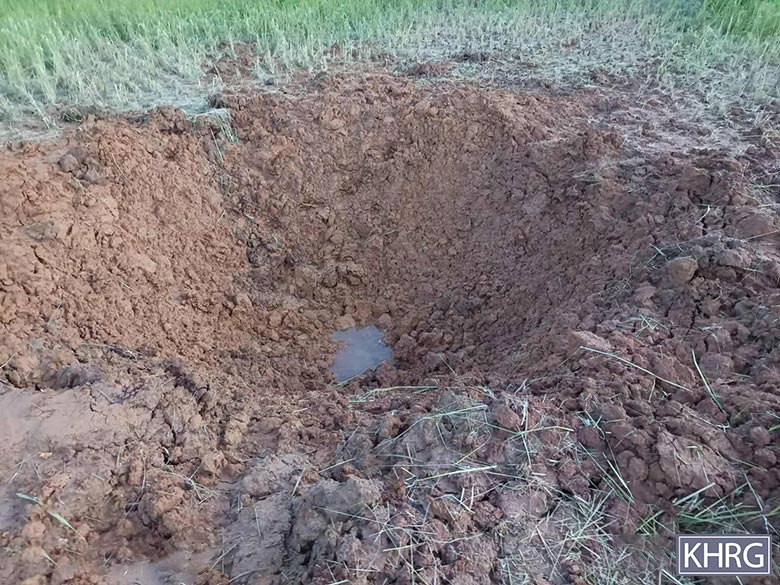
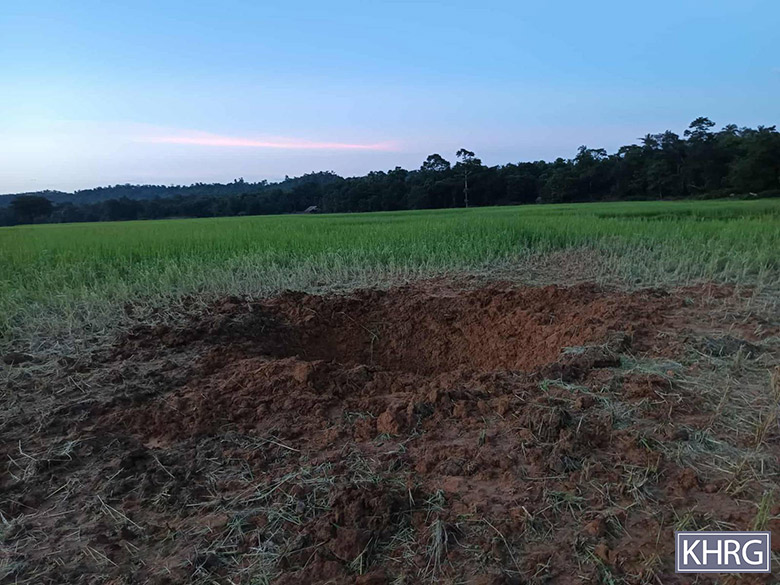


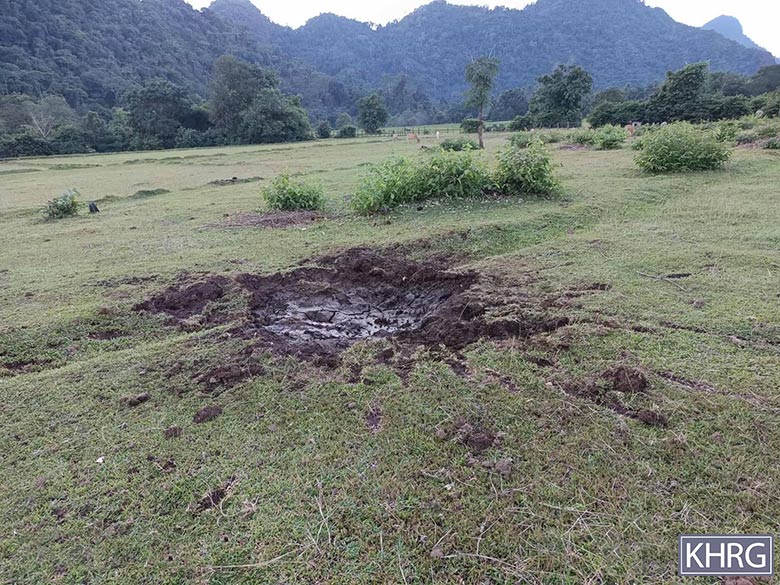
These photos were taken by a KHRG researcher in October 2025 on a farm beside Aa--- village, K’Ter Tee village tract, Dwe Lo Township, Mu Traw District. The photos show a crater of the first 500 pounds bombs dropped by a Burma Army fighter jet on October 9th 2025, at 8:22 pm. One of the bombs landed and exploded in a farm located beside Aa--- village. Some rice paddies in the field were destroyed by the explosion. Also, the shrapnel from the explosion scattered in the surrounding area and damaged some roofs of villagers’ houses. [Photos: KHRG]
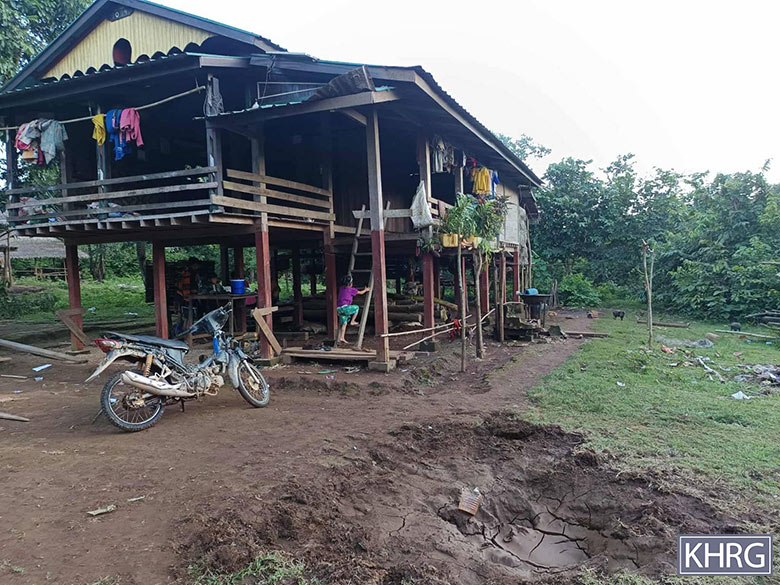
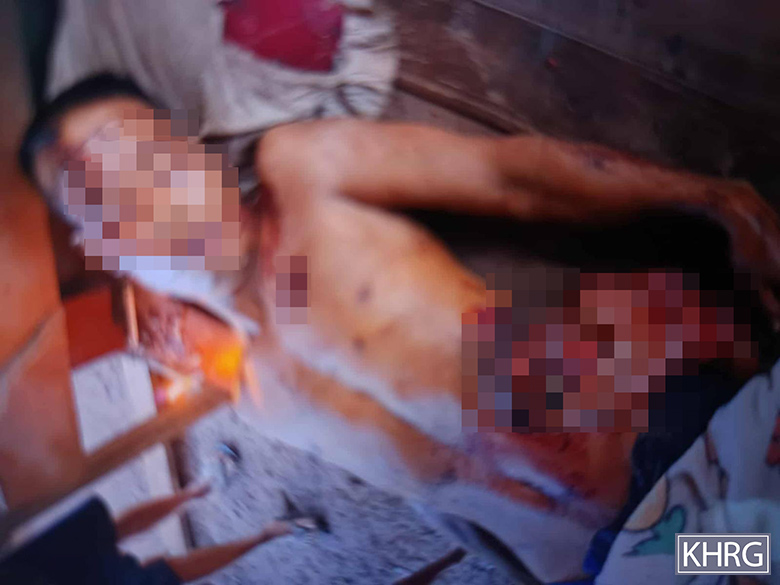


These photos were taken by a KHRG researcher in October 2025, in Aa--- village, K’Ter Tee village tract, Dwe Lo Township, Mu Traw District. The photos show an incident of mortar shelling, which was conducted by the Burma Army combined forces of Light Infantry Battalion (LIB) #407 and LIB #408 under the control of Military Operations Command (MOC) #8 based in K’Ter Tee army camp on October 9th 2025. The left photo above shows the corpse of Saw A---, who was killed by the shrapnel of the second mortar shell, which landed in front of his house. The right photo above shows the house of Naw B--- and Saw A---, and the crater of the second mortar shell, which landed on the front side of the house. The photo below shows the crater of the first mortar shell, which landed in the field of a villager, located behind Naw B---’s house. [Photos: KHRG]
Footnotes:
[1] The present document is based on information received in December 2025 and February 2026. It was provided by a community member in Mu Traw District who has been trained by KHRG as a researcher to monitor human rights conditions on the ground. The names of the victims, their photos and the exact locations are censored for security reasons. The parts in square brackets are explanations added by KHRG. This document combines several received reports with the following KHRG internal log number: #25-458-A2-I1; #25-368-P1; #26-52-S1.
[2] The terms Burma military, Burma Army, SAC, Tatmadaw, and junta are used interchangeably throughout this report to describe the Burma military regime’s armed forces. Villagers themselves commonly use Burma Army, Burmese soldiers, or alternatively the name adopted by the Burma military regime at the time —from the 2021 coup to July 2025, the State Administration Council (SAC). On July 31st 2025, the military junta changed its name to the State Security and Peace Commission (SSPC).
[3] A village tract is an administrative unit of between five and 20 villages in a local area, often centred on a large village.
[4] Saw is a S’gaw Karen male honorific title used before a person’s name.
[5] Military Operations Command (MOC) is comprised of ten battalions for offensive operations. Most MOCs have three Tactical Operations Commands (TOCs) made up of three battalions each.
[6] A Light Infantry Battalion (LIB) comprises 500 soldiers. Most Light Infantry Battalions in the Tatmadaw are under-strength with less than 200 soldiers, yet up-to-date information regarding the size of battalions is hard to come by, particularly following the signing of the NCA. LIBs are primarily used for offensive operations, but they are sometimes used for garrison duties.
[7] The terms Burma military, Burma Army, SAC, Tatmadaw, and junta are used interchangeably throughout this report to describe the Burma military regime’s armed forces. Villagers themselves commonly use Burma Army, Burmese soldiers, or alternatively the name adopted by the Burma military regime at the time —from the 2021 coup to July 2025, the State Administration Council (SAC). On July 31st 2025, the military junta changed its name to the State Security and Peace Commission (SSPC).
[8] ‘Naw’ is a S’gaw Karen female honorific title used before a person’s name.
[9] All conversion estimates for the kyat in this report are based on the 23 March 2026 official market rate of 1 USD = 2,100 MMK, https://wise.com/gb/currency-converter/usd-to-mmk-rate
[10] On February 1st 2021, the Burma Army deposed the democratically elected government led by the National League for Democracy (NLD). The military proclaimed a year-long state of emergency and transferred power to Min Aung Hlaing, the Commander-in-Chief of Myanmar's Armed Forces. Based on unproven fraud allegations, the Tatmadaw invalidated the landslide victory of the NLD in the November 2020 General Election and stated it would hold new elections at the end of the state of emergency. The coup d'état occurred the day before the Parliament of Myanmar was due to swear in the members elected during the 2020 election. Elected President Win Myint and State Counsellor Aung San Suu Kyi were detained, along with ministers, their deputies and members of Parliament.
[11] The Karen National Liberation Army is the armed wing of the Karen National Union.