English
 ကညီကျိာ်
 မြန်မာ
 Print:
1. Introduction
Alongside the Burma Army[1]’s shelling, air strikes, and violent attacks, villagers in Southeast Burma (/Myanmar)[2] have been forced to contend with another threat to their community’s safety and wellbeing: the rapid spread of drugs, chief among these yaba[3]. The armed conflict in locally-defined Karen State[4] has created conditions in which drug use and trade have flourished. The conflict’s impact on access to job opportunities, education, and livelihoods, as well as on mental distress, has pushed many villagers (of different gender and ages) towards drug use. Simultaneously, the widespread presence of drugs has encouraged further heightened levels of use in communities, including amongst children.
Villagers have reported that their personal, familial, and communal wellbeing has worsened significantly due to drug use in villages. Individual users face stigma and poor physical and mental health, sometimes leading to suicide. Families have seen a rise in domestic violence perpetrated by those using drugs, while communities have experienced an increase in youth gang activity, theft, and sexual violence and exploitation. Despite clear gaps in access to drug awareness, rehabilitative treatment, and support, villagers continue to employ strategies to respond to the impacts of drug abuse in their communities, including taking drug users to treatment centres or to drug-free areas, raising awareness, and reporting their concerns to relevant stakeholders.
This briefing paper discusses the spread of drug availability and abuse in Southeast Burma and its impacts reported by villagers in 2025. First, a historical overview is presented, reviewing the development of drug trafficking and consumption in Southeast Burma. The paper later explores the factors driving drug use; the impacts on the wellbeing of users, families, and communities; and villagers’ voices, strategies, and challenges faced while dealing with drug issues. This is followed by a legal analysis of the national and international legal implications of drug-related issues in Karen State. The paper finishes with recommendations to key stakeholders.
2. Historical context: the drug economy in Burma and the Southeast
Drug production and trafficking in Burma were sustained by economies of armed groups-driven extraction in northern Burma, and the Burma Army’s efforts to control territory. Drug trade and trafficking spread in Karen State was also conflict-related. Following the 2021 coup, the expansion of conflict has allowed drug-related abuses to expand even further.
The spread of the drug economy:
Throughout the second half of the 20th century, drug production —primarily opium and heroin— was mainly focused in ‘The Golden Triangle’, an area stretching through Burma’s Shan State several hundred kilometres north of locally-defined Karen State.[5] In exchange for participation in Burma Army offensives,[6] during this period Burma Army-backed militias and other independent armed actors were granted, to varying degrees, free rein over profit extraction in their areas, becoming the leading drug producers. After pressure from China and other international actors led the main opium-producing groups in Northern Burma to ban poppy growing in the late 1990s, their shift focused towards yaba and other Amphetamine-Type Stimulants (ATS) products. [7]
In the late 1990s and 2000s, the Burma Army’s efforts to split apart resistance armed groups provided the space for drug trade and trafficking to spread in Karen State.[8] In 1994, under the leadership of Burma Army-backed monk U[9] Thuzana, several troops abandoned the Karen National Union (KNU)[10] for the new Democratic Karen Buddhist Army (DKBA)[11]. Some DKBA commanders then began participating in drug trafficking to Thailand for their own profit after signing an agreement with the Burma Army in 1995.[12] In the years following, drug use and sale, primarily of yaba, continued to grow, remaining most widespread in Hpa-an District, where the DKBA was strongest.[13] The growth of the drug trade was encouraged by the further splintering of both the DKBA and KNU: in 2007, the KNU/KNLA Peace Council (KNU/KNLA-PC)[14], also based in Hpa-an District, broke away from the KNU after engaging in peace talks with the Burma military regime. Later, the DKBA-Benevolent[15] and DKBA-Buddhist[16] formed, after the Burma Army forced the DKBA to transform into the Karen Border Guard Force (BGF)[17] in 2010. These groups were involved in committing drug-related abuses.[18]
Drug trafficking during the ceasefire periods (2012-2020):
The signing of the 2012 preliminary bilateral ceasefire agreement and then the 2015 Nationwide Ceasefire Agreement (NCA)[19] by the KNU, KNU/KNLA-PC, the DKBA-Benevolent, and others further enabled the spread of drugs, as the removal of checkpoints and the slowing of conflict allowed for their easier transport.[20] KHRG had documented drug-related issues, including killings, sexual and domestic violence, theft, school dropouts, and threats from armed actors taking place across Karen State districts.[21]
There have been efforts to address growing drug abuse in Burma, generally, and in Karen State specifically. In 2018, the government of Burma announced both a partial decriminalisation of drug use via reform to its ‘1993 Narcotic Drugs and Psychotropic Substances Law’[22] as well as the release of a ‘National Drug Control Policy’[23]. Despite this, laws on drug use remained punitive, with significant penalties for people in possession of small quantities of drugs, and the death penalty still in place for certain drug-related offenses.[24] The KNU established its ‘Special Drug Law’, released in 2014 after the KNU, DKBA-Benevolent, BGF, and KNU/KNLA-PC met to establish a Karen-led anti-narcotics committee.[25] At this meeting, the groups announced the building of two detention centres for drug users in Shwe Kokko, BGF-controlled territory, and another in KNU-controlled territory, in Hpa-an District.[26] However, little was done to provide access to treatment for users with addiction and other drug-related ailments.
Drug-related abuses following the 2021 coup:
After millions of people across Burma took to the streets to protest against the Burma Army leaders’s attempt to seize power once again on February 1st 2021, the military regime responded by escalating attacks on civilians and human rights defenders, including in Southeast Burma.[27] This continued the Burma Army’s historical abuses of villagers, which have included the burning down of villages, shoot-on-sight attacks, killings, torture, sexual violence, and the taking of villagers as human shields and porters.[28] In the more than four years since the 2021 coup, the junta has intensified these attacks by also bombing village areas.[29] The junta’s violence has left thousands of villagers dead, injured tens of thousands of others, left hundreds of schools and hospitals inoperable, and deprived people across Burma of their basic rights.[30]
The 2021 coup has also harmed efforts to combat drug-related issues. While efforts led by community-based organisations, villagers, and community leaders to provide treatment to drug users were halted following 2021, drug production in Burma has grown significantly, with Burma becoming the largest opium producer globally.[31]
Since the 2021 coup, villagers in Southeast Burma have repeatedly told KHRG that the same actors controlling the drug trade from the ceasefire period have continued producing and trafficking drugs at high rates, with accessibility to drugs dramatically increasing, in particular yaba, most notably in Dooplaya and Hpa-an Districts —with severe impacts to their communities and wellbeing.[32]
3. Factual summary: impacts of conflict-related drug abuse in Southeast Buma
As political and armed conflict in Southeast Burma has continued to escalate in the five years since the 2021 coup, KHRG documentation has demonstrated a concurrent increase in drug use and trade, primarily of yaba, in communities. During 2025, villagers reported that the spread of drugs was driven by the lack of access to livelihoods and wellbeing for community members, as well as the already extensive presence of drugs in villages. Villagers largely blamed the Burma Army for driving the spread of drugs in Southeast Burma, having severe impacts on the physical and mental health of drug users, and linked to increases in domestic abuse and sexual violence, as well as theft and threats to community safety, particularly in Dooplaya and Hpa-an districts.
Despite clear gaps in access to rehabilitative treatment and support, villagers continue to try to respond to the impacts of drug use in their communities. Villagershave tried to take steps to help support their family members through drug addiction. However, the ongoing conflict and presence of certain armed groups in the community continue to limit the response to the drug-related concerns raised by local villagers.
During the reporting period (January to November 2025), KHRG received 35 field reports[33] (including interviews, short updates, situation updates, field trip reports, and photo notes) and two reports from group discussions with community-based and civil society organisations (CBOs/CSOs), all of which reported on yaba use and impacts in Southeast Burma.[34] Four interviews were also conducted with humanitarian organisations and CBOs/CSOs operating locally, and six interviews were conducted with local authorities, including staff from the Karen National Police Force (KNPF)[35] and the KNU. The factual summary is based on such unpublished documentation.
This section presents the relationship between conflict and the spread of drugs, and the impacts on drug users, their family members, and the community at large. The main factors that villagers see as driving drug abuse in Southeast Burma (3.1) include (a) conflict-related livelihood and wellbeing difficulties, (b) easy access to drugs in the community, and (c) a Burma Army’s military strategy related to drug trafficking. The impacts of drug abuse raised by villagers (3.2) involve (a) personal wellbeing, (b) family wellbeing, and (c) community wellbeing. The last subsection includes the agency strategies employed to respond to drug issues (3.3), including (a) accessing treatment and (b) awareness raising and legal action, and presents (c) villagers’ demands.
3.1. Factors driving drug abuse in Southeast Burma
During the post-2021 coup escalation of Burma Army attacks on villages in Southeast Burma, there has been a significant increase of drugs in Karen State communities, particularly in Dooplaya and Hpa-an districts, where several armed groups operate. Based on KHRG documentation, while most drug users are men or boys, they also include children as young as seven years old, pregnant women, nursing mothers, and parents with young children. Local villagers highlighted conflict-related factors inciting drug use in Southeast Burma, including difficulties faced by villagers to earn livelihoods and support their families, and their mental wellbeing; the widespread presence of drug dealers in communities; and the support of the Burma Army for allied armed groups involved in drug trafficking.
a) Conflict-related livelihood and wellbeing difficulties
Ongoing armed conflict and political instability in Southeast Burma have caused a severe increase in drug abuse by exacerbating the rate of poverty and mental distress that villagers face in their daily lives. Based on villagers’ testimony, the extent of the armed conflict and increased travel restrictions, which in turn drives up commodity prices, leaves local villagers with fewer opportunities to earn money. Many villagers who participate in drug use or sale, particularly young men, are driven to do so by the difficulties they experience in their day-to-day lives: to cope with the pain, grief, and distress caused by the death and injury of family members and the destruction of properties and livelihoods, largely caused by Burma Army attacks. Others do so because of the lack of jobs or access to opportunities to further their education. Yaba is currently the cheapest, most widely available, and commonly used drug in Southeast Burma, although drug users frequently mix multiple drugs based on availability, including crystal meth, tramadol (a prescription opioid), cannabis, kratom, opium, and different mixes of over-the-counter pharmaceuticals.
Naw[36] G---, the DARE Network[37] Operations Director, explained to KHRG: “There are many different reasons why people use drugs. Many young people in Karen State turn to drugs because of stress caused by living in an unstable country, family separation or divorce, loneliness, and trauma. I have witnessed many people using drugs because of deep suffering. Some of our clients used drugs because their family members have died because of the war. Others used drugs to forget the problems they are facing. Many young people feel hopeless. Some do not have access to education or job opportunities, and some of them, as a result, become substance abusers. Another reason is that many substance abusers do not fully understand that they are substance abusers or how drug use will affect their well-being. Some people become drug traffickers as they believe they can support their families and increase household income because they have no other employment opportunities.”
Reportedly, child drug use is increasing in the communities, particularly amongst children who are not going to school, living without sufficient care from their parents, or working to help secure their family’s livelihood on farms, making charcoal, or helping rear cattle.[38] A 19-year-old boy, named Saw[39] Y---, from Xb--- village, Noe Kwee village tract[40], Ta Kreh Township, Hpa-an District, who had recently received treatment from DARE Network, explained to KHRG he started using yaba as a child, after dropping out of school to help his parents on the farm. Some men were using and selling yaba in front of him, at the plantation, and they offered him yaba to use for free. Saw Y--- said: “At that time, I also wanted to try it [yaba], so I used it. I continued to use it until I became addicted and could not live without using it. Then I must buy it by myself.” According to the KNPF District Chief for Hpa-an, Saw A---:
“Teenagers use drugs. Even seven- or eight-year-old children use it. It is because some children do not have parents, and they are poor.”
Drugs are also used to cope with labour hardships, often to be able to work for longer hours to secure family livelihoods during conflict-induced scarcity.[41] Saw Z---, a villager who formerly used drugs, from Xa--- village, S’Tain village tract, Ler K’Saw Township, Mergui-Tavoy District, testified: “They [yaba users] feel like they can work much more when they are consuming drugs [yaba]. They believe in it, so they will find ways to use more drugs [yaba] to work more. When the drug is active, they think they are working [but are not really productive].”
Villagers face significant security risks travelling for jobs or to go to their farms for their family’s livelihoods.[42] This limits access to work and increases pressure to find additional sources of income for villagers. To deal with this pressure, some villagers, usually men, turned to dealing drugs to earn income. The Karen Women’s Organisation (KWO) General Secretary, Naw D---, said during a workshop with other CBO/CSOs: “As the long [armed] conflict leads to poverty and a lack of job opportunities, drug dealing is an easy-to-access option [to make money]. The price [of yaba] is also cheap.”
Villagers, the KNPF, and CBO/CSOs reported that the larger drug suppliers and sellers tend to be people with power and wealth, particularly in areas with poverty and few job opportunities. Such people offer jobs to local villagers, who have few other options, as yaba dealers, plantation workers, security guards, or at their company, particularly in the logging industry. In some cases, they provide yaba in return for work.
b) Easy access to drugs in the community
The longer the armed conflict continues, the more widespread and accessible drugs are in communities in Southeast Burma, leading more people to abuse drugs, especially the more vulnerable, like children. There is a lack of awareness on the impacts of drugs in the communities, with many using without knowledge about the harm being caused by substance abuse. Both men and women (including pregnant villagers) were reported as using drugs.
Villagers explained that children tended to begin using drugs after seeing adults use, or after getting access to drugs from adults, including from drug-selling stalls and dealers close to schools. A 19-year-old teacher named Saw W---, from Xc--- village, Noh T'Kaw village tract, Noh T'Kaw Township, Dooplaya District, explained: “Let’s say adults consume marihuana, usually by rolling it into cigarettes and smoking it. After smoking, they discarded the leftover butts. Children sometimes found these butts and smoked them. […] From my perspective, drug use has become normalised and seen as something ordinary. For them, it is no longer considered an issue.” Naw G---, the DARE Network Operations Director, similarly added: “Children often do not understand why they use drugs. They use drugs simply by following others. If their older siblings use drugs, they do the same. If their neighbours use drugs, they follow. They do not understand the side effects and use whatever substances are available to them. These children are in a very vulnerable situation.”
Some children used drugs due to their family issues, including economic hardship, neglect, or the loss of parents. For instance, in Xb--- village, Noe Kwee village tract, Ta Kreh Township, villagers Saw V---, Saw U---, and Saw T---, currently 13 years old, started using drugs, primarily yaba, when they were about seven. Saw V--- started using yaba because his father used drugs and shared them with him. Saw U--- and Saw T--- started to use yaba after a friend offered. The fathers of both Saw U--- and Saw T--- were also addicted and committed suicide when both boys were about three years old. Saw U--- and his older sister had been living with their grandmother, who had an alcohol use disorder, as his mother migrated to Thailand without providing support for them. Saw T--- lived with his widowed mother and his three other sisters. After all three became addicted to drugs, they stopped enjoying going to school, and their family also stopped supporting their education.
As of October 2025, Saw V--- was staying with his aunt after his father had migrated to Thailand. Saw V--- was not using drugs anymore and had returned to school. On the other hand, Saw U--- and Saw T--- continued to use drugs in the village, and were tending cattle and making charcoal for a living. Saw U--- was now living with his aunt, after his grandmother passed away. His older sister got married when she was 15 years old to a young man who also used drugs.
Staff from local organisations reported that women sometimes also use yaba after being unable to stop their husband or children from using, with whole families experiencing addiction. As Naw C---, from KWO, mentioned during a workshop discussion: “Some women asked their husbands [to stop using], but their husbands did not stop using [drugs], and the women started to use it [drugs]. Some women did this and, [even though] their husbands stopped using, they could not stop using it anymore.” Saw I---, the Hpa-an District KNPF vice investigator, explained to KHRG: “Their [women’s] children started using [drugs] with friends. Some wives do not use, but some of them use because they could not control their husbands. Then, both husband and wife are using drugs. […] When the children are using drugs, they do not go to school, and their parents also do not support them to go to school anymore. They just let their children follow them like a train [go wherever they like]. We cannot do anything about it.”
c) Burma Army’s use of drug trafficking as a military strategy
Drug trafficking in Southeast Burma was frequently raised by villagers as a conflict-related challenge for local communities. Local leaders interviewed by KHRG highlighted the role of the Burma Army in enabling allied armed groups in the sale and spread of drugs in Southeast Burma. Saw A---, the KNPF Hpa-an District Chief, mentioned: “If we try to look at our area in Brigade 7, Hpa-an District, as a result of the split [within armed groups], the people who split used drugs. As per our investigation, they [the Burma Army] did not do this [selling drugs] directly. [It is] the enemy [the Burma Army]’s strategy: They use these [drugs] as weapons; weapons which will fight and destroy revolutionaries. And for the civilians who live in the revolutionary [KNU-controlled] areas, they will be destroyed and will become drug victims.” Naw G---, DARE Network’s Operations Director, also stated:
“There has been an increase in drugs due to political problems. Drug traffickers deliberately plan to distribute drugs within communities, as a weapon of war.”
Community members also believe that the Burma Army purposefully spreads drugs by supporting those producing and trafficking drugs in KNU-controlled areas to weaken dissent, particularly among the youth. Saw S---, a Karen Youth Organisation (KYO) leader from Xd--- village, Noh T'Kaw village tract, Noh T'Kaw Township, Dooplaya District, stated: “We cannot tell [ask] the [Burma] military junta [to stop spreading yaba] anymore. They want our people to be ruined. It [drugs spreading] came from them initially. If our young people are ruined, they [the Burma Army] would not need to fight us. We would be ruined automatically. However, our young people do not know about it. If more young people are using drugs, the future leaders will decrease.”
3.2. Impacts of drug use in the communities
Drug abuse has a significant impact on personal, familial, and communal wellbeing in villages. These impacts worsen the already significant physical and mental health challenges faced by communities. The spread of drugs has also been matched with an increase in violent crime, theft, and domestic violence.
a) Impacts on users: physical and psychosocial ill-being and constraints to education access
Drug use has serious impacts on the physical and mental health of users. Children who use drugs often dropped out of school as a result of drug use. It also lead to villagers facing stigmatisation and ostracisation, particularly women and child users.
Villagers reported that drug use impacted users’ health negatively. The most common signs of using drugs, reported by villagers, included pale skin, skinniness, restlessness, unusual sleep patterns, changes in behaviour, and inappropriate actions and speech towards others. Other serious physical ailments were also mentioned as related to drug use, including kidney and liver failure, lung problems, and stunted physical development amongst children. The KNPF Chief for Hpa-an District, Saw A---, explained about a 12-year-old boy named Saw K---, from Nn--- village, Noe Kwee village tract, Ta Kreh Township, who died from illnesses after struggling with long-term yaba addiction: “Since he used [drugs] his siblings scolded him, but he did not listen. […] His siblings could not tell him [to stop], and he did whatever he wanted to do, and he used until he died.”
Drug users also often suffer from mental health issues, making it difficult for them to live their lives as they normally would and maintain relationships in the family and community. Saw W---, the teacher from Noh T'Kaw Township, Dooplaya District, referred to the conditions of a man from his village: “Before he started using drugs [yaba], he worked hard, came home on time, cared for the children, and helped with cooking. But after he began using drugs [yaba], everything changed. He stopped working, became easily angered, and his wife no longer dared to speak up to him.” A local village head, named Saw R---, from Xe--- village, P’Ta village tract, Ta Kreh Township, Hpa-an District, also testified: “Drug addicts lose their ability to think logically. People experiencing withdrawals do not recognise their parents and siblings and stop showing respect to their parents and other siblings. […] Their brain becomes damaged [over time]. Later, they would look like an insane person.”
Some drug users also end their lives after struggling with bouts linked to mental illness, including hallucinations. The Hpa-an District Chief of the KNPF, Saw A---, explained:
“Some people kill themselves by hanging [themselves] or drinking poison. I saw one of my relatives [who committed suicide due to drug use].”
Additionally, drug use also impacts children’s education. Most child drug users started using after dropping out of school, particularly those who had to stop their studies due to the 2021 coup.[44] Some others stopped going to school after they began using drugs and separated themselves from others. Drug users also find it difficult to concentrate on their studies, so they stay away from school and start working as farmers, or depend on their family members for support. A villager named Saw Z---, from Xa--- village, S’Tain village tract, Ler K’Saw Township, Mergui-Tavoy District, explained: “If a student consumes drugs, they would not be able to memorise. […] The student would not be able to focus on studying. Their [brain] cells are already damaged.”
Drug users also tend to face social stigma in the community. Saw W---, the 19-year-old teacher from Dooplaya District, explained: “When a child is naughty [uses drugs], people simply say, ‘You are naughty and useless.’ First, the child may already be struggling with feelings inside. Second, when the community adds pressure, the child cannot cope with it, and so they continue using drugs. Some children end up living in the way that others label them.”
Women facing drug addiction were reported as particularly struggling to express and ask for help from their family, friends, and community members, as they tend to face more discrimination when their drug use becomes known, based on community expectations of the behaviour of women. Similarly, the Hpa-an District KNPF vice investigator, Saw I---, mentioned: “As you already know about men, some men committed mistakes [used drugs], but they do not like their wives committing mistakes. Husbands use [drugs], but they do not like their wives to use [drugs].”
b) Impacts on family wellbeing: suffering and livelihood difficulties
Villagers explained that growing levels of drug use in their community were also related to an increase in psychological distress, livelihood difficulties, and levels of violence within families.
Villagers reported that drug use erodes happiness, healthy communication, and livelihood security within families, particularly when the breadwinners of the family, often men, are the ones using substances. Saw Q---, a village head from Xb--- village, Noe Kwee village tract, Ta Kreh Township, said:
“The relationship between them [drug users] and their families is not good, and the villagers in the village do not feel good. […] Their families feel distressed, so sadness follows.”
Additionally, family members of drug users also face significant social discrimination, as they are sometimes blamed for the drug use of their relatives, and, as a result, might experience embarrassment and shame. As explained by the teacher from Dooplaya District, Saw W---: “A pastor may lose his dignity if one of his children uses drugs. In the same way, people may not want to listen to the village head if their children are involved with drugs. The community may think, ‘If they cannot even guide their own children, how can they guide others?’ Even if the village head behaves well, their children’s actions cause them to be judged and stereotyped.”
The drop in support for livelihoods from drug users often leads families to struggle to support themselves. To maintain their drug habit, users have also asked or stole money from family members, further undermining the financial and material stability of the family. The Hpa-an District KNPF vice investigator, Saw I---, reported: “If that person [drug user] does not have any income, that person will do unlawful things, including stealing and making aggressive actions to others. These impact the economic and social welfare [of the family].” In some incidents, individuals have abused and directed violent acts at their family members, including their children, when they were unable to get money, with beatings, threats to kill or harm, and theft. Despite these attacks, social or religious practices in certain areas oftentimes discourage spouses from divorcing their partners.
Spouses who leave partners who have made violent threats continue to face many struggles. Single mothers and widows face challenges to secure their families’ livelihoods and raise their children in healthy and safe conditions when they do not receive any community support or services. In incidents where drug users committed suicide, family members also faced struggles. As explained by the Hpa-an District KNPF vice investigator: “Wives and children face difficulties when they lost him [a husband and father who committed suicide]. There are difficulties when losing someone in a family. It is just like losing one hand.”
Drug abuse was also reported as playing a role in instances of domestic and sexual violence, which included killings, and physical and verbal attacks on family members, particularly by men against women and girls. Villagers and local leaders interviewed by KHRG reported that family members do not feel secure when their relatives use drugs due to past incidents of drug users killing their parents, spouses, children, or others in the community.[45]
According to the KNPF, the most frequently reported crimes related to drug use or trafficking, while the second highest was drug-related sexual violence. The Hpa-an District KNPF vice investigator stated: “Most of the [reported] cases are drug-related, including sexual [violence] issues. […] For example, sexual violence [forced] relations between brother and sister, and underage [abuse of minors]. When we asked them [the sexual abusers] about drug issues, they also [told us they] used yaba.” KWO also cited their own data from January to June 2025 showing that 105 of 152 domestic violence cases reported to them involved drug abuse.
The KNPF arrests people under the KNU 2014 Special Drug Law, although they face struggles with the full implementation of the law in areas of mixed control. For instance, in 2025, in Kler Lwee Htoo District, the KNPF arrested and sentenced six drug users and one drug dealer under the KNU 2014 Special Drug Law, all of whom had reportedly accessed drugs from towns controlled by the Burma military regime.
c) Impacts on community wellbeing: Theft, community safety, and youth gangs
Drug abuse negatively affects the community by eroding villagers’ safety, increasing the prevalence of youth gangs, and putting those dealing with addiction at risk of exploitation. During the reporting period, KHRG received documentation of a drug dealer sexually exploiting two women who were addicted to drugs.
KNPF representatives noted that drug use was associated with an increase in crime, generally. A KNPF police chief in Ta Kreh Township, Saw O---, stated: “Due to these [drug abuses], crime has increased. Since crime has increased, our police officers’ work has increased as well.” There has been an increase in theft in communities, including from homes, in clinics, at schools, and in community buildings.[46] For instance, at the middle school in Xb--- school, Noe Kwee village tract, Ta Kreh Township, teachers had to stop keeping school materials in the school because thieves would often steal things to sell them for drugs. A local village secretary, Saw P--- from Xf--- village, P'Ta village tract, Ta Kreh Township, testified: “A [villager going through] drug withdrawal stole five gallons [18.9 litres] of petrol from his neighbours. Thieves [normally] steal when no one is paying attention, but [villagers experiencing] drug withdrawal steal openly in public.”
Growing drug use was also mentioned as linked to an increase in the number of youth gangs in communities, particularly in Hpa-an District. As of November 2025, there were at least 20 different youth gangs active across Hpa-an District, as reported by the KNPF. These groups are made up of young people, many of whom are underage, often involved in drug use and sale in the community. They stretch across several different villages and are sometimes linked to armed groups, some having informal relationships with local commanders.
Community gathering events become unsafe when youth gang members fight with rivals and sell drugs at events. The KNPF Chief for Hpa-an District, Saw A---, explained how ‘Ar Wer Day’[47] events often lead to fights between youth gangs. Similarly, Saw J---, a committee member of the KNU’s Lu Pleh Township administration, explained:
“Fighting mostly happened during celebrations and parties. For instance, New Years, or any party. When we look at the fighters’ backgrounds, we noticed that they have symptoms of drug use.”
Villagers also reported one incident in which drug addiction was used for sexual exploitation. In Xz--- village, Ta Kreh Township, a drug dealer used the promise of access to drugs to force two women struggling with yaba addiction to sell drugs for him and enter into a sexual relationship with him for at least one year. A man who had bought drugs from the dealer also paid the women for sex on at least one occasion. This incident was brought to the attention of the KNPF in July 2025 after the man (who was married) killed the dealer when the dealer told other villagers about his acts. Despite the arrest, the man was not charged with sexual exploitation due to the lack of reporting. Xz--- village is a mixed control area, where the Burma Army, BGF, KNU/KNLA-PC, and KNU are all partially present.
3.3. Villagers’ voices, response strategies, and challenges
Even though villagers, local CBOs, and KNU authorities actively try to stop drug abuse, there is a general lack of awareness of the harms of drug abuse and the treatment centres available for villagers. Local villagers are cooperating with local authorities and striving to help drug users access drug-free areas and raise awareness in the community on the impacts of drugs. Villagers called for local and international stakeholders to take action to help their communities recover from drug use-related struggles.
a) Accessing limited treatment options:
Villagers in Southeast Burma struggle to access the very limited existing treatment options due to the ongoing conflict and the lack of further centres available. There is only one treatment centre in locally-defined Karen State, run by DARE Network. Additionally, DARE Network can only operate in 20 villages in Hpa-an District due to limited funding and security risks. Villagers, for the most part, do not know where or how to access services.[48] Those who are aware of the services still face barriers due to livelihood and financial difficulties, including transportation to the centre and some food costs during the treatment period. Others struggle with mental health issues and are unable to organise treatment and care plans for themselves.
The DARE Network’s Director, Naw G---, explained: “Drug abuse is increasing everywhere, and many people are coming to seek treatment. Most of the people who come to our treatment centre have used yaba. Many are brought because their families or communities can no longer manage their behaviour. Some are only 16 or 17 years old, including girls. Armed conflict is one of the major obstacles we face, as it prevents us from travelling and implementing activities. The lack of law enforcement is another serious challenge. The greatest overall challenge is financial. DARE Network’s addiction treatment is free and has no cost for the community. In the past, we sometimes struggled to buy rice. In some cases, even when funds were available, we could not purchase food due to ongoing fighting. We need consistent funding.”
The Karen National Police Force (KNPF) also cooperated with villagers in Hpa-an District and referred villagers to DARE Network’s treatment centre, or helped to support the education of underage drug users in some instances. Saw A---, KNPF Chief for Hpa-an District, raised some struggles: “We also have supported them to go to school, and we also have sent them to monasteries. Children who were sent to the monastery, some of them have gone back [to drug use]. […] Children who were sent to school, they do not want to go to school. […] We find ways [to help them], and we discuss with the KWO and our friends who live abroad. Because they [those children] have no interest in education, we cannot do anything.” Some villagers also take their family members for treatment. Saw Y---, the 19-year-old villager from Xb--- village, Noe Kwee village tract, Ta Kreh Township, who recovered in the treatment centre, told KHRG:
“My mother sent me to the KNPF, and then the KNPF sent me to the DARE office. I personally wanted to quit it [yaba], but I could not because it is accessible around me. So, I followed the KNPF.”
Some parents in Hpa-an District also sent their children or family members to schools on the Thai-Burma border or to work in Thailand, hoping this would make it harder for them to access yaba and would help to secure financial needs.
Villagers with family members who use drugs and commit crimes or abuses have also reported it to the KNPF. The KNPF Police Chief for Hpa-an District explained: “He [a villager] had destroyed other people’s properties more and more, so his parents came and called on us to arrest him. […] When we went and arrested him, he was hostile to us. He was [only] sometimes aware of his situation [while going through withdrawal]. […] He lived in the house and had a long knife. He was very hostile.”
b) Community awareness and legal actions:
Villagers also reported having set up village rules and raised awareness during religious or community events in hopes of deterring drug use. The village head from Xb--- village, Noe Kwee village tract, Ta Kreh Township, named Saw Q---, testified: “Whenever we have a meeting in our village tract, I always talk about that. […] For me, I spread information about that [drugs] and I let our leaders come. A lot of our leaders from the Karen National Union [KNU] came.” He added:
“I do not want our children to be destroyed. Children are the people that we will have to rely on in the future, and in the future they will lead in our place.”
A school headmaster from Xx--- village, Htee Th’Bluh Hta village tract, Mu Traw District, named Naw H---, explained: “Because the [KNU] authorities are taking action, the situation [of the village] is improving and getting better. The children also dare not use the drug when they know the authorities are taking action. It’s kind of like a warning for the children not to do it anymore.”[49]
c) Villagers’ voices and demands:
Villagers requested support to raise awareness on the impacts of drugs in their communities, as very few villagers can access or participate in awareness-raising trainings due to the escalation of armed conflict since the 2021 coup. Saw W---, the teacher from Dooplaya District, reported: “We want to receive awareness training regarding drugs in the villages. During the awareness training, we want the parents, children, and young people to attend. We need to know how to help and solve the problem for people who use drugs. […] For example, when we see someone use drugs and we want to help them, but we do not know how to help.”
Similarly, a village tract leader, Saw L---, from Xg--- village, Htee Ghuh Thaw village tract, Kruh Tuh Township, Dooplaya District, explained:
“We do not receive any awareness training regarding drugs in our area. It will be better if we receive it [training]. […] If the training is available for young people, they will become valuable people in the future.”
Villagers also called for local and international stakeholders to help reduce drug use in the villages by providing treatment services. Naw G---, the Operations Director of DARE Network, also concluded: “Drugs do not disappear from one area; they spread to other regions. International stakeholders must also work to address this drug issue. Drugs distributed in our area reach their countries as well. Drug producers and traffickers do not limit their activities to one location —they expand widely across regions.”
4. Security and legal analysis: conflict and the rights of users and communities
Drug abuse and trafficking in Southeast Burma are embedded within the broader context of the Burma Army’s attacks on civilians and their efforts to undermine resistance groups. The Burma Army’s backing of certain armed groups in locally-defined Karen State has allowed drug trafficking to spread. Concurrently, the loss of access to job opportunities and schooling, the restricted movement, and the mental suffering and psychosocial distress caused by the Burma military regime’s attacks on villages have increased villagers’ likelihood to turn to drug use or sale. These dynamics produce a feedback loop in which availability and use of drugs, particularly yaba, continue to escalate across Hpa‑an and Dooplaya districts, and to a smaller extent across Mu Traw, Mergui-Tavoy, and Kler Lwee Htoo districts.
Testimonies from villagers, local KNU leaders, and community-based organisations documented by KHRG in 2025 revealed that the impacts of drug abuse are multifaceted and severe, affecting individuals of all ages and genders, with children standing out as one of the most vulnerable groups. Individuals face significant physical and mental health challenges, with reports including suicidality. Women disproportionately receive heightened risks of discrimination and abuse. Families experience profound disruptions to their wellbeing, as drug abuse was also reported to be linked to economic hardship and domestic violence. At the community level, widespread drug use and trade have led to increased crime and a lack of safety. The extended absence of treatment, awareness programmes, and effective legal protection leaves villagers ill-equipped to respond. Villagers’ strategies and efforts to reduce drug use in their communities are often constrained by the ongoing conflict, limited resources, and the shortage of external support.
National and regional legal and policy frameworks:
The Myanmar 1993 Narcotic Drugs and Psychotropic Substances Law, and its 2018 amendment, prioritises criminalisation, imposing harsh penalties for possession and use that have led to detention and further marginalisation, rather than addressing root causes or supporting rehabilitation.[50] The 2018 National Drug Control Policy adopted a more health- and rights-based orientation, not reflected in the amended Law.[51] Regardless, in rural Southeast Burma this framework is not implemented, and the Burma Army’s allied forces continue to play a role in drug trafficking, without facing prosecution for their involvement with drugs. Burma Army troops have also been documented violently abusing villagers found with drugs in their possession.[52]
The KNU’s 2014 Special Drug Law distinguishes between consumption, possession, production, and trafficking, but its approach remains largely punitive, relying on quantity-based sentencing thresholds, and referencing ‘correction’ without defining any clinical or psychosocial support targeted towards drug users.[53] Although the KNU 2014 Special Drug Law sets minimum detention standards, the framework provides only partial, customary forms of rehabilitation and awareness-raising, with no professional, health-based pathways for treatment, follow-up care, or reintegration.[54] This reflects a lack of protection of access to healthcare for people with substance dependence, and weak protection for children.
The national and regional criminalisation approach overlooks the human rights of people who use drugs and fails to provide adequate access to awareness programs, treatment, or social reintegration. This approach targets only the drug use itself rather than addressing the conflict-related root causes or the broader health and social consequences of drug dependence, such as poverty, trauma, or lack of education and livelihood opportunities.[55]
International legal frameworks and a human rights approach:
International drug control conventions[56], including the 1961 Single Convention and the 1988 Convention against Illicit Traffic, all ratified by Burma, do allow for criminal sanctions but also require parties to take measures for the prevention of drug abuse and for the treatment, rehabilitation, and social reintegration of drug users.[57] Matters of drug control and responses to drug use, however, are also inextricably linked to the right to health, with the fundamental right to the highest attainable standard of physical and mental health widely recognised in international human rights law treaties and instruments.[58] The International Covenant on Economic, Social and Cultural Rights (ICESCR), which Burma ratified in 2017, recognises this right in Article 12(1), giving equal weight to physical and mental health, with subsection (2)(c) additionally specifying prevention, treatment, and control of diseases as an obligation.[59] Addiction, meanwhile, has been recognised by a number of major medical institutions, including the World Health Organization (WHO), as a disease,[60] meaning that it would fall within the purview of obligations related to the right to health.
In 2010, the Special Rapporteur on this subject reiterated in his report that the criminalisation of drug use and drug possession may violate several human rights, including the right to health, and recommended a human rights-based approach to drug control, including the decriminalisation or depenalisation of drug use and the implementation of harm-reduction or drug-dependence treatment services.[61] Additionally, the International Guidelines on Human Rights and Drug Policy (2019), a joint publication by the UN Human Rights Office of the High Commissioner (OHCHR), the United Nations Programme on HIV/AIDS (UNAIDS), the UN Development Programme (UNDP), and the WHO, states that in accordance with right to health obligations, there is the need to “ensure the availability and accessibility of harm reduction services […] compliant with fundamental rights (such as privacy, bodily integrity, due process, and freedom from arbitrary detention), and respectful of human dignity”.[62] Crucially, it also specifies the essential nature of drug dependence treatment, stating that “the right to health as applied to drug policy includes access to evidence-based drug dependence treatment on a voluntary basis.”[63]
Alternatives to conviction, such as comprehensive social support, pharmacological and psychosocial treatment, or measures to facilitate social reintegration, are therefore considered both adequate and necessary measures within the drug control framework.[64] Villagers in Southeast Burma consistently call for awareness initiatives, accessible treatment, and rehabilitation programmes that would enable users to recover, return to education or work, and restore relationships. However, such measures are largely unavailable in practice: detention of drug users is frequently employed, often triggered by family members who have no other options, or after crimes are committed. The right to health requires appropriate, accessible, and non-discriminatory physical and mental health services, including harm-reduction and treatment. Yet, as documented throughout this report, villagers in Southeast Burma have limited or no access to such services.
Children and families affected by drug use are particularly vulnerable. As documented, children are exposed to yaba in their homes, neighbourhoods, and even near schools; some begin using at a very young age; many drop out of school; and several face neglect, violence, or exploitation linked to drug use in their families and communities. These realities stand in contrast with the Convention on the Rights of the Child (CRC), ratified by Burma, which requires that the best interests of the child guide all actions affecting them (Article 3); that their rights to life, survival and development be ensured (Art. 6); that they have access to appropriate health care (Art. 24); and that they be protected from involvement in drug use and trafficking (Art. 33). The CRC further provides that any deprivation of liberty be used only as a measure of last resort, for the shortest appropriate period, and with full safeguards against inhuman or degrading treatment (Art. 37). The absence of child-sensitive prevention, treatment, and protection services leaves children in Southeast Burma without the protections the CRC demands.
Overall, as the paper shows, drug trafficking and use in Southeast Burma do not occur in isolation but are shaped by the broader conflict environment. The Burma Army’s widespread violations of international law, including indiscriminate air and drone strikes, artillery attacks on civilian areas, village burnings, extrajudicial killings, arbitrary arrests, torture, enforced disappearances, and the use of civilians as forced labour, human shields, and minesweepers, have profoundly destabilised communities and intensified the conditions in which the drug economy can expand. These violations, carried out with total impunity and in clear disregard for international human rights, humanitarian, and criminal law obligations, have eroded the rule of law and entrenched precisely the conditions in which the drug crisis continues to thrive. Addressing drug-related harms in Southeast Burma requires not only targeted interventions but, fundamentally, an end to the conflict and to the impunity that Burma Army leaders continue to enjoy. Restoring the rule of law and basic security is essential for communities to regain stability and to effectively heal from the drug crisis.
5. Recommendations
To the United Nations, ASEAN Member States, Accountability Actors, and the International Community:
- Target organised drug traffickers and producers through coordinated financial tracing and intelligence-sharing. Pair enforcement with victim identification, protection, and sustainable alternative livelihood options. Ensure investigations and prosecutions do not result in human-rights violations.
- Strengthen rule-of-law and accountability mechanisms, through international justice, universal jurisdiction, and independent investigations, to ensure perpetrators of rights abuses are held responsible, and the lawlessness fuelling the drug crisis is addressed.
- Enforce a comprehensive embargo on arms and aviation fuel, and coordinated targeted sanctions on the junta and its associates, to reduce their capacity to attack civilians.
- Recognise the military junta as the root cause of the widespread human rights and humanitarian crisis.
To donor states, NGOs, and human rights and health organisations:
- Raise awareness and treat drug dependence as a health condition. Fund and deliver culturally appropriate campaigns that explain physical and psychological harms, addiction as treatable, and available referral routes, targeting parents, leaders, and youth, ensuring information is non‑stigmatising.
- Rapidly support the expansion of treatment options. Provide resources for mobile clinics and small local rehabilitation and community‑care units that can operate in insecure areas. Ensure services are locally accessible and include specialised, gender‑sensitive support for women and youth‑specific programmes.
- Prioritise funding, capacity building, and accountability. Provide multi-year, flexible grants, clinical training, and survivor-centred psychosocial support so local actors can expand intake and sustain services. Condition assistance on adherence to human rights.
- Strengthen child protection and family resilience. Support local referral pathways, schooling assistance, and livelihoods aid for caregivers, to prevent child exposure to drugs. Invest in protection services for people affected by drug-linked domestic violence, intimate partner violence, and wider community violence.
- Address the gendered and inter-generational harms linked to drug abuse. Support local organisations providing confidential, survivor-centred services, including safe shelter and emergency counselling. Support community education that tackles the risk of femicide and exploitation in drug-affected households, and highlights prevention.
To the Karen National Union (KNU) and local governance actors:
- Revise the legal and policy approach to drug use to emphasise rehabilitation and community wellbeing, in line with international human rights standards. Strengthen the KNU Drug Policy by adding provisions for voluntary rehabilitation, reintegration, and diversion for small-scale possession.
- Strengthen collaboration among local actors involved in eradicating the production, trafficking, and selling of drugs, and align actions with human rights standards.
- Prioritise health referrals, treatment options, and awareness-raising over detention of drug users to protect dignity, reduce stigma, and improve access to support services.
Front cover note
The drawing on the cover is based on a photo received by KHRG on the destruction of confiscated yaba in Hpa-an District by the Karen National Police Force (KNPF). The drawing also depicts other types of drugs used in Southeast Burma, as well as some of the impacts of drug abuse, including deterring children’s wellbeing or access to education. [Credit: Anonymous local artist]

This photo was taken in January 2025 at a Karen National Liberation Army (KNLA)[43] checkpoint near Xa--- village, S’Tein village tract, Ler K’Saw Township, Mergui-Tavoy District. This photo shows KNLA Company #4 soldiers, under Battalion #203, with 12,520 pills of yaba that were seized from the house of U M---, in Xa--- village. U M--- was a village head operating under the authority of the Burma military regime (or SAC). During the seizure, U M--- fled from his house by boat and managed to escape capture. [Photo: KHRG]


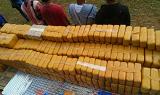

These photos were taken on September 19th 2025, in Maw Ner Plaw area, Lu Pleh Township, Hpa-an District. These photos show KNPF officers destroying at least 6.1 million yaba pills, seen in both photos, packed in yellow wrapping, seized in the first nine months of 2025 in Hpa-an District. The burning is part of the KNPF’s effort to demonstrate to observers that they are not involved in drug trafficking. [Photos: Local villager]
Footnotes:
[1] The terms Burma military, Burma Army, SAC, Tatmadaw, and junta are used interchangeably throughout this report to describe Burma’s armed forces. Villagers themselves commonly use Burma Army, Burmese soldiers, or alternatively the name adopted by the Burma military regime at the time. In the aftermath of the February 1st 2021 military coup, Senior General Min Aung Hlaing established the State Administration Council (SAC) as the executive governing body. The military junta changed its name on July 31st 2025 to State Security and Peace Commission (SSPC).
[2] In 1989, the then-ruling military regime changed the name of the country from Burma to Myanmar without consultation from the people. KHRG prefers the use of Burma because it is more typically used by villagers, and since the name change to Myanmar is reflective of the military regime’s longstanding abuse of power.
[3] Yaba, which means ‘crazy medicine’ in Thai, is a drug containing a mixture of methamphetamine and caffeine in a tablet form, that produces a rapid and powerful rush of euphoria, and increased alertness and energy. See: UNODC, “Yaba, the 'crazy medicine' of East Asia”, May 2008; KHRG, “Chapter IV”, in Truce or Transition? Trends in human rights abuse and local response in Southeast Myanmar since the 2012 ceasefire, June 2014.
[4] Karen State, defined locally, includes the following areas: Kayin State, Tanintharyi Region and parts of Mon State and Bago Region. Karen State, located in Southeastern Burma, is primarily inhabited by ethnic Karen people. Most of the Karen population resides in the largely rural areas of Southeast Burma, living alongside other ethnic groups, including Bamar, Shan, Mon and Pa’O.
[5] Transnational Institute (TNI), “Poppy Farmers Under Pressure: Causes and Consequences of the Opium Decline in Myanmar”, December 2021.
[6] Following independence in 1948, armed struggle erupted in Burma, as several ethnic minority movements across the country took up arms to defend communities against violent attacks from the Burma Army, and called for ethnic rights and more political autonomy. Burma Army offensives included attacks on whole civilian areas.
[7] See: TNI, “Poppy Farmers Under Pressure”, December 2021.
[8] Meehan, P., “Drugs, insurgency and state-building in Burma: Why the drugs trade is central to Burma's changing political order”, Journal of Southeast Asian Studies, 42(3), October 2011, p. 396; KHRG, “Consolidation of Control: The SPDC and the DKBA in Pa'an District”, September 2002.
[9] ‘U’ is a Burmese title used for elder men, used before their name.
[10] The Karen National Union (KNU) is the main Karen political organisation. It was established in 1947 and has been in conflict with the government since 1949. The KNU wields power across large areas of Southeast Myanmar and has been calling for the creation of a democratic federal system since 1976. Although it signed the Nationwide Ceasefire Agreement (NCA) in 2015, following the 2021 coup staged by Burma Army leaders, the KNU officially stated that the NCA has become void.
[11] The Democratic Karen Buddhist Army (DKBA) was originally formed in 1994 as a breakaway group from the KNLA. Since its separation from the KNLA in 1994, it was known to frequently cooperate with and support the Tatmadaw in its conflict with the KNLA. The original group underwent major change in 2010 as the majority of the original DKBA was transformed into the BGF, which is under the control of the Burma/Myanmar government. Following this major change in 2010, the original DKBA is considered to no longer exist as a distinct entity as it has now been submerged within the BGF.
[12] KHRG, “Consolidation of Control: The SPDC and the DKBA in Pa'an District”, September 2002.
[13] Ibid; KHRG, “Hpa-an Photo Set: BGF production and sale of yaba in T’Nay Hsah and Ta Kreh townships”, July 2013.
[14] The KNU/KNLA-PC is an armed group based in the Htoh Kaw Koh village tract area, Hpa-an District. It split from the Karen National Union (KNU) and signed a ceasefire agreement with the Myanmar government in 2007, but refused to transform into a Border Guard Force (BGF) in 2010. It signed the Nationwide Ceasefire Agreement in October 2015 (and are still part of it after the 2021 coup). They currently operate in Hpa-an and Dooplaya districts.
[15] The Democratic Karen Benevolent Army (DKBA Benevolent) was formed in 2010 as a breakaway group following the transformation of the majority of the original Democratic Karen Buddhist Army (1994–2010) into BGFs. This group was originally called the Democratic Karen Buddhist Army until it changed its name in April 2012 in order to reflect its secularity. The DKBA (Benevolent) has signed both the preliminary and nationwide ceasefire agreements with the Burma government, whereas the DKBA (Buddhist) has not signed either agreement.
[16] The Democratic Karen Buddhist Army (DKBA) was re-formed on January 16th 2016 as a splinter group from the Democratic Karen Benevolent Army (2010–present), and is also referred to as Na Ma Kya (‘Deaf Ear’).
[17] Border Guard Force (BGF) battalions of the Tatmadaw (Burma Army) were established in 2010, and they are composed mostly of soldiers from former non-state armed groups, such as older constellations of the DKBA, which formalised ceasefire agreements with the Burma government and agreed to transform into battalions within the Tatmadaw.
[18] KHRG, Truce or Transition?, above, May 2014.
[19] On October 15th 2015, after a negotiation process marred with controversy over the non-inclusion of several ethnic armed groups, a Nationwide Ceasefire Agreement (NCA) was signed between the Burma/Myanmar government and eight of the fifteen ethnic armed groups originally invited to the negotiation table, including the Karen National Union. It was followed by the adoption of a Code of Conduct by the signatories in November 2015. In February 2018, two additional armed ethnic groups signed the NCA under pressure from the Burma/Myanmar government.
[20] KHRG, Truce or Transition?, above.
[21] Ibid.
[22] The Republic of the Union of Myanmar, “The Law Amending the Narcotic Drugs and Psychotropic Substances Law”, February 2018.
[23] Myanmar Police Force (MPF) and Central Committee for Drug Abuse Control (CCDAC), “National Drug Control Policy”, February 2018.
[24] TNI, “Will Myanmar complete its transition towards an evidence-based approach to drug control?”, March 2018.
[25] KNU Drug Prevention Special Act (1/2014) [on file]
[26] DVB, “Karen armed groups united to combat illicit drugs”, July 2014.
[27] KHRG, Resilience and Resistance : Challenges and threats faced by Human Rights Defenders (HRDs) in Southeast Burma since the 2021 coup, September 2024.
[28] KHRG, Undeniable: War crimes, crimes against humanity and 30 years of villagers’ testimonies in rural Southeast Burma, December 2022; KHRG, In the Dark - The crime of enforced disappearance and its impacts on the rural communities of Southeast Burma since the 2021 coup, November 2023.
[29] KHRG, ကဘီယူၤဟဲလံ Aircraft coming!: Impacts of air strikes on local communities and villagers’ protection strategies in Southeast Burma since the 2021 coup, November 2024;
[30] Ibid; KHRG, Stolen Childhoods: Violations of children’s rights, urgent needs, and local agency in rural Southeast Burma during the conflict, October 2025; OHCHR, “Situation of human rights of Rohingya Muslims and other minorities in Myanmar”, August 2025.
[31] UNODC, “Myanmar remains the world’s leading source of opium and heroin”, December 2024.
[32] See, for instance: KHRG, “Hpa-an District Situation Update: Extortion of villagers by the BGF, increased gambling, and teenage drug abuse in Ta Kreh Township (August to October 2023)”, April 2024; KHRG, “Dooplaya District Situation Update: SAC shelling and fighting causing casualties, destruction, and displacement; healthcare and livelihood challenges; land confiscation; and drug issues in Noh T’Kaw and Kruh Tuh Townships (November 2023 to February 2024).”, February 2025.
[33] These unpublished field reports are based on information from Jan-Nov 2025, provided by community members in Kler Lwee Htoo, Mu Traw, Mergui-Tavoy, Dooplaya and Hpa-an Districts trained by KHRG to monitor human rights conditions in their communities. The names of the interviewees, including victims and their exact locations, are censored for security reasons. The parts in square brackets are explanations added by KHRG.
[34] As armed groups are actively involved in the sale and trafficking of drugs in Southeast Burma, investigating and documenting trafficking linkages presents severe security risks for KHRG field staff. This report focuses on the concerns and views raised on drug use as presented by local villagers and does not explicitly explore the sources of drug-trafficking in communities.
[35] The Karen National Police Force, established in 1991, is the law enforcement agency of the Karen National Union.
[36] ‘Naw’ is a S’gaw Karen female honorific title used before a person’s name.
[37] DARE Network is a grassroots NGO that provides culturally appropriate non-medical treatment and prevention education to reduce substance abuse within the communities of displaced ethnic people along the Thai-Burma border. The organisation runs the only treatment clinic available for drug users in Southeast Burma, located in Hpa-an District.
[38] See also: KHRG, Stolen Childhoods, above.
[39] ‘Saw’ is a S’gaw Karen male honorific title used before a person’s name.
[40] A village tract is an administrative unit of between five and 20 villages in a local area, often centred on a large village.
[41] Past reports documented by KHRG also mention the use of drugs to cope with Burma Amy’s forced labour, with drugs being given by Burma Army soldiers.
[42] See: KHRG, Defying Hunger : State Administration Council (SAC)’s systematic destruction of civilian livelihoods and food systems in Southeast Burma (January - December 2024), May 2025.
[43] The Karen National Liberation Army is the armed (KNLA) wing of the Karen National Union (KNU).
[44] See: KHRG, Stolen Childhoods, above.
[45] See: KHRG, Stolen Childhoods, above; KHRG, Neglected Suffering : Sexual violence and barriers to justice faced by villagers in Southeast Burma since the 2021 coup, December 2024, p. 10
[46] KHRG, “Dooplaya District Situation Update: SAC air strikes, education challenges, drug issues, and military activities in Noh T’Kaw and Kruh Tuh townships (January to June 2025).”, November 2025.
[47] ‘Ar Wer’ is a term coined by DKBA, BGF, and KPC and used to describe special days, hence the expression ‘Ar Wer Day.’ Ar Wer day events typically involve celebrations to mark a special occasion, such as the building of a new pagoda or to honour these armed groups, primarily celebrated to serve as a main fundraising activity for armed groups. Sometimes people also engage in illicit activities such as gambling and drug use on Ar Wer days.
[48] See also: KHRG, Stolen Childhoods, above, pp. 85.
[49] KHRG, Stolen Childhoods, p. 85
[50] Thomson, N. and Meehan, P., “Understanding the drugs policy landscape in Myanmar How drugs policies and programmes intersect with conflict, peace, health and development”, Drugs & (dis)order, Global Challenges Research Fund, 2021.
[51] TNI, “Will Myanmar complete its transition towards an evidence-based approach to drug control?”, March 2018.
[52] KHRG, Mergui-Tavoy District Short Update: SAC soldiers arbitrarily detained and tortured a villager at a checkpoint in Ler K’Saw Township (November 2023), Jan 2025
[53] KNU Drug Law 2014, Article 19.
[54] KNU Drug Law 2014, Articles 17 and 19.
[55] UN Special Rapporteur on the Right of Everyone to the Enjoyment of the Highest Attainable Standard of Physical and Mental Health, “Right of everyone to the enjoyment of the highest attainable standard of physical and mental health”, A/65/255, August 2010.
[56] The UN drug control regime is based on three UN Conventions: the 1961 Single Convention on Narcotic Drugs, the 1971 Convention on Psychotropic Substances, and the 1988 Convention against Illicit Traffic.
[57] UN Single Convention on Narcotic Drugs (1961), Article 38; UN Convention against Illicit Traffic (1988), Art. 3
[58] Universal Declaration of Human Rights (UDHR), Art. 25(1); International Covenant on Economic, Social and Cultural Rights (ICESCR), Art. 12; Convention on the Rights of the Child (CRC), Art. 24
[59] ICESCR, Art. 12.
[60] WHO codifies substance abuse and addiction in the ICD-11, the global standard for diagnostic health information: icd.who.int/en/
[61] UN Special Rapporteur, A/65/255, above, August 2010.
[62] OHCHR, UNAIDS, UNDP, and WHO, “International Guidelines on Human Rights and Drug Policy”, March 2019, p.8.
[63] Ibid, p.8.
[64] UN Office on Drugs and Crime (UNOCD), “From coercion to cohesion. Treating drug dependence through health care, not punishment”, October 2009.