
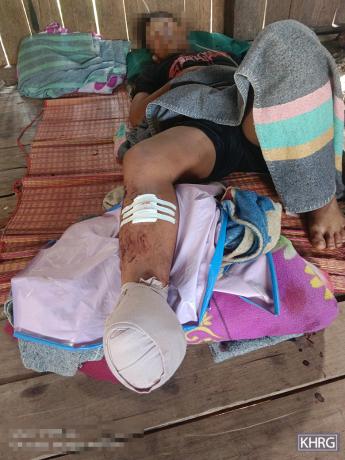
On 24 October 2025, a villager named Saw A---, 17 years old, from Ac--- village, Ler Mu Plaw village tract, Lu Thaw Township, Mu Traw (Hpapun) District, stepped on a landmine on a village road when he was foraging for food. His friends sent him to the Ad---clinic where his right foot was amputated. The photo shows his right leg following the amputation. [Photo: KHRG]
Burma Army shelling caused displacement and difficulties for villagers’ livelihoods
Situations of fighting and conflict escalated because Burma Army[2] soldiers increased their military operations near their army camps and frequently fired shells into villages that were located close their army camps. Shells exploded inside villages, in areas where villagers dwelled, and in villagers’ plantation areas. Thus, villagers who lived close to the Burma Army military camps experienced difficulties to travel. Moreover, villagers felt fear to work on their farms and plantation fields to support their livelihoods. In addition, villagers no longer dared to live nor sleep within their villages. Thus, they displaced themselves into forests. Most displaced villagers were from Saw Muh Plaw village tract,[3] Hpla Hkoh village tract, and Yeh Mu Plaw village tract, Lu Thaw Township, Mu Traw (Hpapun) District, because these three village tracts are located close to army camps of the Burma Army.
Burma Army air strikes and air reconnaissance intensified villager’s challenges
In February 2026, an aircraft of the Burma Army launched two air strikes into Aa--- village, Yeh Mu Plaw village tract. The first air strike happened on 23 February 2026. However, no villagers sustained injuries. The Burma Army conducted the second air strike on 27 February 2026, at 4:50 pm, and the bomb landed on the Ab--- primary school, which is administered by the Karen Education and Culture Department (KECD).[4] On the same day, after the air strike, the Burma Army conducted air reconnaissance with two drones from 5 pm to 7 pm, intensifying villagers’ fear to travel and work inside their villages. Thus, villagers displaced themselves into forests, to rescue themselves from life-threatening risks.
Villagers who were displaced experienced an extreme food shortage because they could not carry much food with them when they were fleeing. Additionally, villagers were afraid to return to their villages to fetch rice from their houses. Thus, some villagers were working really hard to secure enough food. It was extremely hard for some villagers to carry food from place to place and to search for food [while they were in displacement]. When fleeing, some villagers did not have the courage to leave their children [put their children down and make them walk] and carry food [instead], because their children were very young. It was an intense challenge for the villagers to experience.
The Burma Army not only [used aircraft to] conduct air reconnaissance and threaten the villagers, but they also dropped rations for their army camps. The Burma Army increased their military activities, and it was unknown what else [what types of military activities] they would increase in the future. Air reconnaissance intensified the fears of villagers who were living close to army camps of the Burma Army.
Bad weather, [such as] an unseasonal rain, was an additional difficulty for villagers when they displaced in forests. Regarding healthcare, villagers got illnesses and fevers due to the wetness from the unseasonal rain. It was hard for villagers to access treatment as there was a lack of medicine [in the forest], and the clinics were located far [from the forest].
A villager stepped on a landmine planted by the Burma Army
In Lu Thaw Township, soldiers from the Burma Army military camp, located close to villages, planted landmines on villagers’ roads, which are used for traveling to plantations and transportation. It created security risks for travellers, and it became difficult for villagers to travel. On 24 October 2026, a villager named Saw[5] A---, 17 years old, from Ac--- village, Ler Mu Plaw village tract, Lu Thaw Township, was travelling and foraging for leaves [to eat]. When he arrived at Ag--- mountain range, [Ler Mu Plaw village tract,] he stepped on a landmine, which had been planted by the soldiers of the Burma Army. Due to the landmine explosion, his right leg sustained injuries. After the explosion, his friends sent him to the Ad---clinic, which is located in Ad---village, Noh Yo Hta village tract, Lu Thaw Township. The clinic is administered by the Karen Department of Health and Welfare (KDHW).[6] On 25 October 2025, Saw A--- had his right foot amputated at the Ad--- clinic. Saw A--- stepped on a landmine because the soldiers of the Burma Army planted landmines on villagers’ roads, which are located close villages, and which are used for transportation. Whenever villagers travelled, they had to travel with people who take security [people who knew the area’s security situation]. It became an obstacle when emergency traveling was required.
Natural disaster caused challenges for villagers’ livelihoods
Villagers from Lu Thaw Township encountered various types of difficulties from September 2025 to February 2026. Among the various difficulties, the [shortage of] rice was the most pressing difficulty for villagers. In 2025, flooding damaged paddies; in addition, insects descended [on the crop], causing lower rice production for the villagers. Due to the decline in rice production, and rice insufficiency, almost every household had to purchase rice [that they did not have to purchase before]. The demand for rice supply increased and it caused the price of rice to increase. Additionally, villagers who had adequate amounts of rice for their family sold their extra rice at a very high price. For the villagers who had insufficient amounts of rice, they could not purchase rice, and they did not have enough food to eat.
In addition, villagers from the three village tracts, Yeh Mu Plaw village tract, Plah Hkoh village tract, and Saw Muh Plaw village tract, Lu Thaw Township, were displaced. During the displacement, they faced difficulties to work [to support their livelihoods], and to access safe shelters. They were living in constant fear.
In February 2026, Karen National Liberation Army (KNLA)[7] soldiers did military activities and conquered army camps of the Burma Army which were located inside the village tracts. Thus, villagers who lived near those village tracts were living with fear while working, farming, and hill farming to support their livelihoods.
Currently [as of March 2026], almost every villager, especially from Ae--- village and Af--- village, Yeh Mu Plaw village tract, and villagers who lived near army camps of the Burma Army, no longer dared to work in farming and hill farming, and it became a big problem for the villagers. The villagers not only faced difficulties to work to support their livelihoods but also that they were forced to displace and hide in forests, because they did not dare to live in their villages. The difficulties that villagers faced were not only due to lack of work but also due to unseasonal rain. When villagers were displaced, they faced one of their biggest problems due to the unseasonal rain: the wetness.
Villagers faced challenges with shortages of medicine
Common illnesses are malaria, diarrhoea, fever and running nose, coughing, acid reflux, postpartum disorders, and season flu. Normally, people who had those diseases could go to any clinic where they wanted to receive treatment. However, there were shortages of medicine in the clinics; thus, the sick patients bought medicines from pharmacies by themselves.
[This was] because the KDHW distributes medicine supplies a maximum of two times per year. Thus, receiving the distribution once in a year was not enough for everyone who was going to the clinics. The nurses from the clinics gave medicine to patients based on the amount of medicine received by the clinics. The nurses prescribed medicine by name to patients if the medicines were purchasable at pharmacies. It became difficult for villagers who could not afford to purchase medicines.
Burma Army aircraft and [unseasonal] weather troubled local students’ studies
Students from Lu Thaw Township encountered difficulties accessing education. From December 2025 to February 2026, within the three months, almost all schools were closed, because the Burma Army was conducting air reconnaissance to threaten villagers, and there was no safety or security for students to study inside the schools’ buildings. Therefore, students were unable to study inside schools’ buildings. So, villagers had built study places in safe forests. Currently [as of February 2026], students were studying and taking exams in forests.
In addition, sometimes unseasonal rain caused difficulties for students and teachers to study. Schools moving to forests also caused difficulties in transporting schools’ supplies like books, pencils, pens, and blackboards. Although students were studying in forest, they still lived in fear and stayed alert whenever they heard aircraft doing air reconnaissance.
Due to the various difficulties, there were no Kaw Thoo Lei[8] government final exams for Grade 9 students of the 2025 to 2026 academic year; there were final exams only for Grade 12. The additional difficulties for schools were that there was an extreme reduction in support for the teachers. Within a year, teachers only received 9,500 Thai baht (287.01 USD[9]), and the amount was insufficient for the teachers to purchase their basic needs. This [insufficient salary] worried villagers that it would lower the motivations of teachers to teach in the future.
Conclusion
This Situation Update reports situations from Lu Thaw Township, Mu Traw District. The situation of villagers’ livelihoods, displacement increasing, difficulties accessing education, healthcare challenges, the Burma Army setting up [checkpoints] on roads, the Burma Army’s military activities, [including] shelling, landmines, and air strikes are written in this report.
Further background reading on the situation in Mu Traw (Hpapun) District in Southeast Burma/Myanmar can be found in the following KHRG reports: