
 ,
, 
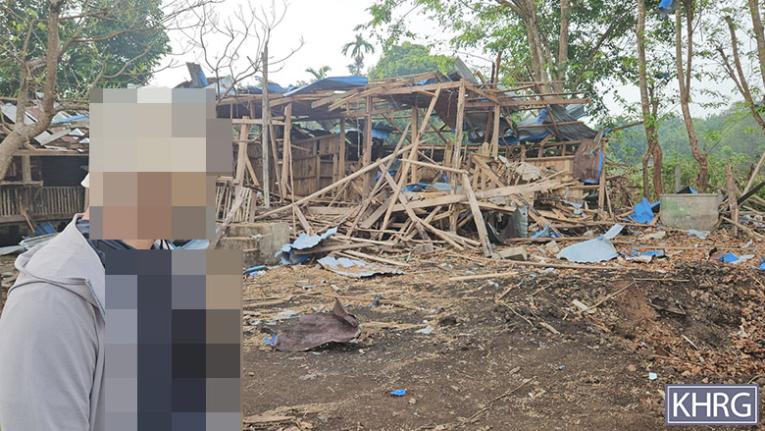
These two photos were taken on February 9th 2025, in Ab--- village, Khaw Hpoh Pleh village tract, Bilin Township, Doo Tha Htoo District. On February 9th 2025, a SAC fighter jet dropped two 500-pound bombs inside Ab--- village’s monastery compound, injuring two monks and damaging the monastery buildings as well as many villagers’ houses. These two photos show damage caused by the SAC’s air strike on the monastery buildings. [Photos: KHRG ]
Since the 2021 coup[1], and following the subsequent escalation of armed conflict, villages have become unsafe across Southeast Burma(/Myanmar)[2] due to the State Administration Council (SAC)[3]’s targeted and indiscriminate attacks. By bombing, shelling, and burning villages, the SAC is also destroying community buildings and endangering community life. Community buildings, including monasteries, churches, schools, and clinics, are used by many villagers to worship, participate in social and cultural activities, study, and receive medical treatment. They are important for community members given their role at the centre of the social lives of villagers. Similarly, cultural events are created by villagers to celebrate their culture and community together. SAC attacks on community buildings and ceremonies have continued in 2025 in locally-defined Karen State[4], limiting villagers’ ability to practice religion and culture, access medical care, and access education. This is in flagrant violation of their human rights, as well as international humanitarian law.
This briefing paper presents evidence reported by villagers and incidents documented by KHRG that took place during January to June 2025, highlighting the challenges that the destruction of community buildings by the SAC posed to villagers’ access to religious practices, cultural celebrations, schooling, and medical treatment throughout locally-defined Karen State. The first section provides a brief overview of the situation of human rights in Southeast Burma, past and present. The second section presents testimonies of SAC attacks on community buildings and cultural events in Southeast Burma during the first half of 2025, as well as the impacts of these attacks on villagers. The last section highlights the legal implications of such attacks, and, finally, the paper provides a set of recommendations for local and international stakeholders.
2. Contextual Overview: attacking villages and community buildings; a decades-old practice for the Burma Army
The Burma Army[5] has systematically attacked villagers and destroyed their communities across Southeast Burma ever since the Karen National Union (KNU)[6] and its armed wing, the Karen National Liberation Army (KNLA)[7] took to arms to push for political autonomy in 1948. This targeting of villagers has been embodied in the Burma Army ‘four cuts’ (‘pyat lay pyat’) counter-insurgency approach. This is a scorched-earth strategy that aimed to destroy the funding, supplies, recruits, and intelligence of insurgents. Under this approach, the Burma Army viewed villagers in Karen State as synonymous with soldiers and targets for military attack and destruction.
For decades, Burma Army soldiers operating in ‘black areas’[8] torched and shelled villages indiscriminately, shot villagers on sight, arbitrarily disappeared villagers, took others as porters and human shields, perpetrated widespread sexual violence, and forcibly relocated entire communities, alongside a litany of other human rights abuses amounting to war crimes and crimes against humanity.[9]
The 2012 bilateral ceasefire between the KNU and the Burma Army, and the subsequent 2015 National Ceasefire Agreement (NCA)[10], allowed for a partial return of some communities to their homes. However, the Burma Army also expanded their presence in certain areas during this period, leading to heightened tensions between villagers and Burma Army soldiers.[11] During that period, local elites and outside businesses pushed for the introduction of several small and large-scale environmentally exploitative developmental projects across Southeast Burma. Meanwhile, hostile policy from the central Burma government enabled the further expropriation of villagers’ small-scale landholdings.[12] Across most areas of Southeast Burma, Burma Army soldiers continued to commit human rights abuses against villagers.
The truce during this period fell apart in the aftermath of the February 1st 2021 seizure of power by Burma Army leaders from the National League for Democracy (NLD)[13]. First elected in 2015, the NLD had won a landslide victory in the November 2020 national elections. Since February 2021, the Burma Army, under the command of the State Administration Council (SAC), has responded to country-wide resistance by increasing its attacks on civilians. As a result, the SAC has committed a wide number of human rights violations. These have included but are not limited to the repeated torching of villages; the torture and murder of imprisoned activists and human rights defenders; rape and sexual assault, including against children; and the extensive use of civilians as human shields.[14]
In Southeast Burma, the SAC’s reinvigoration of the ‘four cuts’ strategy following February 2021 has seen a dramatic increase in the use of air strikes to target villagers and their community buildings.[15] During this most recent period, community buildings (such as monasteries, churches, schools and clinics) have served as centres for community while also being used to shelter and support civilians fleeing conflict.[16] SAC attacks have both undermined these foundational community structures, while also having an outsized impact on many of the villagers worst affected by conflict.[17]
From January 2021 to June 2024, KHRG documented that the SAC conducted at least 203 air strikes on villages in locally-defined Karen State, damaging at least 89 community buildings.[18] Similarly, the Karen Peace Support Network (KPSN) reported that, during February 2021 to November 2024, Burma Army air strikes and shelling across Southeast Burma destroyed 22 schools, 21 hospitals/clinics, 23 churches, and 31 monasteries.[19] Other organisations also reported further attacks which damaged or destroyed hundreds of hospitals, clinics and schools across Burma.[20] All of those numbers likely undercount the actual number and impact of attacks.
In 2025, the SAC’s ongoing attacks on civilians in Burma have been punctuated by the destruction wrought by the March 28th 2025 Sagaing Fault earthquake and the SAC’s (unimplemented) unilateral ceasefire declarations, which followed shortly afterwards.[21] These events have done little to slow the SAC’s attacks on village community buildings and cultural spaces in Southeast Burma.
3. Factual Summary: SAC attacks on villages across Southeast Burma leaving community buildings in ruins
In 2025, attacks on community buildings in Southeast Burma have continued as the SAC has destroyed numerous monasteries, churches, schools and clinics. They have done so using both direct and indiscriminate methods including air strikes, shelling, drone attacks, and arson attacks. SAC attacks on community buildings and ceremonies in locally-defined Karen State have caused multiple civilian casualties, destroyed sites of cultural heritage, and disrupted communities’ capacity to support themselves. Religious practitioners are in fear of practicing their religions, teachers and students are afraid of going to school, patients are unable to access clinics, and villagers are unable to celebrate traditions amongst themselves.
From January to June 2025, KHRG received 55 reports from all seven Districts in Karen State[22] containing evidence of impacts on community buildings. These included 47 attacks by the SAC that destroyed 23 monastery buildings, one church, eight school buildings, and two clinics; and damaged 26 monastery buildings, four church buildings, 16 school buildings, and four clinic buildings. Such SAC attacks on community buildings during the first half of 2025 included 40 air and drone strikes. A further three SAC attacks involved artillery shelling in conjunction with air and drone strikes. One documented instance involved an SAC-perpetrated arson attack on community buildings. Three documented SAC attacks on community buildings and cultural events involved shelling alone.
Such SAC attacks on community buildings in 2025, reported to KHRG, killed at least 16 villagers who were in or nearby community buildings and celebrations, including two women and two children; and injured 70 villagers in or nearby community buildings and celebrations, including at least three women and seven children. The attacks also killed three religious practitioners and one healthcare worker, and injured six religious practitioners.
This factual summary presents evidence of the SAC’s attacks on community buildings from January to June 2025, and the impacts caused by such incidents. Firstly, it discusses the impacts of SAC attacks on religious buildings and cultural events (3.1), including the destruction of cultural heritage and disruption of cultural practices, death and injury of religious practitioners, and the instilling of fear to practice culture. It also summarises evidence of SAC attacks that destroyed and damaged schools (3.2.). These attacks on schools injured children, forced students to stop studying, and obstructed their access to education. Thirdly, SAC attacks on medical clinics (3.3.) denied villagers’ access to medical care and prevented villagers from seeking treatment out of fear. Finally, this chapter discusses agency strategies used by villagers to avoid harm including sleeping outside of their villages, studying in makeshift schools built hidden in the forest, and transporting victims to nearby functioning clinics.
3.1. Impacts of SAC attacks on places of worship
As reported to KHRG, SAC attacks during the first half of 2025 have destroyed at least 23 monastery buildings and one church, and further damaged 26 other monastery buildings and four church buildings. SAC attacks on religious buildings have caused death and injury of religious leaders: from January to June 2025, at least three religious practitioners were killed and six others were injured in attacks on religious buildings. The SAC carried out at least 20 air and drone strikes on religious buildings and at least four attacks involving shelling on monasteries and churches.
Monasteries in Southeast Burma are often built on the top of a hill and include visible pagodas, and churches have clear religious markings on them, making them easy to identify. Villagers struggled to understand exactly why the SAC repeatedly attacked those religious buildings. They condemned such actions and stated that SAC attacks on these buildings have prevented them from accessing spaces central to their religious and cultural practices and have left them living in fear.
a) Destruction of shrines and cultural property
The SAC’s attacks on religious buildings have resulted in the destruction of cultural properties and the injury and deaths of civilians. In one instance, on February 9th 2025, at 12:47 pm, SAC fighter jets dropped two 500-pound bombs into Ab--- village, Khaw Hpoh Pleh (Min Saw) village tract[23], Bilin Township, Doo Tha Htoo (Thaton) District. The bombs landed inside a monastery compound, damaging the monastery’s main three buildings, as well as other three buildings on the monastery grounds. The attack on the religious buildings injured two monks, one on his heel and the other on his abdomen. Both of the monks received urgent first aid treatment at the same monastery from a local healthcare worker. The attack also severely damaged five houses in the village. Another 43 houses were also hit by shrapnel on their roofs and walls and many plantation fields were damaged. SAC fighter jets often dropped bombs into Ab--- village, thus, villagers had already fled to the mountains and river sources for shelter.[24]
In another instance that took place during January 27th – 28th 2025, the SAC conducted two air strikes with a fighter jet in Yz--- village, Nyaung Pin Gyi village tract, Hsaw Htee Township, Kler Lwee Htoo (Nyaunglebin) District. On January 27th 2025, SAC aircraft dropped bombs that damaged several villagers’ houses and caused minor damage to a monastery. The following day, on January 28th 2025, SAC aircraft bombed the same village again, destroying the roof, walls, and floor of two monasteries. A monk named U[25] M--- from Yz--- village, explained: “They [SAC] use aircraft for attacking and destroying [all things]. They attacked two times. The second attack happened on [January] 28th [2025]. The first attacks damaged a dormitory [of the monastery]. The second attack, on [January] 28th [2025], at 1:40 am, destroyed more things [monastery buildings].” The monk also added: “There were seven buildings [in the monastery area]. Only a few buildings can be repaired. All seven buildings were damaged. It has led to us being unable to continue our religious practices and activities. I felt very sad. I am always praying to be able to repair the monastery”[26]
b) Obstruction of religious practices
SAC attacks on religious buildings threaten both the physical safety of religious practitioners and villagers alike, while also posing significant barriers to villagers’ ability to practice religion. Due to the methods employed during the attacks, many villagers believe the SAC destruction of religious buildings was intentional.
For instance, on January 21st 2025, SAC Light Infantry Battalion (LIB)[27] #20, based in Zy--- village, Ain Wine village tract, Hsaw Htee (Shwegyin) Township, Kler Lwee Htoo District, released a drone and dropped a bomb on a monastery in Yh--- village, Ain Wine village tract. The attack damaged the monastery and killed a monk named E---. It also injured another monk named Saw[28] H--- on his left thigh.
On April 6th 2025, SAC ground soldiers entered Pb--- village, in P’Shar Loh village tract, Daw Hpah Hkoh (Thandaunggyi) Township, Taw Oo (Toungoo) District, and burned down four villagers’ houses and five religious buildings used by Christian nuns, including four dormitory buildings, and one rice barn. The four religious buildings and the rice barn that were burned down were all located on a religious campus. The property was marked as a religious campus with a large statue of the Virgin Mary and several buildings with large crosses on them. Saw D---, a villager from Pb--- village, explained to KHRG: “I am not sure why they [SAC] burned them down [the houses and religious buildings]. In my point of view, they burned down these buildings when they were conducting ‘clearance operations’. There was no fighting happening [at that time]. They closed the road when they burned the houses.”[29]
On the date of the incident, there were no villagers in Pb--- village. Over the three years prior to the attack, the villagers had repeatedly temporarily fled from the village. Some villagers had fled to their huts, while others fled to the town, to the houses of their relatives, or into the jungle. The nuns had previously stayed in the dormitory houses. After the SAC burned them down, it became very difficult for the nuns to return to the religious campus and to practice their religion because they no longer had places to stay. The destruction of their rice barn also left the nuns with little food to support themselves.
c) Disruption of cultural events causing fear and death
Villagers also reported SAC attacks on cultural celebrations taking place in villages, increasing villagers fear of holding open-air events. In early 2025, KHRG received three reports regarding SAC attacks on cultural practices and ceremonies. During those incidents, SAC fighter jets dropped bombs on village areas where people were celebrating important Karen cultural events outdoors, like the Karen New Year[30] festivities or Karen Wrist Tying[31] ceremonies. The attacks left villagers in fear and made them uncertain about holding future cultural ceremonies.
On January 7th 2025, at 11:30 am, the SAC conducted an air strike onto Yp--- village, in Paw Hkloh area, K’Ser Doh Township, Mergui-Tavoy District. This air strike happened only a few days after the celebration of Karen New Year in the village, on a part of the village where many people had gathered to join the festivities. Due to the air strike, two villagers were severely injured. They were sent to a military clinic and later transferred to a hospital in Thailand. This air strike also damaged one house, a motorcycle, and several plantations. Since the SAC conducted the air strike without any fighting happening in the area, some villagers were afraid and unsure if they should celebrate the Karen New Year during the coming year or not.[32]
Another incident occurred on May 25th 2025, at 9 am, when an SAC fighter jet dropped four 100-pound bombs on a wedding ceremony in Py--- village, Kyoe Gyi village tract, Ler Doh (Kyaukkyi) Township, Kler Lwee Htoo District, killing 10 people, including the bride and two children, and injuring at least 49 people who were present at the wedding. This air strike also damaged six villagers’ houses. The wedding was held in an open area in Py--- village. A local villager named Saw P—, who is the village treasurer and witnessed the attack, reported to KHRG: “Actually, I welcomed this wedding ceremony. I stayed at the wedding stage [during the incident]. I stayed close to a girl [who was attending the wedding]. That girl was injured on her leg, but I was not. She asked me to help her, and then I held her. When I turned around and looked, many people said, 'Help me, Pa Doh[33]! Help me, Pa Doh!’. Then, I said, 'I will find someone to help. The aircraft is coming again, so there is no one’. When I was going [to get help], I saw people with blown-out intestines. I saw [dead and injured people] everywhere when I went, so I was about to pass out. I am not sure whether the bride and groom were members of the organisation [KNU] and were attacked for that reason. I also do not know if I was personally targeted, since many guests were visiting me sometimes. I heard that the bride’s father is a member of the KNU, but I am not certain whether he is actually working with the KNU or not.”[34] After the air strike, the villagers were afraid and anxious.
3.2. SAC attacks on schools cause destruction and fear, and force students to stop studying
Targeted and indiscriminate attacks conducted by the SAC on schools in Southeast Burma have resulted in a severe disruption of access to education. During January to June 2025, KHRG received 16 reports of attacks on schools committed by the SAC in Southeast Burma: at least eight school buildings were completely destroyed while 18 others sustained damage as a result of air strikes and drone attacks. At least three students and one teacher were injured during such SAC attacks. Most of the SAC attacks on school buildings documented during the reporting period destroyed or damaged schools administered by the Karen Education and Culture Department (KECD)[35].
Before conducting air strikes on schools, a common practice by the SAC has been conducting air reconnaissance using drones over the targeted areas. Schools in Karen State are often easily identifiable, with large, coloured roofs and a big open, vacant space in front to use as a playground. Hence, repeated SAC reconnaissance flights before attacks on these schools suggest that some of the attacks were deliberately targeting these community buildings.
These attacks destroyed and damaged schools; caused significant physical and psychological harm to students, teachers, and parents; led communities to shut down many schools out of fear of further attacks; and led teachers and parents to stop classes for their safety.
a) Destruction of schools keeping students out of class
SAC attacks have resulted in destruction of school buildings and stopped their operations. In one instance, on January 21st 2025, at around 1 am, the SAC dropped two 500-pound bombs on El--- village, Yaw K’Daw village tract, Noh T’Kaw (Kyainseikgyi) Township, Dooplaya District. The bomb landed next to a school (administered by the KECD) in El--- village, damaging the roof, beams and stands of the two school buildings. Another bomb landed outside the village, causing no damage. A teacher named Naw[36] C---, from El--- village, explained: “They might have noted it [the school] for a long time. The aircraft was patrolling [over the area] once every one or two weeks. […] I did not know the type of aircraft. It conducted reconnaissance during the daytime. The sound is ‘Tuuu’ [usually the sound of a drone] … This type of aircraft had never dropped bombs.”[37]
The school principal, Naw G---, also from El--- village, argued: “I did not know exactly [why the SAC attacked the school]. As I heard, they [SAC] had planned to eliminate Kaw Thoo Lei [Karen State]’s schools. So, they [SAC] bombed the schools to destroy them.”[38]
After the air strikes, the schoolteachers and students were afraid, so they moved the classes to the jungle. When studying in the forest, the students struggled to concentrate because they did not have proper shelter, had little access to quiet, private spaces, and got bitten often by insects.
In another instance, on February 13th 2025, at about 4:30 pm, the SAC conducted an air strike onto a primary school (administered by the KECD) in Th--- village, Kyauk Pyal village tract, Kyeh Htoh (Kyaikto) Township, Doo Tha Htoo District, damaging the school building and a nearby medical clinic (administered by the Karen Department of Health and Welfare (KDHW)[39]). Prior to this air attack, on that same day at about 11:30 am, the SAC had dropped two other 500-pound bombs on the nearby area: the first bomb was dropped onto a People’s Defence Force (PDF)[40] army camp outside of Mt--- village, in Pyin Ka Tol Kone village tract. The second bomb was dropped onto the entrance of a monastery located inside Mt--- village, destroying the pagoda, covered walkways, the shrine, and other monastery buildings. Mt--- villagers told KHRG that, before the air strike happened, an SAC Y-12 aircraft conducted reconnaissance over the area for many days.[41]
On February 7th 2025, the SAC conducted six rounds of air strikes between 2 am and 3:30 am, on Ah Su Chaw village tract and Shwen Law Aye village tract, Bilin Township, Doo Tha Htoo District. One of the bombs landed at the entrance of the KECD-run Bc--- school, damaging both the teachers’ boarding house and the school building. In total, three bombs landed onto Na--- village, Shwen Law Aye village tract, and seven bombs landed onto Bc--- village, Ah Su Chaw village tract.[42] After the attacks, the school buildings could not be used anymore.
b) Injury of students and school personnel
SAC attacks on school areas also injured students and teachers. For instance, on May 29th 2025, in the evening, an SAC fighter jet dropped several bombs in Kt--- village, Thay Baw Boe village tract, Kaw T’Ree (Kawkareik) Township, Dooplaya District. One of the bombs landed and exploded in a school dormitory in the village, injuring three students: Saw F--- (aged 14), Saw I--- (aged 15) and Saw L--- (aged 16). After the incident, local KNLA authorities sent the injured students to a clinic in Pk--- village, Thay Baw Boe village tract, to receive medical treatment. As Saw N---, the school vice-principal from Kt--- school, expressed: “They are my students. I feel very sad about what happened to them. […] After they were injured, they could not study [for a couple weeks].”[43]
In another instance on May 18th 2025, around 11:30 am, an SAC fighter jet dropped two 500-pound bombs in the compound of Tp--- high school in K’lay Wah Mu Htaw village tract, Daw Hpah Hkoh Township, Taw Oo District, when the school was closed on a Sunday. The school is administered by the KECD. Only one bomb exploded. Saw K---, the school principal of Tp--- high school, was hit by a piece of the bombshell on his shoulder. Two villagers’ houses, some trees, and a toilet were also damaged. There were about 20 people (including students, local healthcare workers and teachers) in the school compound when the incident happened, who immediately ran to a stream to find safety. The injured villager sought medical treatment on the same day. The attack left all the students afraid and worried.[44]
c) Disruption of classes due to damage and fear
During January 16th to February 13th 2025, KHRG documented a series of attacks on village schools in Doo Tha Htoo District. On January 16th 2025, at 4:40 pm, an SAC ‘suicide drone’ was dropped onto a school (administered by the KECD) on the outskirts of Ab--- village, Khaw Hpoh Pleh village tract, Bilin Township. The explosion caused significant damage to the school building. Just two minutes later, another drone dropped a bomb on a nearby village, close to the school. Villagers stated that they planned to reopen the school again when the situation gets better. However, as of July 2025, the school remained closed. Villagers in Ab--- village stated that the loss of the school would delay the students’ educational growth.[45]
Saw A---, an Ab--- villager, explained: “The school had been attacked twice already. One was by air strike and the second time was by drone strike. When the first air strike happened [on April 29th 2024], the school was closed for 20 days. After 20 days, [local KNU] leaders and village heads said we could attend the school. So then, we continued to attend the school again. But when [Karen] New Year came, villagers said the aircraft may come to conduct more air strikes, so the school was closed again for 10 days. After this, the village head and teachers in the village said that they dare not, or are not confident enough, to open the school again. They [the students] had just attended school for three or four days, then the drone strike was conducted on the school again. So, the school was closed.” [46]
The ongoing attacks by the SAC have severely disrupted access to education for students in Southeast Burma. Frequent air strikes have created an atmosphere of fear and uncertainty, leading to the closure of many schools. Teachers are afraid to teach, and students are afraid to attend school regularly. In addition, parents are also deeply concerned for their children’s safety, and many have chosen not to send them to school.
On April 23rd 2025, at 8:06 pm, SAC dropped three bombs onto Da--- village, Wa Ka village tract, Kruh Tuh (Kyonedoe) Township, Dooplaya District. Two of the bombs landed on the school campus, close to the teachers’ quarters. One of the bombs exploded and another bomb remained unexploded on the campus. The exploded bomb destroyed the school, the teachers’ quarters, the school toilets, and the school’s water tank, and damaged another two school buildings. Da--- school is under the administration of the SAC.
Villagers from Da--- village told KHRG that they assumed that the SAC was targeting three buildings during this air strike: the teacher’s quarters, in the school campus; a KNU’s office, located in the village; and Da---’s hospital, next to the school. A group of displaced villagers had recently come to stay on the school campus, and so local villagers believed that the SAC might have mistakenly thought they were related to armed resistance forces. Villagers also believed the hospital was targeted because fighting had happened close to the village and the SAC had assumed that the armed resistance forces were being treated at the hospital.
After the attack, fear was widespread. As a parent from Da--- village shared: “We’re too afraid to send our children to school. It’s not safe. Even if we want them to learn, we cannot risk their lives.” A village tract leader [position censored for security], also in Da--- village, stated: “We’re not confident enough to reopen the school this year. Also, our school was destroyed and the buildings on the school campus were damaged as well. We don’t have the budget to repair it. I am still thinking about how to manage the education for the children in the village. We will probably have to ask students to study at other villagers’ houses. If we do not do it like that, our children will have to delay their education […] If any organisation or someone can help us to [provide funds to] repair our school, it will be very beneficial for us. It seems like they [the SAC] are closing the door on our children’s future.”[47]
3.3. Attacks on clinics preventing access to medical care
Attacks on clinics and hospitals by the SAC have caused ongoing challenges for villagers seeking to access medical care. From January to June 2025, SAC attacks on clinics included air strikes, drone strikes. At least two medical buildings were completely destroyed and four other were damaged by SAC air strikes or drone attacks, as reported by villagers to KHRG.
Due to these SAC attacks, local villagers are afraid to live in villages where clinics and hospitals are located. These attacks have also directly undermined the ability of villagers to access essential medical services. Poor access to medical services has left many to travel long distances in order to reach functional medical services, and severely endangered their lives.[48]
a) Destruction of clinics and hospitals
In one instance, on May 4th 2025, a hospital from Hp--- village, Hah T’Reh village tract, Hpa-an Township, Doo Tha Htoo District, was destroyed by an SAC air strike. After the SAC conducted an air strike on Hp--- hospital, villagers were unable to access healthcare in the village. This hospital was administered by the KDHW. Saw T---, a villager from Hp--- village, explained: “At midnight, an SAC aircraft conducted an air strike onto Hp--- village. The bomb landed on the hospital and the hospital was damaged. Actually, it was not [only] damaged, but the whole hospital was completely destroyed by the bomb explosion.”[49] The villagers and healthcare workers had temporarily fled before the incident, as they had been warned by local KNU authorities about a possible SAC attack. As a result, no one was injured.
Repeated attacks on clinics mean that medical buildings are often closed, under-staffed, or hidden. As a result, injured villagers must travel further to access care. Delayed treatment worsens medical conditions, and trust in healthcare is eroded as people stop feeling safe enough to seek help. If they do travel, they often have to pass through active conflict zones, flooded roads, and heavily militarised checkpoints. This exposes already vulnerable people to further danger and delays in access to urgent care.[50]
As explained by Saw S---, a local villager from Lk--- village, Sa Tein village tract, Ler K’Saw Township, Mergui-Tavoy District: “It’s a big challenge. There is no medical care in the village anymore [as of April 2025]. People have to go far away to other areas to find a clinic [to seek out medical care]. The roads are often flooded and muddy in the rainy season. There are so many checkpoints, and people are interrogated all along the way” [51]
b) Fear to access medical facilities
The SAC targeting of clinics has made health workers fear for their lives, resulting in the suspension or complete shutdown of vital medical services. The risk of being caught in an SAC attack has deprived many villagers of access to medicine.
For instance, Tn--- village, in Thoo K’Bee village tract, Ler Doh Township, Kler Lwee Htoo District, had never been attacked by the SAC prior to 2025. However, on March 1st 2025, shortly after a clinic was built in the village with the support of KDHW, an SAC aircraft dropped three bombs onto the village. Two bombs landed in the village and damaged six houses. Another bomb landed in a farm, injuring a villager named Naw J---, on her thigh, while she was handling cows. Two cows were also injured. Villagers told KHRG that PDF soldiers had received treatment at the clinic, so this is likely why the SAC targeted the village.
Naw J---, the injured villager, told KHRG: “In my point of view, they [SAC] might have received information about the clinic being relocated into our village, so the air strikes happened. In the past, the shelling never landed in the vicinity [of the village]. [Before the clinic was relocated,] the clinic was [previously] located in Ye--- village [in Thoo K’Bee village tract], so the drone strikes happened in Ye--- village. […] After that, the clinic was relocated to Tn--- village. […] After the clinic was moved to Tn--- over one month ago, villagers have been afraid. We, villagers, asked each other, ‘Did you hear the clinic is set up there?’. We were afraid that if the Burma Army were attacked at night, injured [armed resistance forces] soldiers would be taken to our clinic, and then they [SAC] might attack us.”[52]
Since clinics may be seen as targets by the SAC, villagers worry that being near a clinic might also make them a target. As a result, they often delay or avoid treatment or refuse to travel to access medical care. Attacks like this also force local health workers to relocate or operate in hiding, leaving fewer or no staff in rural clinics.
3.4. Villagers’ agency against repeated SAC attacks on their communities
Villagers’ agency plays a critical role in ensuring they survive repeated SAC attacks on community buildings. Communities rely on their own networks, leadership, and creativity to ensure continued access to important support that such social infrastructure provide. They maintain this access through, for instance, the relocation of lessons in hidden places and the use of mobile clinics. Villagers also gathered in smaller groups in order to continue celebrating some of their traditions.
a) Temporary displacement to avoid injury from attacks
As villages in Southeast Burma are often attacked by the SAC, villagers sometimes sleep outside of villages, often at their farm huts, so they can rest without worrying about imminent air strikes or shelling at night. By temporarily fleeing their homes only at night, villagers are still able to access their properties and livelihood means in their village during the day. Villagers also temporarily close community buildings during periods when they are concerned that their village may come under attack. By doing this, villagers reduce the risk of being injured by SAC attacks.
For instance, during the morning of January 31st 2025, three SAC ‘suicide drones’, were dropped into Ph--- village, Ta Aoo Hkee village tract, Billin Township, Doo Tha Htoo District, and landed on a monastery. Three other ‘suicide drones’ did not explode but landed in farms near the village. Since SAC drones often targeted schools, parents did not dare to send their children to attend school. As a result, the school was closed at the time of the attack. As villagers were sleeping in huts outside the village at night, the attack did not injure anyone.[53]
b) Studying in makeshift schools, built hidden in the forest
After experiencing repeated attacks on schools since 2021, many communities across Southeast Burma devised creative strategies to continue providing education while protecting students and teachers. Villagers, in coordination with local KNU authorities and administrators, built makeshift school buildings deep in the forest and in caves, hidden from the SAC’s aerial surveillance and military targeting. In areas where constructing a forest school was not possible, students learned in small groups in private homes. Despite this, villages are not completely safe from attacks. Students and educators have been injured and killed while studying in private homes during January – June 2025.[54]
The steps that villagers take to protect students from SAC attacks are embodied in their response to an air strike in Nk--- village, Ma Htaw village tract, Dwe Lo Township, Mu Traw (Hpapun) District. On March 19th 2025, an SAC fighter jet carried out an air strike at 5 am onto a primary school located in Nk--- village. The attack destroyed three school buildings and damaged the school’s items and the roof of the teachers’ quarters. Parents, local education coordinators and local KNU authorities were concerned about the risk of further air strikes, shelling, and drone strikes. Therefore, they built a school in the forest for the students. As a result, the children from Kh---, Nk---, and Tn--- villages, all in Ma Htaw village tract, continued their studies in the forest. However, some children still faced difficulties attending class as they lived far from the new school built in the forest. Villagers from Nk--- village who were afraid of mortar shelling and air strikes dropped out of school.
Children face several challenges in accessing relocated schools, including damaged and poor-quality roads. This problem is exacerbated during rainy season, where poor weather conditions worsen road quality even further and often result in flooding. Mosquito-borne diseases are also reported during that time. As a result, students sometimes cannot attend school. While relocated in the forests, schools still often need to close intermittently to avoid being noticed by SAC air reconnaissance.[55]
c) Local leaders and community organisations transporting victims to clinics
From January to June 2025, in areas where clinics and hospitals had been destroyed or were too dangerous to access due to SAC surveillance and attacks, local village leaders and fellow villagers continued to arrange emergency transportation for patients and victims to medical facilities, towns, or across the border.[56] Likewise, local civil society groups also continued to help arranging transportation for injured villagers.
For instance, during the air strike on Da--- village, Wa Ka village tract, Kruh Tuh Township, mentioned above, one of the bombs landed on the house of a 40-year-old villager named Saw B--- while he was eating dinner at his kitchen. The bomb explosion destroyed his house and left him deaf in his left ear. His face was also severely injured by the explosion. After the injury, a village tract administrator and other villagers took him to a relocated clinic, which had been built in a hidden place, due to the destruction of Da--- hospital caused by the attack. He was hospitalised for around two weeks.[57] Reportedly, on some occasions, local KNU administrators also took on the role of escorts to help navigate dangerous checkpoints in frontline areas and provided protection during journeys.
4. Security and legal analysis: implications of the SAC attacks on community buildings
State Administration Council (SAC) attacks on community buildings and cultural celebrations during the first half of 2025 are a continuation of the previous Burma Army approach to warfare, most prominently embodied in the ‘four cuts’ strategy. Through the implementation of this strategy, they continue to violate the education, welfare, and cultural and spiritual rights of villagers in Southeast Burma. The sheer quantity of SAC attacks on villages, their destructive force, and the variety of methods that the SAC has employed to destroy community areas –air strikes, shelling, drone attacks, and arson attacks– is a demonstration of the disregard that SAC leaders have for civilian life and objects. Community buildings are also easily identifiable by their location, size, and prominent markings denoting them as schools, clinics, and religious buildings, raising doubts that attacks on these are unintentional.
More than buildings, monasteries, churches, schools and clinics are places for villagers in locally-defined Karen State to educate, care for, and practice culture with each other. KHRG’s documentation shows that Burma Army attacks on these social and cultural buildings, as well as on cultural ceremonies, have forced villagers to restrain, or radically reform, their pursuits of these rights. School children either stop their studies completely or continue schooling while facing serious risks to their safety; villagers are left to travel long distances to access basic medical care; friends and communities hesitate to celebrate weddings and other cultural celebrations; and religious devotees abandon their places of practice. As a result of these attacks, these physical centres of communities are now no longer safe.
a) Indiscriminate and targeted attacks:
As the abovementioned evidence shows, SAC’s attacks on community buildings and cultural celebrations in Southeast Burma are both premeditated and targeted, as well as the product of indiscriminate attacks on villages. SAC attacks on community buildings in 2025 have included the frequent use of reconnaissance flights before attacks; arson attacks carried out by ground troops; a significant number of drone and air strikes; as well as shelling attacks. Under customary International Humanitarian Law (IHL), civilian objects can only be considered legitimate targets for attack when, based on the information reasonably available at the time, they are being used for military purposes.[58] In line with this exception, the Burma Army has an obligation to ensure that their attacks do not target civilian objects and do not employ means or methods of warfare that are indiscriminate or cause disproportionate harm to civilians or civilian objects.[59] Indeed, the documentation that KHRG has received of attacks perpetrated by the SAC between January to May 2025 shows that Burma Army attacks are striking civilian objects —including community buildings— without distinction. Further, the SAC’s use of force is consistently disproportionate and clearly violates the principle of precaution, which requires that, in the conduct of military operations, constant care must be taken to spare civilian objects.[60]
b) Protections afforded to community buildings and cultural celebrations:
In addition to this, community buildings are protected under customary IHL and treaty-based International Human Rights Law (IHRL), all of which are applicable to the situation in Burma.
Hospitals and clinics have been protected in some form under international humanitarian law since the 1864 Geneva Convention.[61] Today, customary IHL outlines prohibitions on attacks on medical personnel, units, and, more generally, “zones”. Under customary international humanitarian law, attacks on a medical unit or zone, whether civilian or military, must be respected and protected at all times. This protection ceases only if they are used to commit, outside their humanitarian function, acts harmful to the enemy.[62] There is no evidence that the clinics attacked in Southeast Burma match this exception, and therefore SAC attacks on medical facilities are in violation of customary IHL.
The ongoing threat of Burma Army attacks on hospitals and clinics since the 2021 coup, that has continued in 2025, prevents villagers from seeking out urgent and lifesaving medical care. In this sense, attacks on clinics have long lasting impacts on villagers’ basic rights to medical care and adequate living standards, as enshrined in the formative documents of international human rights law.[63] By destroying hospitals and clinics, the Burma military regime’s violations are turning civilian infrastructure into a battleground. Those who survive are left with no choice but to risk their lives again to access basic medical care.
Similarly, attacks on schools and other educational institutions are prohibited under customary IHL, provided they are not being used for military purposes.[64] More specifically, children affected by conflict are afforded special protection under customary IHL[65] and IHRL, including in the Convention on the Rights of the Child (CRC), to which Burma(/Myanmar) is a signatory. Attacks on schools not only generally violate the child’s right to protection and care during conflict but specifically hinders their ability to enjoy their fundamental right to education.[66] As shown by the evidence presented in this paper, Burma Army attacks violate these rights not only by destroying the student’s place to study, but generally by both forcing schools to repeatedly shut down or relocate and forcing parents to pull their children out of school due to fear of attacks.
Finally, the Convention for the Protection of Cultural Property in the Event of Armed Conflict, ratified by Burma in December 1954, obligates parties to an armed conflict to respect and protect cultural property, including buildings of religious and cultural significance, and to take all feasible measures to prevent their damage or destruction.[67] Customary IHL also prohibits attacks on religious and cultural institutions, unless they are being used for military purposes and thus become military objectives. As well, just like attacks on clinics, the prohibition on the killing or injuring of religious personnel is enshrined in Customary IHL.[68] Customary IHL's prohibition of attacks on civilian populations and against cultural property forbid attacks on civilian celebrations and gatherings.[69]
SAC attacks have a clear impact on the capacity of communities to uphold their own cultural practices. Many of the religious buildings impacted by SAC attacks during this period carry historical and cultural importance to communities. They also operate as places of rest and respite for villagers and as homes for religious practitioners. As with the attacks on other types of community buildings, the right to enjoy the practices embedded in these activities and spaces is laid out in foundational human rights documents.[70] Similarly, cultural events, such as the Karen New Year, weddings, and funerals allow for the collective celebration and embodiment of local culture and history. The SAC’s attacks stand to both disrupt the everyday social and religious lives of villagers and lay to waste heritage sites of intangible importance to rural villagers.
Overall, Burma Army attacks on community buildings during January to June 2025 are in clear violation of customary IHL, absolute jus cogens rules that no parties to a conflict may ever break, and obligations owed to the international community as a whole (erga omnes). This conclusion can be made both through consideration of the nature of these attacks; and by the types of objects that have been damaged/destroyed by these attacks.
5. Recommendations
To international stakeholders, non-governmental organisations (NGOs), international organisations, and regional and foreign governments:
Condemn the SAC’s attacks on community and social infrastructure as flagrant violations of international law, including international human rights law (IHRL) and customary international humanitarian law (IHL). These attacks are not isolated incidents, and severely threaten the fundamental rights, social fabric, and safety of the civilian population in Southeast Burma.
Acknowledge that the Burma military junta is the root cause of the current human rights and humanitarian crisis, and the perpetrator of widespread, indiscriminate and direct attacks against civilians, as well as the driver of mass displacement in Burma. Acknowledge that the SAC is committing war crimes and crimes against humanity.
Impose a full arms embargo and targeted sanctions on the SAC, including bans on aviation fuel and all military-related supplies. Sanction junta leaders, military-linked companies, and key revenue streams like oil, gas and other extractives to cut off funds for attacks on civilians.
Support cross-border humanitarian access and service delivery by strengthening partnerships with community-based organisations (CBOs), ethnic service providers and local civil society actors who are providing health, education, and social services. The military junta is weaponising assistance to access areas outside of their control.[71] No aid should be delivered through them.
Expand international investigative mandates to examine the systemic attacks against civilians in Southeast Burma, through collaboration with local rights organisations. Prioritise legal accountability through referrals to international and domestic accountability mechanisms, including the International Criminal Court and the exercise of universal jurisdiction.
Reject all engagement that might legitimise the SAC, including recognition, agreements, cooperation, or sham elections. Legitimising the junta fuels its impunity and violent attacks against the civilian population. International actors must firmly oppose their seizing of power and the regime’s campaign of terror.
Condemn the lifting of sanctions against the SAC and bilateral security cooperation with the junta, including the recent rollback of US sanctions and the agreement between the Royal Thai Air Force and the SAC.[72] These actions risk enabling further indiscriminate attacks on civilians and obstructing efforts to ensure justice.
Urge neighbouring countries to ensure that their authorities do not deny entry to people crossing the border seeking refuge; and encourage them to work with cross border organisations to develop support and protection services for those seeking refuge.
Support organisations operating in refugee camps in Thailand and urgently address the escalating humanitarian needs caused by the SAC’s widespread destruction of social infrastructure and attacks. Prioritise efforts to fill the critical gap left by recent USAID funding cuts, and ensure displaced communities receive adequate protection, essential services, and opportunities to rebuild their lives with dignity.
Actively engage with local voices, including civil society organisations and affected communities, to ensure that international responses align with ground realities and local needs.
Front cover note:
The photo on the cover was taken in February 2025, at a monastery in Yz--- village area, Nyaung Pin Gyi village tract, Hsaw Htee (Shwegyin) Township, Kler Lwee Htoo District. On January 27th and 28th 2025, the SAC conducted two air strikes with a fighter jet on Yz--- village and damaged the roof, wall, and floor of two monasteries located next to each other. On January 27th, one of the monastery buildings was slightly damaged by shrapnel from the SAC air strike. On January 28th, the SAC dropped bombs on both monasteries and completely destroyed two monastery buildings. The photo shows the damage caused to one of the monastery buildings by SAC air strikes. [Photo: KHRG].
 ,
, 
These photos were taken by a KHRG researcher in May 2025 in Da--- village, Wa Ka village tract, Kruh Tuh Township, Dooplaya District. The photo on the left shows the destruction of the Da--- school and the right photo shows the school’s teacher’s quarters, both destroyed by the SAC air strike on April 23rd 2025 on the village. [Photos: KHRG]
Since the 2021 coup[1], and following the subsequent escalation of armed conflict, villages have become unsafe across Southeast Burma(/Myanmar)[2] due to the State Administration Council (SAC)[3]’s targeted and indiscriminate attacks. By bombing, shelling, and burning villages, the SAC is also destroying community buildings and endangering community life. Community buildings, including monasteries, churches, schools, and clinics, are used by many villagers to worship, participate in social and cultural activities, study, and receive medical treatment. They are important for community members given their role at the centre of the social lives of villagers. Similarly, cultural events are created by villagers to celebrate their culture and community together. SAC attacks on community buildings and ceremonies have continued in 2025 in locally-defined Karen State[4], limiting villagers’ ability to practice religion and culture, access medical care, and access education. This is in flagrant violation of their human rights, as well as international humanitarian law.
This briefing paper presents evidence reported by villagers and incidents documented by KHRG that took place during January to June 2025, highlighting the challenges that the destruction of community buildings by the SAC posed to villagers’ access to religious practices, cultural celebrations, schooling, and medical treatment throughout locally-defined Karen State. The first section provides a brief overview of the situation of human rights in Southeast Burma, past and present. The second section presents testimonies of SAC attacks on community buildings and cultural events in Southeast Burma during the first half of 2025, as well as the impacts of these attacks on villagers. The last section highlights the legal implications of such attacks, and, finally, the paper provides a set of recommendations for local and international stakeholders.
2. Contextual Overview: attacking villages and community buildings; a decades-old practice for the Burma Army
The Burma Army[5] has systematically attacked villagers and destroyed their communities across Southeast Burma ever since the Karen National Union (KNU)[6] and its armed wing, the Karen National Liberation Army (KNLA)[7] took to arms to push for political autonomy in 1948. This targeting of villagers has been embodied in the Burma Army ‘four cuts’ (‘pyat lay pyat’) counter-insurgency approach. This is a scorched-earth strategy that aimed to destroy the funding, supplies, recruits, and intelligence of insurgents. Under this approach, the Burma Army viewed villagers in Karen State as synonymous with soldiers and targets for military attack and destruction.
For decades, Burma Army soldiers operating in ‘black areas’[8] torched and shelled villages indiscriminately, shot villagers on sight, arbitrarily disappeared villagers, took others as porters and human shields, perpetrated widespread sexual violence, and forcibly relocated entire communities, alongside a litany of other human rights abuses amounting to war crimes and crimes against humanity.[9]
The 2012 bilateral ceasefire between the KNU and the Burma Army, and the subsequent 2015 National Ceasefire Agreement (NCA)[10], allowed for a partial return of some communities to their homes. However, the Burma Army also expanded their presence in certain areas during this period, leading to heightened tensions between villagers and Burma Army soldiers.[11] During that period, local elites and outside businesses pushed for the introduction of several small and large-scale environmentally exploitative developmental projects across Southeast Burma. Meanwhile, hostile policy from the central Burma government enabled the further expropriation of villagers’ small-scale landholdings.[12] Across most areas of Southeast Burma, Burma Army soldiers continued to commit human rights abuses against villagers.
The truce during this period fell apart in the aftermath of the February 1st 2021 seizure of power by Burma Army leaders from the National League for Democracy (NLD)[13]. First elected in 2015, the NLD had won a landslide victory in the November 2020 national elections. Since February 2021, the Burma Army, under the command of the State Administration Council (SAC), has responded to country-wide resistance by increasing its attacks on civilians. As a result, the SAC has committed a wide number of human rights violations. These have included but are not limited to the repeated torching of villages; the torture and murder of imprisoned activists and human rights defenders; rape and sexual assault, including against children; and the extensive use of civilians as human shields.[14]
In Southeast Burma, the SAC’s reinvigoration of the ‘four cuts’ strategy following February 2021 has seen a dramatic increase in the use of air strikes to target villagers and their community buildings.[15] During this most recent period, community buildings (such as monasteries, churches, schools and clinics) have served as centres for community while also being used to shelter and support civilians fleeing conflict.[16] SAC attacks have both undermined these foundational community structures, while also having an outsized impact on many of the villagers worst affected by conflict.[17]
From January 2021 to June 2024, KHRG documented that the SAC conducted at least 203 air strikes on villages in locally-defined Karen State, damaging at least 89 community buildings.[18] Similarly, the Karen Peace Support Network (KPSN) reported that, during February 2021 to November 2024, Burma Army air strikes and shelling across Southeast Burma destroyed 22 schools, 21 hospitals/clinics, 23 churches, and 31 monasteries.[19] Other organisations also reported further attacks which damaged or destroyed hundreds of hospitals, clinics and schools across Burma.[20] All of those numbers likely undercount the actual number and impact of attacks.
In 2025, the SAC’s ongoing attacks on civilians in Burma have been punctuated by the destruction wrought by the March 28th 2025 Sagaing Fault earthquake and the SAC’s (unimplemented) unilateral ceasefire declarations, which followed shortly afterwards.[21] These events have done little to slow the SAC’s attacks on village community buildings and cultural spaces in Southeast Burma.
3. Factual Summary: SAC attacks on villages across Southeast Burma leaving community buildings in ruins
In 2025, attacks on community buildings in Southeast Burma have continued as the SAC has destroyed numerous monasteries, churches, schools and clinics. They have done so using both direct and indiscriminate methods including air strikes, shelling, drone attacks, and arson attacks. SAC attacks on community buildings and ceremonies in locally-defined Karen State have caused multiple civilian casualties, destroyed sites of cultural heritage, and disrupted communities’ capacity to support themselves. Religious practitioners are in fear of practicing their religions, teachers and students are afraid of going to school, patients are unable to access clinics, and villagers are unable to celebrate traditions amongst themselves.
From January to June 2025, KHRG received 55 reports from all seven Districts in Karen State[22] containing evidence of impacts on community buildings. These included 47 attacks by the SAC that destroyed 23 monastery buildings, one church, eight school buildings, and two clinics; and damaged 26 monastery buildings, four church buildings, 16 school buildings, and four clinic buildings. Such SAC attacks on community buildings during the first half of 2025 included 40 air and drone strikes. A further three SAC attacks involved artillery shelling in conjunction with air and drone strikes. One documented instance involved an SAC-perpetrated arson attack on community buildings. Three documented SAC attacks on community buildings and cultural events involved shelling alone.
Such SAC attacks on community buildings in 2025, reported to KHRG, killed at least 16 villagers who were in or nearby community buildings and celebrations, including two women and two children; and injured 70 villagers in or nearby community buildings and celebrations, including at least three women and seven children. The attacks also killed three religious practitioners and one healthcare worker, and injured six religious practitioners.
This factual summary presents evidence of the SAC’s attacks on community buildings from January to June 2025, and the impacts caused by such incidents. Firstly, it discusses the impacts of SAC attacks on religious buildings and cultural events (3.1), including the destruction of cultural heritage and disruption of cultural practices, death and injury of religious practitioners, and the instilling of fear to practice culture. It also summarises evidence of SAC attacks that destroyed and damaged schools (3.2.). These attacks on schools injured children, forced students to stop studying, and obstructed their access to education. Thirdly, SAC attacks on medical clinics (3.3.) denied villagers’ access to medical care and prevented villagers from seeking treatment out of fear. Finally, this chapter discusses agency strategies used by villagers to avoid harm including sleeping outside of their villages, studying in makeshift schools built hidden in the forest, and transporting victims to nearby functioning clinics.
3.1. Impacts of SAC attacks on places of worship
As reported to KHRG, SAC attacks during the first half of 2025 have destroyed at least 23 monastery buildings and one church, and further damaged 26 other monastery buildings and four church buildings. SAC attacks on religious buildings have caused death and injury of religious leaders: from January to June 2025, at least three religious practitioners were killed and six others were injured in attacks on religious buildings. The SAC carried out at least 20 air and drone strikes on religious buildings and at least four attacks involving shelling on monasteries and churches.
Monasteries in Southeast Burma are often built on the top of a hill and include visible pagodas, and churches have clear religious markings on them, making them easy to identify. Villagers struggled to understand exactly why the SAC repeatedly attacked those religious buildings. They condemned such actions and stated that SAC attacks on these buildings have prevented them from accessing spaces central to their religious and cultural practices and have left them living in fear.
a) Destruction of shrines and cultural property
The SAC’s attacks on religious buildings have resulted in the destruction of cultural properties and the injury and deaths of civilians. In one instance, on February 9th 2025, at 12:47 pm, SAC fighter jets dropped two 500-pound bombs into Ab--- village, Khaw Hpoh Pleh (Min Saw) village tract[23], Bilin Township, Doo Tha Htoo (Thaton) District. The bombs landed inside a monastery compound, damaging the monastery’s main three buildings, as well as other three buildings on the monastery grounds. The attack on the religious buildings injured two monks, one on his heel and the other on his abdomen. Both of the monks received urgent first aid treatment at the same monastery from a local healthcare worker. The attack also severely damaged five houses in the village. Another 43 houses were also hit by shrapnel on their roofs and walls and many plantation fields were damaged. SAC fighter jets often dropped bombs into Ab--- village, thus, villagers had already fled to the mountains and river sources for shelter.[24]
In another instance that took place during January 27th – 28th 2025, the SAC conducted two air strikes with a fighter jet in Yz--- village, Nyaung Pin Gyi village tract, Hsaw Htee Township, Kler Lwee Htoo (Nyaunglebin) District. On January 27th 2025, SAC aircraft dropped bombs that damaged several villagers’ houses and caused minor damage to a monastery. The following day, on January 28th 2025, SAC aircraft bombed the same village again, destroying the roof, walls, and floor of two monasteries. A monk named U[25] M--- from Yz--- village, explained: “They [SAC] use aircraft for attacking and destroying [all things]. They attacked two times. The second attack happened on [January] 28th [2025]. The first attacks damaged a dormitory [of the monastery]. The second attack, on [January] 28th [2025], at 1:40 am, destroyed more things [monastery buildings].” The monk also added: “There were seven buildings [in the monastery area]. Only a few buildings can be repaired. All seven buildings were damaged. It has led to us being unable to continue our religious practices and activities. I felt very sad. I am always praying to be able to repair the monastery”[26]
b) Obstruction of religious practices
SAC attacks on religious buildings threaten both the physical safety of religious practitioners and villagers alike, while also posing significant barriers to villagers’ ability to practice religion. Due to the methods employed during the attacks, many villagers believe the SAC destruction of religious buildings was intentional.
For instance, on January 21st 2025, SAC Light Infantry Battalion (LIB)[27] #20, based in Zy--- village, Ain Wine village tract, Hsaw Htee (Shwegyin) Township, Kler Lwee Htoo District, released a drone and dropped a bomb on a monastery in Yh--- village, Ain Wine village tract. The attack damaged the monastery and killed a monk named E---. It also injured another monk named Saw[28] H--- on his left thigh.
On April 6th 2025, SAC ground soldiers entered Pb--- village, in P’Shar Loh village tract, Daw Hpah Hkoh (Thandaunggyi) Township, Taw Oo (Toungoo) District, and burned down four villagers’ houses and five religious buildings used by Christian nuns, including four dormitory buildings, and one rice barn. The four religious buildings and the rice barn that were burned down were all located on a religious campus. The property was marked as a religious campus with a large statue of the Virgin Mary and several buildings with large crosses on them. Saw D---, a villager from Pb--- village, explained to KHRG: “I am not sure why they [SAC] burned them down [the houses and religious buildings]. In my point of view, they burned down these buildings when they were conducting ‘clearance operations’. There was no fighting happening [at that time]. They closed the road when they burned the houses.”[29]
On the date of the incident, there were no villagers in Pb--- village. Over the three years prior to the attack, the villagers had repeatedly temporarily fled from the village. Some villagers had fled to their huts, while others fled to the town, to the houses of their relatives, or into the jungle. The nuns had previously stayed in the dormitory houses. After the SAC burned them down, it became very difficult for the nuns to return to the religious campus and to practice their religion because they no longer had places to stay. The destruction of their rice barn also left the nuns with little food to support themselves.
c) Disruption of cultural events causing fear and death
Villagers also reported SAC attacks on cultural celebrations taking place in villages, increasing villagers fear of holding open-air events. In early 2025, KHRG received three reports regarding SAC attacks on cultural practices and ceremonies. During those incidents, SAC fighter jets dropped bombs on village areas where people were celebrating important Karen cultural events outdoors, like the Karen New Year[30] festivities or Karen Wrist Tying[31] ceremonies. The attacks left villagers in fear and made them uncertain about holding future cultural ceremonies.
On January 7th 2025, at 11:30 am, the SAC conducted an air strike onto Yp--- village, in Paw Hkloh area, K’Ser Doh Township, Mergui-Tavoy District. This air strike happened only a few days after the celebration of Karen New Year in the village, on a part of the village where many people had gathered to join the festivities. Due to the air strike, two villagers were severely injured. They were sent to a military clinic and later transferred to a hospital in Thailand. This air strike also damaged one house, a motorcycle, and several plantations. Since the SAC conducted the air strike without any fighting happening in the area, some villagers were afraid and unsure if they should celebrate the Karen New Year during the coming year or not.[32]
Another incident occurred on May 25th 2025, at 9 am, when an SAC fighter jet dropped four 100-pound bombs on a wedding ceremony in Py--- village, Kyoe Gyi village tract, Ler Doh (Kyaukkyi) Township, Kler Lwee Htoo District, killing 10 people, including the bride and two children, and injuring at least 49 people who were present at the wedding. This air strike also damaged six villagers’ houses. The wedding was held in an open area in Py--- village. A local villager named Saw P—, who is the village treasurer and witnessed the attack, reported to KHRG: “Actually, I welcomed this wedding ceremony. I stayed at the wedding stage [during the incident]. I stayed close to a girl [who was attending the wedding]. That girl was injured on her leg, but I was not. She asked me to help her, and then I held her. When I turned around and looked, many people said, 'Help me, Pa Doh[33]! Help me, Pa Doh!’. Then, I said, 'I will find someone to help. The aircraft is coming again, so there is no one’. When I was going [to get help], I saw people with blown-out intestines. I saw [dead and injured people] everywhere when I went, so I was about to pass out. I am not sure whether the bride and groom were members of the organisation [KNU] and were attacked for that reason. I also do not know if I was personally targeted, since many guests were visiting me sometimes. I heard that the bride’s father is a member of the KNU, but I am not certain whether he is actually working with the KNU or not.”[34] After the air strike, the villagers were afraid and anxious.
3.2. SAC attacks on schools cause destruction and fear, and force students to stop studying
Targeted and indiscriminate attacks conducted by the SAC on schools in Southeast Burma have resulted in a severe disruption of access to education. During January to June 2025, KHRG received 16 reports of attacks on schools committed by the SAC in Southeast Burma: at least eight school buildings were completely destroyed while 18 others sustained damage as a result of air strikes and drone attacks. At least three students and one teacher were injured during such SAC attacks. Most of the SAC attacks on school buildings documented during the reporting period destroyed or damaged schools administered by the Karen Education and Culture Department (KECD)[35].
Before conducting air strikes on schools, a common practice by the SAC has been conducting air reconnaissance using drones over the targeted areas. Schools in Karen State are often easily identifiable, with large, coloured roofs and a big open, vacant space in front to use as a playground. Hence, repeated SAC reconnaissance flights before attacks on these schools suggest that some of the attacks were deliberately targeting these community buildings.
These attacks destroyed and damaged schools; caused significant physical and psychological harm to students, teachers, and parents; led communities to shut down many schools out of fear of further attacks; and led teachers and parents to stop classes for their safety.
a) Destruction of schools keeping students out of class
SAC attacks have resulted in destruction of school buildings and stopped their operations. In one instance, on January 21st 2025, at around 1 am, the SAC dropped two 500-pound bombs on El--- village, Yaw K’Daw village tract, Noh T’Kaw (Kyainseikgyi) Township, Dooplaya District. The bomb landed next to a school (administered by the KECD) in El--- village, damaging the roof, beams and stands of the two school buildings. Another bomb landed outside the village, causing no damage. A teacher named Naw[36] C---, from El--- village, explained: “They might have noted it [the school] for a long time. The aircraft was patrolling [over the area] once every one or two weeks. […] I did not know the type of aircraft. It conducted reconnaissance during the daytime. The sound is ‘Tuuu’ [usually the sound of a drone] … This type of aircraft had never dropped bombs.”[37]
The school principal, Naw G---, also from El--- village, argued: “I did not know exactly [why the SAC attacked the school]. As I heard, they [SAC] had planned to eliminate Kaw Thoo Lei [Karen State]’s schools. So, they [SAC] bombed the schools to destroy them.”[38]
After the air strikes, the schoolteachers and students were afraid, so they moved the classes to the jungle. When studying in the forest, the students struggled to concentrate because they did not have proper shelter, had little access to quiet, private spaces, and got bitten often by insects.
In another instance, on February 13th 2025, at about 4:30 pm, the SAC conducted an air strike onto a primary school (administered by the KECD) in Th--- village, Kyauk Pyal village tract, Kyeh Htoh (Kyaikto) Township, Doo Tha Htoo District, damaging the school building and a nearby medical clinic (administered by the Karen Department of Health and Welfare (KDHW)[39]). Prior to this air attack, on that same day at about 11:30 am, the SAC had dropped two other 500-pound bombs on the nearby area: the first bomb was dropped onto a People’s Defence Force (PDF)[40] army camp outside of Mt--- village, in Pyin Ka Tol Kone village tract. The second bomb was dropped onto the entrance of a monastery located inside Mt--- village, destroying the pagoda, covered walkways, the shrine, and other monastery buildings. Mt--- villagers told KHRG that, before the air strike happened, an SAC Y-12 aircraft conducted reconnaissance over the area for many days.[41]
On February 7th 2025, the SAC conducted six rounds of air strikes between 2 am and 3:30 am, on Ah Su Chaw village tract and Shwen Law Aye village tract, Bilin Township, Doo Tha Htoo District. One of the bombs landed at the entrance of the KECD-run Bc--- school, damaging both the teachers’ boarding house and the school building. In total, three bombs landed onto Na--- village, Shwen Law Aye village tract, and seven bombs landed onto Bc--- village, Ah Su Chaw village tract.[42] After the attacks, the school buildings could not be used anymore.
b) Injury of students and school personnel
SAC attacks on school areas also injured students and teachers. For instance, on May 29th 2025, in the evening, an SAC fighter jet dropped several bombs in Kt--- village, Thay Baw Boe village tract, Kaw T’Ree (Kawkareik) Township, Dooplaya District. One of the bombs landed and exploded in a school dormitory in the village, injuring three students: Saw F--- (aged 14), Saw I--- (aged 15) and Saw L--- (aged 16). After the incident, local KNLA authorities sent the injured students to a clinic in Pk--- village, Thay Baw Boe village tract, to receive medical treatment. As Saw N---, the school vice-principal from Kt--- school, expressed: “They are my students. I feel very sad about what happened to them. […] After they were injured, they could not study [for a couple weeks].”[43]
In another instance on May 18th 2025, around 11:30 am, an SAC fighter jet dropped two 500-pound bombs in the compound of Tp--- high school in K’lay Wah Mu Htaw village tract, Daw Hpah Hkoh Township, Taw Oo District, when the school was closed on a Sunday. The school is administered by the KECD. Only one bomb exploded. Saw K---, the school principal of Tp--- high school, was hit by a piece of the bombshell on his shoulder. Two villagers’ houses, some trees, and a toilet were also damaged. There were about 20 people (including students, local healthcare workers and teachers) in the school compound when the incident happened, who immediately ran to a stream to find safety. The injured villager sought medical treatment on the same day. The attack left all the students afraid and worried.[44]
c) Disruption of classes due to damage and fear
During January 16th to February 13th 2025, KHRG documented a series of attacks on village schools in Doo Tha Htoo District. On January 16th 2025, at 4:40 pm, an SAC ‘suicide drone’ was dropped onto a school (administered by the KECD) on the outskirts of Ab--- village, Khaw Hpoh Pleh village tract, Bilin Township. The explosion caused significant damage to the school building. Just two minutes later, another drone dropped a bomb on a nearby village, close to the school. Villagers stated that they planned to reopen the school again when the situation gets better. However, as of July 2025, the school remained closed. Villagers in Ab--- village stated that the loss of the school would delay the students’ educational growth.[45]
Saw A---, an Ab--- villager, explained: “The school had been attacked twice already. One was by air strike and the second time was by drone strike. When the first air strike happened [on April 29th 2024], the school was closed for 20 days. After 20 days, [local KNU] leaders and village heads said we could attend the school. So then, we continued to attend the school again. But when [Karen] New Year came, villagers said the aircraft may come to conduct more air strikes, so the school was closed again for 10 days. After this, the village head and teachers in the village said that they dare not, or are not confident enough, to open the school again. They [the students] had just attended school for three or four days, then the drone strike was conducted on the school again. So, the school was closed.” [46]
The ongoing attacks by the SAC have severely disrupted access to education for students in Southeast Burma. Frequent air strikes have created an atmosphere of fear and uncertainty, leading to the closure of many schools. Teachers are afraid to teach, and students are afraid to attend school regularly. In addition, parents are also deeply concerned for their children’s safety, and many have chosen not to send them to school.
On April 23rd 2025, at 8:06 pm, SAC dropped three bombs onto Da--- village, Wa Ka village tract, Kruh Tuh (Kyonedoe) Township, Dooplaya District. Two of the bombs landed on the school campus, close to the teachers’ quarters. One of the bombs exploded and another bomb remained unexploded on the campus. The exploded bomb destroyed the school, the teachers’ quarters, the school toilets, and the school’s water tank, and damaged another two school buildings. Da--- school is under the administration of the SAC.
Villagers from Da--- village told KHRG that they assumed that the SAC was targeting three buildings during this air strike: the teacher’s quarters, in the school campus; a KNU’s office, located in the village; and Da---’s hospital, next to the school. A group of displaced villagers had recently come to stay on the school campus, and so local villagers believed that the SAC might have mistakenly thought they were related to armed resistance forces. Villagers also believed the hospital was targeted because fighting had happened close to the village and the SAC had assumed that the armed resistance forces were being treated at the hospital.
After the attack, fear was widespread. As a parent from Da--- village shared: “We’re too afraid to send our children to school. It’s not safe. Even if we want them to learn, we cannot risk their lives.” A village tract leader [position censored for security], also in Da--- village, stated: “We’re not confident enough to reopen the school this year. Also, our school was destroyed and the buildings on the school campus were damaged as well. We don’t have the budget to repair it. I am still thinking about how to manage the education for the children in the village. We will probably have to ask students to study at other villagers’ houses. If we do not do it like that, our children will have to delay their education […] If any organisation or someone can help us to [provide funds to] repair our school, it will be very beneficial for us. It seems like they [the SAC] are closing the door on our children’s future.”[47]
3.3. Attacks on clinics preventing access to medical care
Attacks on clinics and hospitals by the SAC have caused ongoing challenges for villagers seeking to access medical care. From January to June 2025, SAC attacks on clinics included air strikes, drone strikes. At least two medical buildings were completely destroyed and four other were damaged by SAC air strikes or drone attacks, as reported by villagers to KHRG.
Due to these SAC attacks, local villagers are afraid to live in villages where clinics and hospitals are located. These attacks have also directly undermined the ability of villagers to access essential medical services. Poor access to medical services has left many to travel long distances in order to reach functional medical services, and severely endangered their lives.[48]
a) Destruction of clinics and hospitals
In one instance, on May 4th 2025, a hospital from Hp--- village, Hah T’Reh village tract, Hpa-an Township, Doo Tha Htoo District, was destroyed by an SAC air strike. After the SAC conducted an air strike on Hp--- hospital, villagers were unable to access healthcare in the village. This hospital was administered by the KDHW. Saw T---, a villager from Hp--- village, explained: “At midnight, an SAC aircraft conducted an air strike onto Hp--- village. The bomb landed on the hospital and the hospital was damaged. Actually, it was not [only] damaged, but the whole hospital was completely destroyed by the bomb explosion.”[49] The villagers and healthcare workers had temporarily fled before the incident, as they had been warned by local KNU authorities about a possible SAC attack. As a result, no one was injured.
Repeated attacks on clinics mean that medical buildings are often closed, under-staffed, or hidden. As a result, injured villagers must travel further to access care. Delayed treatment worsens medical conditions, and trust in healthcare is eroded as people stop feeling safe enough to seek help. If they do travel, they often have to pass through active conflict zones, flooded roads, and heavily militarised checkpoints. This exposes already vulnerable people to further danger and delays in access to urgent care.[50]
As explained by Saw S---, a local villager from Lk--- village, Sa Tein village tract, Ler K’Saw Township, Mergui-Tavoy District: “It’s a big challenge. There is no medical care in the village anymore [as of April 2025]. People have to go far away to other areas to find a clinic [to seek out medical care]. The roads are often flooded and muddy in the rainy season. There are so many checkpoints, and people are interrogated all along the way” [51]
b) Fear to access medical facilities
The SAC targeting of clinics has made health workers fear for their lives, resulting in the suspension or complete shutdown of vital medical services. The risk of being caught in an SAC attack has deprived many villagers of access to medicine.
For instance, Tn--- village, in Thoo K’Bee village tract, Ler Doh Township, Kler Lwee Htoo District, had never been attacked by the SAC prior to 2025. However, on March 1st 2025, shortly after a clinic was built in the village with the support of KDHW, an SAC aircraft dropped three bombs onto the village. Two bombs landed in the village and damaged six houses. Another bomb landed in a farm, injuring a villager named Naw J---, on her thigh, while she was handling cows. Two cows were also injured. Villagers told KHRG that PDF soldiers had received treatment at the clinic, so this is likely why the SAC targeted the village.
Naw J---, the injured villager, told KHRG: “In my point of view, they [SAC] might have received information about the clinic being relocated into our village, so the air strikes happened. In the past, the shelling never landed in the vicinity [of the village]. [Before the clinic was relocated,] the clinic was [previously] located in Ye--- village [in Thoo K’Bee village tract], so the drone strikes happened in Ye--- village. […] After that, the clinic was relocated to Tn--- village. […] After the clinic was moved to Tn--- over one month ago, villagers have been afraid. We, villagers, asked each other, ‘Did you hear the clinic is set up there?’. We were afraid that if the Burma Army were attacked at night, injured [armed resistance forces] soldiers would be taken to our clinic, and then they [SAC] might attack us.”[52]
Since clinics may be seen as targets by the SAC, villagers worry that being near a clinic might also make them a target. As a result, they often delay or avoid treatment or refuse to travel to access medical care. Attacks like this also force local health workers to relocate or operate in hiding, leaving fewer or no staff in rural clinics.
3.4. Villagers’ agency against repeated SAC attacks on their communities
Villagers’ agency plays a critical role in ensuring they survive repeated SAC attacks on community buildings. Communities rely on their own networks, leadership, and creativity to ensure continued access to important support that such social infrastructure provide. They maintain this access through, for instance, the relocation of lessons in hidden places and the use of mobile clinics. Villagers also gathered in smaller groups in order to continue celebrating some of their traditions.
a) Temporary displacement to avoid injury from attacks
As villages in Southeast Burma are often attacked by the SAC, villagers sometimes sleep outside of villages, often at their farm huts, so they can rest without worrying about imminent air strikes or shelling at night. By temporarily fleeing their homes only at night, villagers are still able to access their properties and livelihood means in their village during the day. Villagers also temporarily close community buildings during periods when they are concerned that their village may come under attack. By doing this, villagers reduce the risk of being injured by SAC attacks.
For instance, during the morning of January 31st 2025, three SAC ‘suicide drones’, were dropped into Ph--- village, Ta Aoo Hkee village tract, Billin Township, Doo Tha Htoo District, and landed on a monastery. Three other ‘suicide drones’ did not explode but landed in farms near the village. Since SAC drones often targeted schools, parents did not dare to send their children to attend school. As a result, the school was closed at the time of the attack. As villagers were sleeping in huts outside the village at night, the attack did not injure anyone.[53]
b) Studying in makeshift schools, built hidden in the forest
After experiencing repeated attacks on schools since 2021, many communities across Southeast Burma devised creative strategies to continue providing education while protecting students and teachers. Villagers, in coordination with local KNU authorities and administrators, built makeshift school buildings deep in the forest and in caves, hidden from the SAC’s aerial surveillance and military targeting. In areas where constructing a forest school was not possible, students learned in small groups in private homes. Despite this, villages are not completely safe from attacks. Students and educators have been injured and killed while studying in private homes during January – June 2025.[54]
The steps that villagers take to protect students from SAC attacks are embodied in their response to an air strike in Nk--- village, Ma Htaw village tract, Dwe Lo Township, Mu Traw (Hpapun) District. On March 19th 2025, an SAC fighter jet carried out an air strike at 5 am onto a primary school located in Nk--- village. The attack destroyed three school buildings and damaged the school’s items and the roof of the teachers’ quarters. Parents, local education coordinators and local KNU authorities were concerned about the risk of further air strikes, shelling, and drone strikes. Therefore, they built a school in the forest for the students. As a result, the children from Kh---, Nk---, and Tn--- villages, all in Ma Htaw village tract, continued their studies in the forest. However, some children still faced difficulties attending class as they lived far from the new school built in the forest. Villagers from Nk--- village who were afraid of mortar shelling and air strikes dropped out of school.
Children face several challenges in accessing relocated schools, including damaged and poor-quality roads. This problem is exacerbated during rainy season, where poor weather conditions worsen road quality even further and often result in flooding. Mosquito-borne diseases are also reported during that time. As a result, students sometimes cannot attend school. While relocated in the forests, schools still often need to close intermittently to avoid being noticed by SAC air reconnaissance.[55]
c) Local leaders and community organisations transporting victims to clinics
From January to June 2025, in areas where clinics and hospitals had been destroyed or were too dangerous to access due to SAC surveillance and attacks, local village leaders and fellow villagers continued to arrange emergency transportation for patients and victims to medical facilities, towns, or across the border.[56] Likewise, local civil society groups also continued to help arranging transportation for injured villagers.
For instance, during the air strike on Da--- village, Wa Ka village tract, Kruh Tuh Township, mentioned above, one of the bombs landed on the house of a 40-year-old villager named Saw B--- while he was eating dinner at his kitchen. The bomb explosion destroyed his house and left him deaf in his left ear. His face was also severely injured by the explosion. After the injury, a village tract administrator and other villagers took him to a relocated clinic, which had been built in a hidden place, due to the destruction of Da--- hospital caused by the attack. He was hospitalised for around two weeks.[57] Reportedly, on some occasions, local KNU administrators also took on the role of escorts to help navigate dangerous checkpoints in frontline areas and provided protection during journeys.
4. Security and legal analysis: implications of the SAC attacks on community buildings
State Administration Council (SAC) attacks on community buildings and cultural celebrations during the first half of 2025 are a continuation of the previous Burma Army approach to warfare, most prominently embodied in the ‘four cuts’ strategy. Through the implementation of this strategy, they continue to violate the education, welfare, and cultural and spiritual rights of villagers in Southeast Burma. The sheer quantity of SAC attacks on villages, their destructive force, and the variety of methods that the SAC has employed to destroy community areas –air strikes, shelling, drone attacks, and arson attacks– is a demonstration of the disregard that SAC leaders have for civilian life and objects. Community buildings are also easily identifiable by their location, size, and prominent markings denoting them as schools, clinics, and religious buildings, raising doubts that attacks on these are unintentional.
More than buildings, monasteries, churches, schools and clinics are places for villagers in locally-defined Karen State to educate, care for, and practice culture with each other. KHRG’s documentation shows that Burma Army attacks on these social and cultural buildings, as well as on cultural ceremonies, have forced villagers to restrain, or radically reform, their pursuits of these rights. School children either stop their studies completely or continue schooling while facing serious risks to their safety; villagers are left to travel long distances to access basic medical care; friends and communities hesitate to celebrate weddings and other cultural celebrations; and religious devotees abandon their places of practice. As a result of these attacks, these physical centres of communities are now no longer safe.
a) Indiscriminate and targeted attacks:
As the abovementioned evidence shows, SAC’s attacks on community buildings and cultural celebrations in Southeast Burma are both premeditated and targeted, as well as the product of indiscriminate attacks on villages. SAC attacks on community buildings in 2025 have included the frequent use of reconnaissance flights before attacks; arson attacks carried out by ground troops; a significant number of drone and air strikes; as well as shelling attacks. Under customary International Humanitarian Law (IHL), civilian objects can only be considered legitimate targets for attack when, based on the information reasonably available at the time, they are being used for military purposes.[58] In line with this exception, the Burma Army has an obligation to ensure that their attacks do not target civilian objects and do not employ means or methods of warfare that are indiscriminate or cause disproportionate harm to civilians or civilian objects.[59] Indeed, the documentation that KHRG has received of attacks perpetrated by the SAC between January to May 2025 shows that Burma Army attacks are striking civilian objects —including community buildings— without distinction. Further, the SAC’s use of force is consistently disproportionate and clearly violates the principle of precaution, which requires that, in the conduct of military operations, constant care must be taken to spare civilian objects.[60]
b) Protections afforded to community buildings and cultural celebrations:
In addition to this, community buildings are protected under customary IHL and treaty-based International Human Rights Law (IHRL), all of which are applicable to the situation in Burma.
Hospitals and clinics have been protected in some form under international humanitarian law since the 1864 Geneva Convention.[61] Today, customary IHL outlines prohibitions on attacks on medical personnel, units, and, more generally, “zones”. Under customary international humanitarian law, attacks on a medical unit or zone, whether civilian or military, must be respected and protected at all times. This protection ceases only if they are used to commit, outside their humanitarian function, acts harmful to the enemy.[62] There is no evidence that the clinics attacked in Southeast Burma match this exception, and therefore SAC attacks on medical facilities are in violation of customary IHL.
The ongoing threat of Burma Army attacks on hospitals and clinics since the 2021 coup, that has continued in 2025, prevents villagers from seeking out urgent and lifesaving medical care. In this sense, attacks on clinics have long lasting impacts on villagers’ basic rights to medical care and adequate living standards, as enshrined in the formative documents of international human rights law.[63] By destroying hospitals and clinics, the Burma military regime’s violations are turning civilian infrastructure into a battleground. Those who survive are left with no choice but to risk their lives again to access basic medical care.
Similarly, attacks on schools and other educational institutions are prohibited under customary IHL, provided they are not being used for military purposes.[64] More specifically, children affected by conflict are afforded special protection under customary IHL[65] and IHRL, including in the Convention on the Rights of the Child (CRC), to which Burma(/Myanmar) is a signatory. Attacks on schools not only generally violate the child’s right to protection and care during conflict but specifically hinders their ability to enjoy their fundamental right to education.[66] As shown by the evidence presented in this paper, Burma Army attacks violate these rights not only by destroying the student’s place to study, but generally by both forcing schools to repeatedly shut down or relocate and forcing parents to pull their children out of school due to fear of attacks.
Finally, the Convention for the Protection of Cultural Property in the Event of Armed Conflict, ratified by Burma in December 1954, obligates parties to an armed conflict to respect and protect cultural property, including buildings of religious and cultural significance, and to take all feasible measures to prevent their damage or destruction.[67] Customary IHL also prohibits attacks on religious and cultural institutions, unless they are being used for military purposes and thus become military objectives. As well, just like attacks on clinics, the prohibition on the killing or injuring of religious personnel is enshrined in Customary IHL.[68] Customary IHL's prohibition of attacks on civilian populations and against cultural property forbid attacks on civilian celebrations and gatherings.[69]
SAC attacks have a clear impact on the capacity of communities to uphold their own cultural practices. Many of the religious buildings impacted by SAC attacks during this period carry historical and cultural importance to communities. They also operate as places of rest and respite for villagers and as homes for religious practitioners. As with the attacks on other types of community buildings, the right to enjoy the practices embedded in these activities and spaces is laid out in foundational human rights documents.[70] Similarly, cultural events, such as the Karen New Year, weddings, and funerals allow for the collective celebration and embodiment of local culture and history. The SAC’s attacks stand to both disrupt the everyday social and religious lives of villagers and lay to waste heritage sites of intangible importance to rural villagers.
Overall, Burma Army attacks on community buildings during January to June 2025 are in clear violation of customary IHL, absolute jus cogens rules that no parties to a conflict may ever break, and obligations owed to the international community as a whole (erga omnes). This conclusion can be made both through consideration of the nature of these attacks; and by the types of objects that have been damaged/destroyed by these attacks.
5. Recommendations
To international stakeholders, non-governmental organisations (NGOs), international organisations, and regional and foreign governments:
Condemn the SAC’s attacks on community and social infrastructure as flagrant violations of international law, including international human rights law (IHRL) and customary international humanitarian law (IHL). These attacks are not isolated incidents, and severely threaten the fundamental rights, social fabric, and safety of the civilian population in Southeast Burma.
Acknowledge that the Burma military junta is the root cause of the current human rights and humanitarian crisis, and the perpetrator of widespread, indiscriminate and direct attacks against civilians, as well as the driver of mass displacement in Burma. Acknowledge that the SAC is committing war crimes and crimes against humanity.
Impose a full arms embargo and targeted sanctions on the SAC, including bans on aviation fuel and all military-related supplies. Sanction junta leaders, military-linked companies, and key revenue streams like oil, gas and other extractives to cut off funds for attacks on civilians.
Support cross-border humanitarian access and service delivery by strengthening partnerships with community-based organisations (CBOs), ethnic service providers and local civil society actors who are providing health, education, and social services. The military junta is weaponising assistance to access areas outside of their control.[71] No aid should be delivered through them.
Expand international investigative mandates to examine the systemic attacks against civilians in Southeast Burma, through collaboration with local rights organisations. Prioritise legal accountability through referrals to international and domestic accountability mechanisms, including the International Criminal Court and the exercise of universal jurisdiction.
Reject all engagement that might legitimise the SAC, including recognition, agreements, cooperation, or sham elections. Legitimising the junta fuels its impunity and violent attacks against the civilian population. International actors must firmly oppose their seizing of power and the regime’s campaign of terror.
Condemn the lifting of sanctions against the SAC and bilateral security cooperation with the junta, including the recent rollback of US sanctions and the agreement between the Royal Thai Air Force and the SAC.[72] These actions risk enabling further indiscriminate attacks on civilians and obstructing efforts to ensure justice.
Urge neighbouring countries to ensure that their authorities do not deny entry to people crossing the border seeking refuge; and encourage them to work with cross border organisations to develop support and protection services for those seeking refuge.
Support organisations operating in refugee camps in Thailand and urgently address the escalating humanitarian needs caused by the SAC’s widespread destruction of social infrastructure and attacks. Prioritise efforts to fill the critical gap left by recent USAID funding cuts, and ensure displaced communities receive adequate protection, essential services, and opportunities to rebuild their lives with dignity.
Actively engage with local voices, including civil society organisations and affected communities, to ensure that international responses align with ground realities and local needs.
Front cover note:
The photo on the cover was taken in February 2025, at a monastery in Yz--- village area, Nyaung Pin Gyi village tract, Hsaw Htee (Shwegyin) Township, Kler Lwee Htoo District. On January 27th and 28th 2025, the SAC conducted two air strikes with a fighter jet on Yz--- village and damaged the roof, wall, and floor of two monasteries located next to each other. On January 27th, one of the monastery buildings was slightly damaged by shrapnel from the SAC air strike. On January 28th, the SAC dropped bombs on both monasteries and completely destroyed two monastery buildings. The photo shows the damage caused to one of the monastery buildings by SAC air strikes. [Photo: KHRG].
 ,
,  ,
,  ,
, 
These photos were taken by KHRG in May 2025, in Hp--- village, Hah T’Reh village tract, Hpa-an Township, Doo Tha Htoo District. These photos show Hp--- hospital (administered by the KDHW), a hospital that was destroyed after an SAC fighter jet conducted air strikes on Hp--- village, on May 4th 2025, at midnight. [Photos: KHRG]
Since the 2021 coup[1], and following the subsequent escalation of armed conflict, villages have become unsafe across Southeast Burma(/Myanmar)[2] due to the State Administration Council (SAC)[3]’s targeted and indiscriminate attacks. By bombing, shelling, and burning villages, the SAC is also destroying community buildings and endangering community life. Community buildings, including monasteries, churches, schools, and clinics, are used by many villagers to worship, participate in social and cultural activities, study, and receive medical treatment. They are important for community members given their role at the centre of the social lives of villagers. Similarly, cultural events are created by villagers to celebrate their culture and community together. SAC attacks on community buildings and ceremonies have continued in 2025 in locally-defined Karen State[4], limiting villagers’ ability to practice religion and culture, access medical care, and access education. This is in flagrant violation of their human rights, as well as international humanitarian law.
This briefing paper presents evidence reported by villagers and incidents documented by KHRG that took place during January to June 2025, highlighting the challenges that the destruction of community buildings by the SAC posed to villagers’ access to religious practices, cultural celebrations, schooling, and medical treatment throughout locally-defined Karen State. The first section provides a brief overview of the situation of human rights in Southeast Burma, past and present. The second section presents testimonies of SAC attacks on community buildings and cultural events in Southeast Burma during the first half of 2025, as well as the impacts of these attacks on villagers. The last section highlights the legal implications of such attacks, and, finally, the paper provides a set of recommendations for local and international stakeholders.
2. Contextual Overview: attacking villages and community buildings; a decades-old practice for the Burma Army
The Burma Army[5] has systematically attacked villagers and destroyed their communities across Southeast Burma ever since the Karen National Union (KNU)[6] and its armed wing, the Karen National Liberation Army (KNLA)[7] took to arms to push for political autonomy in 1948. This targeting of villagers has been embodied in the Burma Army ‘four cuts’ (‘pyat lay pyat’) counter-insurgency approach. This is a scorched-earth strategy that aimed to destroy the funding, supplies, recruits, and intelligence of insurgents. Under this approach, the Burma Army viewed villagers in Karen State as synonymous with soldiers and targets for military attack and destruction.
For decades, Burma Army soldiers operating in ‘black areas’[8] torched and shelled villages indiscriminately, shot villagers on sight, arbitrarily disappeared villagers, took others as porters and human shields, perpetrated widespread sexual violence, and forcibly relocated entire communities, alongside a litany of other human rights abuses amounting to war crimes and crimes against humanity.[9]
The 2012 bilateral ceasefire between the KNU and the Burma Army, and the subsequent 2015 National Ceasefire Agreement (NCA)[10], allowed for a partial return of some communities to their homes. However, the Burma Army also expanded their presence in certain areas during this period, leading to heightened tensions between villagers and Burma Army soldiers.[11] During that period, local elites and outside businesses pushed for the introduction of several small and large-scale environmentally exploitative developmental projects across Southeast Burma. Meanwhile, hostile policy from the central Burma government enabled the further expropriation of villagers’ small-scale landholdings.[12] Across most areas of Southeast Burma, Burma Army soldiers continued to commit human rights abuses against villagers.
The truce during this period fell apart in the aftermath of the February 1st 2021 seizure of power by Burma Army leaders from the National League for Democracy (NLD)[13]. First elected in 2015, the NLD had won a landslide victory in the November 2020 national elections. Since February 2021, the Burma Army, under the command of the State Administration Council (SAC), has responded to country-wide resistance by increasing its attacks on civilians. As a result, the SAC has committed a wide number of human rights violations. These have included but are not limited to the repeated torching of villages; the torture and murder of imprisoned activists and human rights defenders; rape and sexual assault, including against children; and the extensive use of civilians as human shields.[14]
In Southeast Burma, the SAC’s reinvigoration of the ‘four cuts’ strategy following February 2021 has seen a dramatic increase in the use of air strikes to target villagers and their community buildings.[15] During this most recent period, community buildings (such as monasteries, churches, schools and clinics) have served as centres for community while also being used to shelter and support civilians fleeing conflict.[16] SAC attacks have both undermined these foundational community structures, while also having an outsized impact on many of the villagers worst affected by conflict.[17]
From January 2021 to June 2024, KHRG documented that the SAC conducted at least 203 air strikes on villages in locally-defined Karen State, damaging at least 89 community buildings.[18] Similarly, the Karen Peace Support Network (KPSN) reported that, during February 2021 to November 2024, Burma Army air strikes and shelling across Southeast Burma destroyed 22 schools, 21 hospitals/clinics, 23 churches, and 31 monasteries.[19] Other organisations also reported further attacks which damaged or destroyed hundreds of hospitals, clinics and schools across Burma.[20] All of those numbers likely undercount the actual number and impact of attacks.
In 2025, the SAC’s ongoing attacks on civilians in Burma have been punctuated by the destruction wrought by the March 28th 2025 Sagaing Fault earthquake and the SAC’s (unimplemented) unilateral ceasefire declarations, which followed shortly afterwards.[21] These events have done little to slow the SAC’s attacks on village community buildings and cultural spaces in Southeast Burma.
3. Factual Summary: SAC attacks on villages across Southeast Burma leaving community buildings in ruins
In 2025, attacks on community buildings in Southeast Burma have continued as the SAC has destroyed numerous monasteries, churches, schools and clinics. They have done so using both direct and indiscriminate methods including air strikes, shelling, drone attacks, and arson attacks. SAC attacks on community buildings and ceremonies in locally-defined Karen State have caused multiple civilian casualties, destroyed sites of cultural heritage, and disrupted communities’ capacity to support themselves. Religious practitioners are in fear of practicing their religions, teachers and students are afraid of going to school, patients are unable to access clinics, and villagers are unable to celebrate traditions amongst themselves.
From January to June 2025, KHRG received 55 reports from all seven Districts in Karen State[22] containing evidence of impacts on community buildings. These included 47 attacks by the SAC that destroyed 23 monastery buildings, one church, eight school buildings, and two clinics; and damaged 26 monastery buildings, four church buildings, 16 school buildings, and four clinic buildings. Such SAC attacks on community buildings during the first half of 2025 included 40 air and drone strikes. A further three SAC attacks involved artillery shelling in conjunction with air and drone strikes. One documented instance involved an SAC-perpetrated arson attack on community buildings. Three documented SAC attacks on community buildings and cultural events involved shelling alone.
Such SAC attacks on community buildings in 2025, reported to KHRG, killed at least 16 villagers who were in or nearby community buildings and celebrations, including two women and two children; and injured 70 villagers in or nearby community buildings and celebrations, including at least three women and seven children. The attacks also killed three religious practitioners and one healthcare worker, and injured six religious practitioners.
This factual summary presents evidence of the SAC’s attacks on community buildings from January to June 2025, and the impacts caused by such incidents. Firstly, it discusses the impacts of SAC attacks on religious buildings and cultural events (3.1), including the destruction of cultural heritage and disruption of cultural practices, death and injury of religious practitioners, and the instilling of fear to practice culture. It also summarises evidence of SAC attacks that destroyed and damaged schools (3.2.). These attacks on schools injured children, forced students to stop studying, and obstructed their access to education. Thirdly, SAC attacks on medical clinics (3.3.) denied villagers’ access to medical care and prevented villagers from seeking treatment out of fear. Finally, this chapter discusses agency strategies used by villagers to avoid harm including sleeping outside of their villages, studying in makeshift schools built hidden in the forest, and transporting victims to nearby functioning clinics.
3.1. Impacts of SAC attacks on places of worship
As reported to KHRG, SAC attacks during the first half of 2025 have destroyed at least 23 monastery buildings and one church, and further damaged 26 other monastery buildings and four church buildings. SAC attacks on religious buildings have caused death and injury of religious leaders: from January to June 2025, at least three religious practitioners were killed and six others were injured in attacks on religious buildings. The SAC carried out at least 20 air and drone strikes on religious buildings and at least four attacks involving shelling on monasteries and churches.
Monasteries in Southeast Burma are often built on the top of a hill and include visible pagodas, and churches have clear religious markings on them, making them easy to identify. Villagers struggled to understand exactly why the SAC repeatedly attacked those religious buildings. They condemned such actions and stated that SAC attacks on these buildings have prevented them from accessing spaces central to their religious and cultural practices and have left them living in fear.
a) Destruction of shrines and cultural property
The SAC’s attacks on religious buildings have resulted in the destruction of cultural properties and the injury and deaths of civilians. In one instance, on February 9th 2025, at 12:47 pm, SAC fighter jets dropped two 500-pound bombs into Ab--- village, Khaw Hpoh Pleh (Min Saw) village tract[23], Bilin Township, Doo Tha Htoo (Thaton) District. The bombs landed inside a monastery compound, damaging the monastery’s main three buildings, as well as other three buildings on the monastery grounds. The attack on the religious buildings injured two monks, one on his heel and the other on his abdomen. Both of the monks received urgent first aid treatment at the same monastery from a local healthcare worker. The attack also severely damaged five houses in the village. Another 43 houses were also hit by shrapnel on their roofs and walls and many plantation fields were damaged. SAC fighter jets often dropped bombs into Ab--- village, thus, villagers had already fled to the mountains and river sources for shelter.[24]
In another instance that took place during January 27th – 28th 2025, the SAC conducted two air strikes with a fighter jet in Yz--- village, Nyaung Pin Gyi village tract, Hsaw Htee Township, Kler Lwee Htoo (Nyaunglebin) District. On January 27th 2025, SAC aircraft dropped bombs that damaged several villagers’ houses and caused minor damage to a monastery. The following day, on January 28th 2025, SAC aircraft bombed the same village again, destroying the roof, walls, and floor of two monasteries. A monk named U[25] M--- from Yz--- village, explained: “They [SAC] use aircraft for attacking and destroying [all things]. They attacked two times. The second attack happened on [January] 28th [2025]. The first attacks damaged a dormitory [of the monastery]. The second attack, on [January] 28th [2025], at 1:40 am, destroyed more things [monastery buildings].” The monk also added: “There were seven buildings [in the monastery area]. Only a few buildings can be repaired. All seven buildings were damaged. It has led to us being unable to continue our religious practices and activities. I felt very sad. I am always praying to be able to repair the monastery”[26]
b) Obstruction of religious practices
SAC attacks on religious buildings threaten both the physical safety of religious practitioners and villagers alike, while also posing significant barriers to villagers’ ability to practice religion. Due to the methods employed during the attacks, many villagers believe the SAC destruction of religious buildings was intentional.
For instance, on January 21st 2025, SAC Light Infantry Battalion (LIB)[27] #20, based in Zy--- village, Ain Wine village tract, Hsaw Htee (Shwegyin) Township, Kler Lwee Htoo District, released a drone and dropped a bomb on a monastery in Yh--- village, Ain Wine village tract. The attack damaged the monastery and killed a monk named E---. It also injured another monk named Saw[28] H--- on his left thigh.
On April 6th 2025, SAC ground soldiers entered Pb--- village, in P’Shar Loh village tract, Daw Hpah Hkoh (Thandaunggyi) Township, Taw Oo (Toungoo) District, and burned down four villagers’ houses and five religious buildings used by Christian nuns, including four dormitory buildings, and one rice barn. The four religious buildings and the rice barn that were burned down were all located on a religious campus. The property was marked as a religious campus with a large statue of the Virgin Mary and several buildings with large crosses on them. Saw D---, a villager from Pb--- village, explained to KHRG: “I am not sure why they [SAC] burned them down [the houses and religious buildings]. In my point of view, they burned down these buildings when they were conducting ‘clearance operations’. There was no fighting happening [at that time]. They closed the road when they burned the houses.”[29]
On the date of the incident, there were no villagers in Pb--- village. Over the three years prior to the attack, the villagers had repeatedly temporarily fled from the village. Some villagers had fled to their huts, while others fled to the town, to the houses of their relatives, or into the jungle. The nuns had previously stayed in the dormitory houses. After the SAC burned them down, it became very difficult for the nuns to return to the religious campus and to practice their religion because they no longer had places to stay. The destruction of their rice barn also left the nuns with little food to support themselves.
c) Disruption of cultural events causing fear and death
Villagers also reported SAC attacks on cultural celebrations taking place in villages, increasing villagers fear of holding open-air events. In early 2025, KHRG received three reports regarding SAC attacks on cultural practices and ceremonies. During those incidents, SAC fighter jets dropped bombs on village areas where people were celebrating important Karen cultural events outdoors, like the Karen New Year[30] festivities or Karen Wrist Tying[31] ceremonies. The attacks left villagers in fear and made them uncertain about holding future cultural ceremonies.
On January 7th 2025, at 11:30 am, the SAC conducted an air strike onto Yp--- village, in Paw Hkloh area, K’Ser Doh Township, Mergui-Tavoy District. This air strike happened only a few days after the celebration of Karen New Year in the village, on a part of the village where many people had gathered to join the festivities. Due to the air strike, two villagers were severely injured. They were sent to a military clinic and later transferred to a hospital in Thailand. This air strike also damaged one house, a motorcycle, and several plantations. Since the SAC conducted the air strike without any fighting happening in the area, some villagers were afraid and unsure if they should celebrate the Karen New Year during the coming year or not.[32]
Another incident occurred on May 25th 2025, at 9 am, when an SAC fighter jet dropped four 100-pound bombs on a wedding ceremony in Py--- village, Kyoe Gyi village tract, Ler Doh (Kyaukkyi) Township, Kler Lwee Htoo District, killing 10 people, including the bride and two children, and injuring at least 49 people who were present at the wedding. This air strike also damaged six villagers’ houses. The wedding was held in an open area in Py--- village. A local villager named Saw P—, who is the village treasurer and witnessed the attack, reported to KHRG: “Actually, I welcomed this wedding ceremony. I stayed at the wedding stage [during the incident]. I stayed close to a girl [who was attending the wedding]. That girl was injured on her leg, but I was not. She asked me to help her, and then I held her. When I turned around and looked, many people said, 'Help me, Pa Doh[33]! Help me, Pa Doh!’. Then, I said, 'I will find someone to help. The aircraft is coming again, so there is no one’. When I was going [to get help], I saw people with blown-out intestines. I saw [dead and injured people] everywhere when I went, so I was about to pass out. I am not sure whether the bride and groom were members of the organisation [KNU] and were attacked for that reason. I also do not know if I was personally targeted, since many guests were visiting me sometimes. I heard that the bride’s father is a member of the KNU, but I am not certain whether he is actually working with the KNU or not.”[34] After the air strike, the villagers were afraid and anxious.
3.2. SAC attacks on schools cause destruction and fear, and force students to stop studying
Targeted and indiscriminate attacks conducted by the SAC on schools in Southeast Burma have resulted in a severe disruption of access to education. During January to June 2025, KHRG received 16 reports of attacks on schools committed by the SAC in Southeast Burma: at least eight school buildings were completely destroyed while 18 others sustained damage as a result of air strikes and drone attacks. At least three students and one teacher were injured during such SAC attacks. Most of the SAC attacks on school buildings documented during the reporting period destroyed or damaged schools administered by the Karen Education and Culture Department (KECD)[35].
Before conducting air strikes on schools, a common practice by the SAC has been conducting air reconnaissance using drones over the targeted areas. Schools in Karen State are often easily identifiable, with large, coloured roofs and a big open, vacant space in front to use as a playground. Hence, repeated SAC reconnaissance flights before attacks on these schools suggest that some of the attacks were deliberately targeting these community buildings.
These attacks destroyed and damaged schools; caused significant physical and psychological harm to students, teachers, and parents; led communities to shut down many schools out of fear of further attacks; and led teachers and parents to stop classes for their safety.
a) Destruction of schools keeping students out of class
SAC attacks have resulted in destruction of school buildings and stopped their operations. In one instance, on January 21st 2025, at around 1 am, the SAC dropped two 500-pound bombs on El--- village, Yaw K’Daw village tract, Noh T’Kaw (Kyainseikgyi) Township, Dooplaya District. The bomb landed next to a school (administered by the KECD) in El--- village, damaging the roof, beams and stands of the two school buildings. Another bomb landed outside the village, causing no damage. A teacher named Naw[36] C---, from El--- village, explained: “They might have noted it [the school] for a long time. The aircraft was patrolling [over the area] once every one or two weeks. […] I did not know the type of aircraft. It conducted reconnaissance during the daytime. The sound is ‘Tuuu’ [usually the sound of a drone] … This type of aircraft had never dropped bombs.”[37]
The school principal, Naw G---, also from El--- village, argued: “I did not know exactly [why the SAC attacked the school]. As I heard, they [SAC] had planned to eliminate Kaw Thoo Lei [Karen State]’s schools. So, they [SAC] bombed the schools to destroy them.”[38]
After the air strikes, the schoolteachers and students were afraid, so they moved the classes to the jungle. When studying in the forest, the students struggled to concentrate because they did not have proper shelter, had little access to quiet, private spaces, and got bitten often by insects.
In another instance, on February 13th 2025, at about 4:30 pm, the SAC conducted an air strike onto a primary school (administered by the KECD) in Th--- village, Kyauk Pyal village tract, Kyeh Htoh (Kyaikto) Township, Doo Tha Htoo District, damaging the school building and a nearby medical clinic (administered by the Karen Department of Health and Welfare (KDHW)[39]). Prior to this air attack, on that same day at about 11:30 am, the SAC had dropped two other 500-pound bombs on the nearby area: the first bomb was dropped onto a People’s Defence Force (PDF)[40] army camp outside of Mt--- village, in Pyin Ka Tol Kone village tract. The second bomb was dropped onto the entrance of a monastery located inside Mt--- village, destroying the pagoda, covered walkways, the shrine, and other monastery buildings. Mt--- villagers told KHRG that, before the air strike happened, an SAC Y-12 aircraft conducted reconnaissance over the area for many days.[41]
On February 7th 2025, the SAC conducted six rounds of air strikes between 2 am and 3:30 am, on Ah Su Chaw village tract and Shwen Law Aye village tract, Bilin Township, Doo Tha Htoo District. One of the bombs landed at the entrance of the KECD-run Bc--- school, damaging both the teachers’ boarding house and the school building. In total, three bombs landed onto Na--- village, Shwen Law Aye village tract, and seven bombs landed onto Bc--- village, Ah Su Chaw village tract.[42] After the attacks, the school buildings could not be used anymore.
b) Injury of students and school personnel
SAC attacks on school areas also injured students and teachers. For instance, on May 29th 2025, in the evening, an SAC fighter jet dropped several bombs in Kt--- village, Thay Baw Boe village tract, Kaw T’Ree (Kawkareik) Township, Dooplaya District. One of the bombs landed and exploded in a school dormitory in the village, injuring three students: Saw F--- (aged 14), Saw I--- (aged 15) and Saw L--- (aged 16). After the incident, local KNLA authorities sent the injured students to a clinic in Pk--- village, Thay Baw Boe village tract, to receive medical treatment. As Saw N---, the school vice-principal from Kt--- school, expressed: “They are my students. I feel very sad about what happened to them. […] After they were injured, they could not study [for a couple weeks].”[43]
In another instance on May 18th 2025, around 11:30 am, an SAC fighter jet dropped two 500-pound bombs in the compound of Tp--- high school in K’lay Wah Mu Htaw village tract, Daw Hpah Hkoh Township, Taw Oo District, when the school was closed on a Sunday. The school is administered by the KECD. Only one bomb exploded. Saw K---, the school principal of Tp--- high school, was hit by a piece of the bombshell on his shoulder. Two villagers’ houses, some trees, and a toilet were also damaged. There were about 20 people (including students, local healthcare workers and teachers) in the school compound when the incident happened, who immediately ran to a stream to find safety. The injured villager sought medical treatment on the same day. The attack left all the students afraid and worried.[44]
c) Disruption of classes due to damage and fear
During January 16th to February 13th 2025, KHRG documented a series of attacks on village schools in Doo Tha Htoo District. On January 16th 2025, at 4:40 pm, an SAC ‘suicide drone’ was dropped onto a school (administered by the KECD) on the outskirts of Ab--- village, Khaw Hpoh Pleh village tract, Bilin Township. The explosion caused significant damage to the school building. Just two minutes later, another drone dropped a bomb on a nearby village, close to the school. Villagers stated that they planned to reopen the school again when the situation gets better. However, as of July 2025, the school remained closed. Villagers in Ab--- village stated that the loss of the school would delay the students’ educational growth.[45]
Saw A---, an Ab--- villager, explained: “The school had been attacked twice already. One was by air strike and the second time was by drone strike. When the first air strike happened [on April 29th 2024], the school was closed for 20 days. After 20 days, [local KNU] leaders and village heads said we could attend the school. So then, we continued to attend the school again. But when [Karen] New Year came, villagers said the aircraft may come to conduct more air strikes, so the school was closed again for 10 days. After this, the village head and teachers in the village said that they dare not, or are not confident enough, to open the school again. They [the students] had just attended school for three or four days, then the drone strike was conducted on the school again. So, the school was closed.” [46]
The ongoing attacks by the SAC have severely disrupted access to education for students in Southeast Burma. Frequent air strikes have created an atmosphere of fear and uncertainty, leading to the closure of many schools. Teachers are afraid to teach, and students are afraid to attend school regularly. In addition, parents are also deeply concerned for their children’s safety, and many have chosen not to send them to school.
On April 23rd 2025, at 8:06 pm, SAC dropped three bombs onto Da--- village, Wa Ka village tract, Kruh Tuh (Kyonedoe) Township, Dooplaya District. Two of the bombs landed on the school campus, close to the teachers’ quarters. One of the bombs exploded and another bomb remained unexploded on the campus. The exploded bomb destroyed the school, the teachers’ quarters, the school toilets, and the school’s water tank, and damaged another two school buildings. Da--- school is under the administration of the SAC.
Villagers from Da--- village told KHRG that they assumed that the SAC was targeting three buildings during this air strike: the teacher’s quarters, in the school campus; a KNU’s office, located in the village; and Da---’s hospital, next to the school. A group of displaced villagers had recently come to stay on the school campus, and so local villagers believed that the SAC might have mistakenly thought they were related to armed resistance forces. Villagers also believed the hospital was targeted because fighting had happened close to the village and the SAC had assumed that the armed resistance forces were being treated at the hospital.
After the attack, fear was widespread. As a parent from Da--- village shared: “We’re too afraid to send our children to school. It’s not safe. Even if we want them to learn, we cannot risk their lives.” A village tract leader [position censored for security], also in Da--- village, stated: “We’re not confident enough to reopen the school this year. Also, our school was destroyed and the buildings on the school campus were damaged as well. We don’t have the budget to repair it. I am still thinking about how to manage the education for the children in the village. We will probably have to ask students to study at other villagers’ houses. If we do not do it like that, our children will have to delay their education […] If any organisation or someone can help us to [provide funds to] repair our school, it will be very beneficial for us. It seems like they [the SAC] are closing the door on our children’s future.”[47]
3.3. Attacks on clinics preventing access to medical care
Attacks on clinics and hospitals by the SAC have caused ongoing challenges for villagers seeking to access medical care. From January to June 2025, SAC attacks on clinics included air strikes, drone strikes. At least two medical buildings were completely destroyed and four other were damaged by SAC air strikes or drone attacks, as reported by villagers to KHRG.
Due to these SAC attacks, local villagers are afraid to live in villages where clinics and hospitals are located. These attacks have also directly undermined the ability of villagers to access essential medical services. Poor access to medical services has left many to travel long distances in order to reach functional medical services, and severely endangered their lives.[48]
a) Destruction of clinics and hospitals
In one instance, on May 4th 2025, a hospital from Hp--- village, Hah T’Reh village tract, Hpa-an Township, Doo Tha Htoo District, was destroyed by an SAC air strike. After the SAC conducted an air strike on Hp--- hospital, villagers were unable to access healthcare in the village. This hospital was administered by the KDHW. Saw T---, a villager from Hp--- village, explained: “At midnight, an SAC aircraft conducted an air strike onto Hp--- village. The bomb landed on the hospital and the hospital was damaged. Actually, it was not [only] damaged, but the whole hospital was completely destroyed by the bomb explosion.”[49] The villagers and healthcare workers had temporarily fled before the incident, as they had been warned by local KNU authorities about a possible SAC attack. As a result, no one was injured.
Repeated attacks on clinics mean that medical buildings are often closed, under-staffed, or hidden. As a result, injured villagers must travel further to access care. Delayed treatment worsens medical conditions, and trust in healthcare is eroded as people stop feeling safe enough to seek help. If they do travel, they often have to pass through active conflict zones, flooded roads, and heavily militarised checkpoints. This exposes already vulnerable people to further danger and delays in access to urgent care.[50]
As explained by Saw S---, a local villager from Lk--- village, Sa Tein village tract, Ler K’Saw Township, Mergui-Tavoy District: “It’s a big challenge. There is no medical care in the village anymore [as of April 2025]. People have to go far away to other areas to find a clinic [to seek out medical care]. The roads are often flooded and muddy in the rainy season. There are so many checkpoints, and people are interrogated all along the way” [51]
b) Fear to access medical facilities
The SAC targeting of clinics has made health workers fear for their lives, resulting in the suspension or complete shutdown of vital medical services. The risk of being caught in an SAC attack has deprived many villagers of access to medicine.
For instance, Tn--- village, in Thoo K’Bee village tract, Ler Doh Township, Kler Lwee Htoo District, had never been attacked by the SAC prior to 2025. However, on March 1st 2025, shortly after a clinic was built in the village with the support of KDHW, an SAC aircraft dropped three bombs onto the village. Two bombs landed in the village and damaged six houses. Another bomb landed in a farm, injuring a villager named Naw J---, on her thigh, while she was handling cows. Two cows were also injured. Villagers told KHRG that PDF soldiers had received treatment at the clinic, so this is likely why the SAC targeted the village.
Naw J---, the injured villager, told KHRG: “In my point of view, they [SAC] might have received information about the clinic being relocated into our village, so the air strikes happened. In the past, the shelling never landed in the vicinity [of the village]. [Before the clinic was relocated,] the clinic was [previously] located in Ye--- village [in Thoo K’Bee village tract], so the drone strikes happened in Ye--- village. […] After that, the clinic was relocated to Tn--- village. […] After the clinic was moved to Tn--- over one month ago, villagers have been afraid. We, villagers, asked each other, ‘Did you hear the clinic is set up there?’. We were afraid that if the Burma Army were attacked at night, injured [armed resistance forces] soldiers would be taken to our clinic, and then they [SAC] might attack us.”[52]
Since clinics may be seen as targets by the SAC, villagers worry that being near a clinic might also make them a target. As a result, they often delay or avoid treatment or refuse to travel to access medical care. Attacks like this also force local health workers to relocate or operate in hiding, leaving fewer or no staff in rural clinics.
3.4. Villagers’ agency against repeated SAC attacks on their communities
Villagers’ agency plays a critical role in ensuring they survive repeated SAC attacks on community buildings. Communities rely on their own networks, leadership, and creativity to ensure continued access to important support that such social infrastructure provide. They maintain this access through, for instance, the relocation of lessons in hidden places and the use of mobile clinics. Villagers also gathered in smaller groups in order to continue celebrating some of their traditions.
a) Temporary displacement to avoid injury from attacks
As villages in Southeast Burma are often attacked by the SAC, villagers sometimes sleep outside of villages, often at their farm huts, so they can rest without worrying about imminent air strikes or shelling at night. By temporarily fleeing their homes only at night, villagers are still able to access their properties and livelihood means in their village during the day. Villagers also temporarily close community buildings during periods when they are concerned that their village may come under attack. By doing this, villagers reduce the risk of being injured by SAC attacks.
For instance, during the morning of January 31st 2025, three SAC ‘suicide drones’, were dropped into Ph--- village, Ta Aoo Hkee village tract, Billin Township, Doo Tha Htoo District, and landed on a monastery. Three other ‘suicide drones’ did not explode but landed in farms near the village. Since SAC drones often targeted schools, parents did not dare to send their children to attend school. As a result, the school was closed at the time of the attack. As villagers were sleeping in huts outside the village at night, the attack did not injure anyone.[53]
b) Studying in makeshift schools, built hidden in the forest
After experiencing repeated attacks on schools since 2021, many communities across Southeast Burma devised creative strategies to continue providing education while protecting students and teachers. Villagers, in coordination with local KNU authorities and administrators, built makeshift school buildings deep in the forest and in caves, hidden from the SAC’s aerial surveillance and military targeting. In areas where constructing a forest school was not possible, students learned in small groups in private homes. Despite this, villages are not completely safe from attacks. Students and educators have been injured and killed while studying in private homes during January – June 2025.[54]
The steps that villagers take to protect students from SAC attacks are embodied in their response to an air strike in Nk--- village, Ma Htaw village tract, Dwe Lo Township, Mu Traw (Hpapun) District. On March 19th 2025, an SAC fighter jet carried out an air strike at 5 am onto a primary school located in Nk--- village. The attack destroyed three school buildings and damaged the school’s items and the roof of the teachers’ quarters. Parents, local education coordinators and local KNU authorities were concerned about the risk of further air strikes, shelling, and drone strikes. Therefore, they built a school in the forest for the students. As a result, the children from Kh---, Nk---, and Tn--- villages, all in Ma Htaw village tract, continued their studies in the forest. However, some children still faced difficulties attending class as they lived far from the new school built in the forest. Villagers from Nk--- village who were afraid of mortar shelling and air strikes dropped out of school.
Children face several challenges in accessing relocated schools, including damaged and poor-quality roads. This problem is exacerbated during rainy season, where poor weather conditions worsen road quality even further and often result in flooding. Mosquito-borne diseases are also reported during that time. As a result, students sometimes cannot attend school. While relocated in the forests, schools still often need to close intermittently to avoid being noticed by SAC air reconnaissance.[55]
c) Local leaders and community organisations transporting victims to clinics
From January to June 2025, in areas where clinics and hospitals had been destroyed or were too dangerous to access due to SAC surveillance and attacks, local village leaders and fellow villagers continued to arrange emergency transportation for patients and victims to medical facilities, towns, or across the border.[56] Likewise, local civil society groups also continued to help arranging transportation for injured villagers.
For instance, during the air strike on Da--- village, Wa Ka village tract, Kruh Tuh Township, mentioned above, one of the bombs landed on the house of a 40-year-old villager named Saw B--- while he was eating dinner at his kitchen. The bomb explosion destroyed his house and left him deaf in his left ear. His face was also severely injured by the explosion. After the injury, a village tract administrator and other villagers took him to a relocated clinic, which had been built in a hidden place, due to the destruction of Da--- hospital caused by the attack. He was hospitalised for around two weeks.[57] Reportedly, on some occasions, local KNU administrators also took on the role of escorts to help navigate dangerous checkpoints in frontline areas and provided protection during journeys.
4. Security and legal analysis: implications of the SAC attacks on community buildings
State Administration Council (SAC) attacks on community buildings and cultural celebrations during the first half of 2025 are a continuation of the previous Burma Army approach to warfare, most prominently embodied in the ‘four cuts’ strategy. Through the implementation of this strategy, they continue to violate the education, welfare, and cultural and spiritual rights of villagers in Southeast Burma. The sheer quantity of SAC attacks on villages, their destructive force, and the variety of methods that the SAC has employed to destroy community areas –air strikes, shelling, drone attacks, and arson attacks– is a demonstration of the disregard that SAC leaders have for civilian life and objects. Community buildings are also easily identifiable by their location, size, and prominent markings denoting them as schools, clinics, and religious buildings, raising doubts that attacks on these are unintentional.
More than buildings, monasteries, churches, schools and clinics are places for villagers in locally-defined Karen State to educate, care for, and practice culture with each other. KHRG’s documentation shows that Burma Army attacks on these social and cultural buildings, as well as on cultural ceremonies, have forced villagers to restrain, or radically reform, their pursuits of these rights. School children either stop their studies completely or continue schooling while facing serious risks to their safety; villagers are left to travel long distances to access basic medical care; friends and communities hesitate to celebrate weddings and other cultural celebrations; and religious devotees abandon their places of practice. As a result of these attacks, these physical centres of communities are now no longer safe.
a) Indiscriminate and targeted attacks:
As the abovementioned evidence shows, SAC’s attacks on community buildings and cultural celebrations in Southeast Burma are both premeditated and targeted, as well as the product of indiscriminate attacks on villages. SAC attacks on community buildings in 2025 have included the frequent use of reconnaissance flights before attacks; arson attacks carried out by ground troops; a significant number of drone and air strikes; as well as shelling attacks. Under customary International Humanitarian Law (IHL), civilian objects can only be considered legitimate targets for attack when, based on the information reasonably available at the time, they are being used for military purposes.[58] In line with this exception, the Burma Army has an obligation to ensure that their attacks do not target civilian objects and do not employ means or methods of warfare that are indiscriminate or cause disproportionate harm to civilians or civilian objects.[59] Indeed, the documentation that KHRG has received of attacks perpetrated by the SAC between January to May 2025 shows that Burma Army attacks are striking civilian objects —including community buildings— without distinction. Further, the SAC’s use of force is consistently disproportionate and clearly violates the principle of precaution, which requires that, in the conduct of military operations, constant care must be taken to spare civilian objects.[60]
b) Protections afforded to community buildings and cultural celebrations:
In addition to this, community buildings are protected under customary IHL and treaty-based International Human Rights Law (IHRL), all of which are applicable to the situation in Burma.
Hospitals and clinics have been protected in some form under international humanitarian law since the 1864 Geneva Convention.[61] Today, customary IHL outlines prohibitions on attacks on medical personnel, units, and, more generally, “zones”. Under customary international humanitarian law, attacks on a medical unit or zone, whether civilian or military, must be respected and protected at all times. This protection ceases only if they are used to commit, outside their humanitarian function, acts harmful to the enemy.[62] There is no evidence that the clinics attacked in Southeast Burma match this exception, and therefore SAC attacks on medical facilities are in violation of customary IHL.
The ongoing threat of Burma Army attacks on hospitals and clinics since the 2021 coup, that has continued in 2025, prevents villagers from seeking out urgent and lifesaving medical care. In this sense, attacks on clinics have long lasting impacts on villagers’ basic rights to medical care and adequate living standards, as enshrined in the formative documents of international human rights law.[63] By destroying hospitals and clinics, the Burma military regime’s violations are turning civilian infrastructure into a battleground. Those who survive are left with no choice but to risk their lives again to access basic medical care.
Similarly, attacks on schools and other educational institutions are prohibited under customary IHL, provided they are not being used for military purposes.[64] More specifically, children affected by conflict are afforded special protection under customary IHL[65] and IHRL, including in the Convention on the Rights of the Child (CRC), to which Burma(/Myanmar) is a signatory. Attacks on schools not only generally violate the child’s right to protection and care during conflict but specifically hinders their ability to enjoy their fundamental right to education.[66] As shown by the evidence presented in this paper, Burma Army attacks violate these rights not only by destroying the student’s place to study, but generally by both forcing schools to repeatedly shut down or relocate and forcing parents to pull their children out of school due to fear of attacks.
Finally, the Convention for the Protection of Cultural Property in the Event of Armed Conflict, ratified by Burma in December 1954, obligates parties to an armed conflict to respect and protect cultural property, including buildings of religious and cultural significance, and to take all feasible measures to prevent their damage or destruction.[67] Customary IHL also prohibits attacks on religious and cultural institutions, unless they are being used for military purposes and thus become military objectives. As well, just like attacks on clinics, the prohibition on the killing or injuring of religious personnel is enshrined in Customary IHL.[68] Customary IHL's prohibition of attacks on civilian populations and against cultural property forbid attacks on civilian celebrations and gatherings.[69]
SAC attacks have a clear impact on the capacity of communities to uphold their own cultural practices. Many of the religious buildings impacted by SAC attacks during this period carry historical and cultural importance to communities. They also operate as places of rest and respite for villagers and as homes for religious practitioners. As with the attacks on other types of community buildings, the right to enjoy the practices embedded in these activities and spaces is laid out in foundational human rights documents.[70] Similarly, cultural events, such as the Karen New Year, weddings, and funerals allow for the collective celebration and embodiment of local culture and history. The SAC’s attacks stand to both disrupt the everyday social and religious lives of villagers and lay to waste heritage sites of intangible importance to rural villagers.
Overall, Burma Army attacks on community buildings during January to June 2025 are in clear violation of customary IHL, absolute jus cogens rules that no parties to a conflict may ever break, and obligations owed to the international community as a whole (erga omnes). This conclusion can be made both through consideration of the nature of these attacks; and by the types of objects that have been damaged/destroyed by these attacks.
5. Recommendations
To international stakeholders, non-governmental organisations (NGOs), international organisations, and regional and foreign governments:
Condemn the SAC’s attacks on community and social infrastructure as flagrant violations of international law, including international human rights law (IHRL) and customary international humanitarian law (IHL). These attacks are not isolated incidents, and severely threaten the fundamental rights, social fabric, and safety of the civilian population in Southeast Burma.
Acknowledge that the Burma military junta is the root cause of the current human rights and humanitarian crisis, and the perpetrator of widespread, indiscriminate and direct attacks against civilians, as well as the driver of mass displacement in Burma. Acknowledge that the SAC is committing war crimes and crimes against humanity.
Impose a full arms embargo and targeted sanctions on the SAC, including bans on aviation fuel and all military-related supplies. Sanction junta leaders, military-linked companies, and key revenue streams like oil, gas and other extractives to cut off funds for attacks on civilians.
Support cross-border humanitarian access and service delivery by strengthening partnerships with community-based organisations (CBOs), ethnic service providers and local civil society actors who are providing health, education, and social services. The military junta is weaponising assistance to access areas outside of their control.[71] No aid should be delivered through them.
Expand international investigative mandates to examine the systemic attacks against civilians in Southeast Burma, through collaboration with local rights organisations. Prioritise legal accountability through referrals to international and domestic accountability mechanisms, including the International Criminal Court and the exercise of universal jurisdiction.
Reject all engagement that might legitimise the SAC, including recognition, agreements, cooperation, or sham elections. Legitimising the junta fuels its impunity and violent attacks against the civilian population. International actors must firmly oppose their seizing of power and the regime’s campaign of terror.
Condemn the lifting of sanctions against the SAC and bilateral security cooperation with the junta, including the recent rollback of US sanctions and the agreement between the Royal Thai Air Force and the SAC.[72] These actions risk enabling further indiscriminate attacks on civilians and obstructing efforts to ensure justice.
Urge neighbouring countries to ensure that their authorities do not deny entry to people crossing the border seeking refuge; and encourage them to work with cross border organisations to develop support and protection services for those seeking refuge.
Support organisations operating in refugee camps in Thailand and urgently address the escalating humanitarian needs caused by the SAC’s widespread destruction of social infrastructure and attacks. Prioritise efforts to fill the critical gap left by recent USAID funding cuts, and ensure displaced communities receive adequate protection, essential services, and opportunities to rebuild their lives with dignity.
Actively engage with local voices, including civil society organisations and affected communities, to ensure that international responses align with ground realities and local needs.
Front cover note:
The photo on the cover was taken in February 2025, at a monastery in Yz--- village area, Nyaung Pin Gyi village tract, Hsaw Htee (Shwegyin) Township, Kler Lwee Htoo District. On January 27th and 28th 2025, the SAC conducted two air strikes with a fighter jet on Yz--- village and damaged the roof, wall, and floor of two monasteries located next to each other. On January 27th, one of the monastery buildings was slightly damaged by shrapnel from the SAC air strike. On January 28th, the SAC dropped bombs on both monasteries and completely destroyed two monastery buildings. The photo shows the damage caused to one of the monastery buildings by SAC air strikes. [Photo: KHRG].