English
 ကညီကျိာ်
 မြန်မာ
 Print:
This Short Update describes events occurring in Noh T’Kaw (Kyainseikgyi) Township, Dooplaya District, in December 2025 to January 2026. On 10 December 2025, Democratic Karen Benevolent Army (DKBA) soldiers forced a villager named A--- from Aa--- village, Da Li village tract, to transport rations and Burma Army soldiers to the Da Li Bridge, Da Li village tract. While he was transporting the Burma Army soldiers, the combined forces of the Karen National Liberation Army (KNLA) and People’s Defence Force (PDF) attacked them, and the truck was burned and destroyed. After his truck was burned, A--- faced livelihood difficulties because he relied on the truck to support his family as a driver. On 6 January 2026, Burma Army Infantry Battalion (IB) #32 fired 81 mm and 120 mm mortar shells into the villages in Noh T’Kaw village tract. One of the mortar shells landed in Ab--- village and damaged a villager's house and plantation. On 9 January 2026, around 600 villagers from Noh T’Kaw and Noh Taw Plah village tracts protested against the Burma military regime's election.[1]
DKBA forced villagers to transport soldiers and goods
After the military coup in February 2021[2], the KNLA [Karen National Liberation Army][3] and the PDF [People’s Defence Force][4] destroyed Da Li’s bridge that was located in between Kyainseikgyi Town [also known locally as Seik Gyi Town], Noh T’Kaw (Kyainseikgyi) Township, Dooplaya District, and Ac--- village, [no village tract[5]], Kruh Tuh Township, Dooplaya District, to cut off the [transportation] connection between Burma Army[6] soldiers. Therefore, Burma Army soldiers could no longer use this bridge for travel. This bridge was very important for Burma Army soldiers who live in Chaung N’Hkwar army camp to connect with soldiers who live in Kyainseikgyi Town army camp. As the Burma military regime planned to hold an election[7] in December 2025, they tried in many ways to regain control of the bridge [so that they could repair and use it]. In December 2025, the Burma Army worked with Democratic Karen Benevolent Army (DKBA)[8] Lieutenant Naik Klat, and deployed more troops, so they regained control of the Da Li Bridge and the road from Kyainseikgyi Town.
On 10 December 2025, at around 8 am, DKBA soldiers under the control of Lieutenant Naik Klat forced a villager named A---, from Aa--- village, Da Li village tract, Noh T’Kaw Township, to transport rations for Burma Army soldiers from Ac--- village to Da Li Bridge [with his personal vehicle]. [Details censored for security.] The DKBA forced A--- to transport the rations two times. The first time [previously, on an unknown date], A--- had to transport around 100 sacks of rice (50 kg each). A--- was worried that the DKBA soldiers would force him to transport rations again, so he hid his truck. However, the DKBA soldiers forced him to transport the rations again [on 10 December]. A--- stated: “The second time, they were also DKBA soldiers who asked [forced] me to go. I told them I was afraid to go. They said nothing would happen, and [they] would take the responsibility. I told them: ‘You can take my truck, but I am not going to follow you.’ Yet, a DKBA soldier said: ‘No, I will not take it [the truck]. You have to drive by yourself. I don’t know how to drive.’”
A--- drove DKBA soldiers to Ac--- village. When he arrived at the village, he was forced to transport around 30 Burma Army soldiers instead of rations. On 10 December 2025, at around 10 am, the KNLA, combined with PDF soldiers, attacked them with gun fire and a previously-planted tripwire mine [that the KNLA/PDF could trigger to detonate] on their way to Da Li Bridge. Due to the attack, his truck was burned, and some of the Burma Army soldiers were killed and injured. A--- added: “At first, I heard a sound like ‘Oooo.’ I heard the sound of gun firing one to two rounds. When I turned around, I saw that the truck was on fire. I planned to jump out of the truck, but a DKBA soldier ordered me to keep driving. I jumped out of the truck when we reached Da Li Bridge, after about one minute of driving. The truck then caught fire completely and exploded.” [A--- was not injured by the incident.]
A--- purchased his truck for 80,000,000 kyats (approximately 38,100 USD[9]) and relied on it to support his family. As he was a driver, after his truck was burned and destroyed, he faced difficulties in continuing his livelihood activities to support his family. A--- went to see Lieutenant Naik Klat, but he did not meet with him. A--- met with one of the DKBA soldiers, and the soldier told him that the case regarding the truck burning had already been reported to the leaders. However, as of January 2026, A--- had not received any response from the DKBA soldiers.
Burma Army shelling caused damage to a house and a plantation
On 6 January 2026, the KNLA combined forces [with the PDF], attacked the [Burma Army] Infantry Battalion (IB)[10] #32 located in the Burma Army control area in Noh T’Kaw Township. At around 11 am, the Burma Army soldiers indiscriminately fired 81 mm and 120 mm mortar shells into the villages near their area. The mortar shells landed in Ab--- village and Ad--- village, Noh T’Kaw village tract, Noh T’Kaw Township. These two villages are located close to each other under the Karen National Union (KNU)[11] administration. One of the mortar shells landed behind the house of Naw[12] B--- (38 years old) in Ab--- village, damaging the roof of the house and several coconut trees and betel nut trees.
Naw B---, from Ab--- village, explained to KHRG: “The first shell landed next to my house, and the shrapnel spread [but did not damage the house]. The second shell landed in my house compound. I was cutting dried fish when the first shell landed. At first, my mother stayed in the house. However, she said the shell landed very close, so she went down from the house and stayed under the house. I thought that the shell would not come again, so I went to the kitchen to fry the fish. Then, I heard the sound of another shell being fired. I was not sure where that shell would land, so I planned to go down from the house. Before I arrived at the door of the house, the shell landed. I felt like I was deaf. I told my mother that I was deaf. I thought that I would have been injured by the shrapnel if I had not gone down from the house.” [Naw B--- did not need to seek medical treatment following the incident.]
Villagers protested against the junta's election
On 9 January 2026, at 9 am, villagers and young people from all four townships in [Dooplaya] District held protests in several places. In Noh T’Kaw (Kyainseikgyi) Township, the villagers held a protest in four different places [in Noh Taw Plah village tract, Noh T’Kaw village tract, Wah Ma village tract, and Lay Wah Ploe village tract] against the election [second phase and third phase] that the SAC [State Administration Council[13], now referred to as Burma military regime] would hold in January 2026 [on the 11th and 25th]. Therefore, at 9 am, a total of around 600 people from two village tracts, Noh T’Kaw and Noh Taw Plah village tracts, held a protest on the road along the Ae--- village. During the protest, they [the villagers] had mentioned six calls [against the election]. They are:
- We do not need a government that tortures and kills civilians;
- We do not want the sham election held by the military regime;
- We do not want military regimes and ethnocentrism;
- It is our right to build multiracial unity;
- It is our right to build a Kawthoolei[14] government; and
- Do not give votes to the war dog’s [military regime’s] exit [strategy, to be perceived as legitimate instead of a dictatorship] of 2026 and protest against it.
They protested for one hour and were calling for these issues.
According to a local [KNU] leader named Saw[15] C---, the Burma Army planned to hold the third phase of the election in Noh T’Kaw Township on 25 January 2026. There were six polling stations in [Kyainseikgyi] town, and three polling stations in the villages outside the town, in Noh T’Kaw Township. The polling stations were located in Ther Ter village and Kya Inn village, Noh T’Kaw village tract, and May K’Lah Kone village, Kyaw Kay Hkoh village tract. Saw C--- also stated that it was not only the Karen people but also the Bamar people who rejected this sham election. The villagers eagerly participated in the protest. A village secretary named Saw D--- from Af--- village, Meh Pra village tract, Noh T’Kaw Township, who participated in the protest stated: “No one forced us to join the protest. We joined the protest because we did not accept it [the sham election].”
Further background reading on the situation in Dooplaya District in Southeast Burma/Myanmar can be found in the following KHRG reports:
- Stolen Childhoods: Violations of children’s rights, urgent needs, and local agency in rural Southeast Burma during the conflict, October 2025.
- Community spaces under fire : Attacks and destruction of community buildings and cultural events in Southeast Burma by the State Administration Council (SAC) (January - June 2025), August 2025.
- “Dooplaya District Incident Report: Burma Army shelling injured a villager in Noh T’Kaw Township (December 2025)”, March 2026.
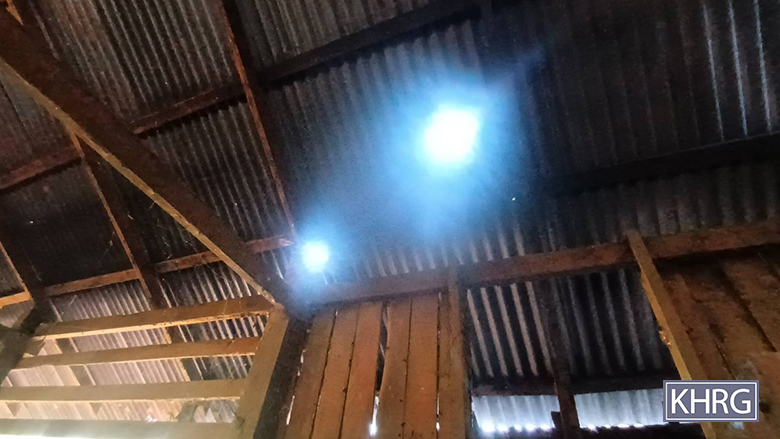
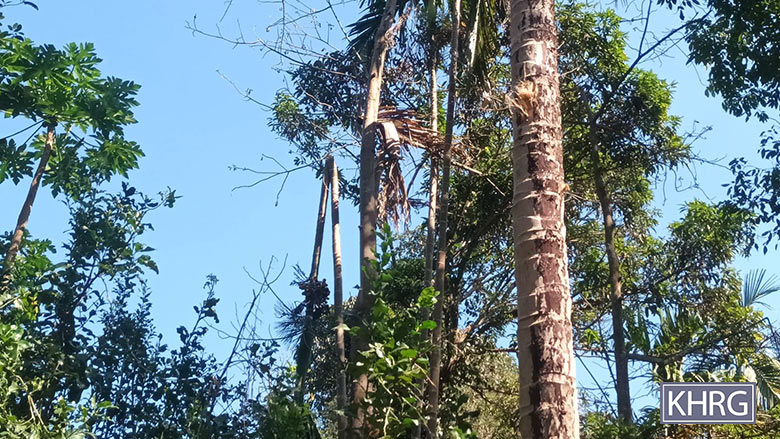
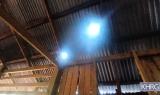
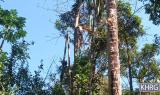
These two photos were taken in January 2026, in Ab--- village, Noh T’Kaw village tract, Noh T’Kaw (Kyainseikgyi) Township, Dooplaya District. On 6 January 2026, Burma Army Infantry Battalion (IB) #32 fired 81 mm and 120 mm mortar shells into the villages in Noh T’Kaw village tract. One of the mortar shells landed in Ab--- village and damaged the house and plantation of a villager named Naw B---. The photo on the left shows the roof of her house, damaged by the shrapnel. The photo on the right shows her coconut tree and betelnut tree, also damaged by the shrapnel. [Photos: KHRG]
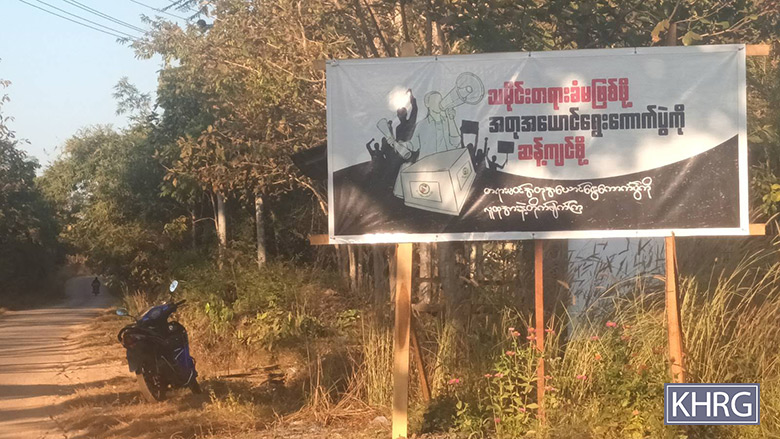
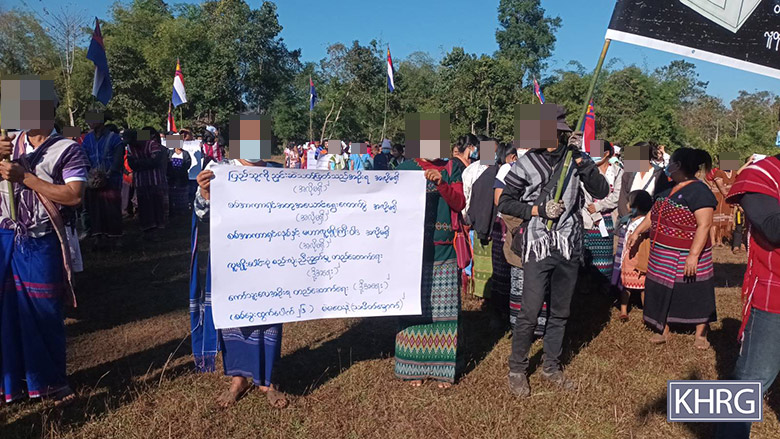
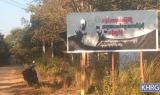
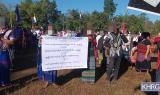
These two photos were taken on January 2026, in Ae--- village, Noh Taw Plah village tract, Noh T’Kaw Township, Dooplaya District. On 9 January 2026, around 600 villagers from Noh T’Kaw and Noh Taw Plah village tracts protested against the Burma military regime's sham election. [Photos: KHRG]
Footnotes:
[1] The present document is based on information received in January 2026. It was provided by a community member in Dooplaya District who has been trained by KHRG as a researcher to monitor human rights conditions on the ground. The names of the victims, their photos and the exact locations are censored for security reasons. The parts in square brackets are explanations added by KHRG. This document combines several received reports with the following KHRG internal log numbers: #26-25-D1, #26-25-D2, #26-25-A1 to A3, #26-44-D1 and #26-44-A1-I1.
[2] On 1 February 2021, the Myanmar military deposed the democratically elected government led by the National League for Democracy (NLD). The military proclaimed a year-long state of emergency and transferred power to Min Aung Hlaing, the Commander-in-Chief of Myanmar's Armed Forces. Based on unproven fraud allegations, the Tatmadaw invalidated the landslide victory of the NLD in the November 2020 General Election and stated it would hold new elections at the end of the state of emergency. The coup d'état occurred the day before the Parliament of Myanmar was due to swear in the members elected during the 2020 election. Elected President Win Myint and State Counsellor Aung San Suu Kyi were detained, along with ministers, their deputies and members of Parliament.
[3] The Karen National Liberation Army is the armed wing of the Karen National Union.
[4] The People’s Defence Force (PDF) is an armed resistance established independently as local civilian militias operating across the country. Following the 1 February 2021 military coup and the ongoing brutal violence enacted by the junta, the majority of these groups began working with the National Unity Government (NUG), a body claiming to be the legitimate government of Burma/Myanmar, which then formalized the PDF on 5 May 2021 as a precursor to a federal army.
[5] A village tract is an administrative unit of between five and 20 villages in a local area, often centred on a large village.
[6] The terms Burma military, Burma Army, SAC, Tatmadaw, and junta are used interchangeably throughout this report to describe the Burma military regime’s armed forces. Villagers themselves commonly use Burma Army, Burmese soldiers, or alternatively the name adopted by the Burma military regime at the time —from the 2021 coup to July 2025, the State Administration Council (SAC). On 31 July 2025, the military junta changed its name to the State Security and Peace Commission (SSPC).
[7] The non-democratic elections held by the Burma military regime in 2025-2026 have been largely condemned by various international stakeholders, including ASEAN and high-ranking UN officials, as not legitimate. The junta’s election was split into three phases, making polling stations subsequently available in different regions: phase 1 took place on 28 December 2025; phase 2 took place on 11 January 2026; and phase 3 took place on 25 January 2026. The military junta backs the Union Solidarity and Development Party (USDP), a party which is known for its close ties with the military and from which most officials are former military personnel. The junta was formerly self-designated as the State Administrative Council (SAC), after the 1 February 2021 military coup headed by Senior General Min Aung Hlaing, which deposed the democratically elected government led by the National League for Democracy (NLD), following Burma’s 2020 general elections. Following the election, Min Aung Hlaing was named president of Myanmar/the Burma military regime on 3 April 2026.
[8] The Democratic Karen Benevolent Army (DKBA Benevolent) was formed in 2010 as a breakaway group following the transformation of the majority of the original Democratic Karen Buddhist Army (1994 – 2010) into Border Guard Forces (BGF). This group was originally called the Democratic Karen Buddhist Army, until it changed its name to the Democratic Karen Benevolent Army in April 2012, in order to reflect its secularity. This DKBA (Benevolent) (2010 – present) should not be confused with either the original DKBA (Buddhist) (1994-2010) which was transformed into the BGF in 2010, or with the DKBA (Buddhist) (2016 – present) which was formed in 2016 as a splinter group of the DKBA (Benevolent). Importantly, the DKBA (Benevolent) has signed both the preliminary and nationwide ceasefire agreements with the Burma/Myanmar government, whereas the DKBA (Buddhist) has not signed either agreement.
[9] All conversion estimates for the kyat in this report are based on the 4 March 2026 official market rate of 2,100 MMK to 1 USD, https://wise.com/gb/currency-converter/usd-to-mmk-rate.
[10] An Infantry Battalion (IB) comprises 500 soldiers. However, most Infantry Battalions in the Tatmadaw are under-strength with less than 200 soldiers. Yet up to date information regarding the size of battalions is hard to come by, particularly following the signing of the NCA. They are primarily used for garrison duty but are sometimes used in offensive operations.
[11] The Karen National Union (KNU) is the main Karen political organisation. It was established in 1947 and has been in conflict with the government since 1949. The KNU wields power across large areas of Southeast Myanmar and has been calling for the creation of a democratic federal system since 1976. Although it signed the Nationwide Ceasefire Agreement (NCA) in 2015, following the 2021 coup staged by Burma Army leaders, the KNU officially stated that the NCA has become void.
[12] ‘Naw’ is a S’gaw Karen female honorific title used before a person’s name.
[13] The State Administration Council (SAC) was the name of the executive governing body of the Burma military regime created in the aftermath of the 1 February 2021 military coup. It was established by Senior General Min Aung Hlaing on 2 February 2021 and was composed of eight military officers and eight civilians. The chairperson serves as the de facto head of government of Burma/Myanmar and leads the Military Cabinet of Myanmar, the executive branch of the government. Min Aung Hlaing assumed the role of SAC chairperson following the coup. The military junta changed its name on 31 July 2025 from SAC to State Security and Peace Commission (SSPC), with Min Aung Hlaing retaining his position as chairperson.
[14] The term Kaw Thoo Lei refers to Karen State as demarcated by the Karen National Union (KNU), but the exact meaning and etymology is disputed; see: Jonathan Falla. True Love and Bartholomew: Rebels on the Burmese Border, Cambridge University Press: 1991.
[15] ‘Saw’ is a S’gaw Karen male honorific title used before a person’s name.